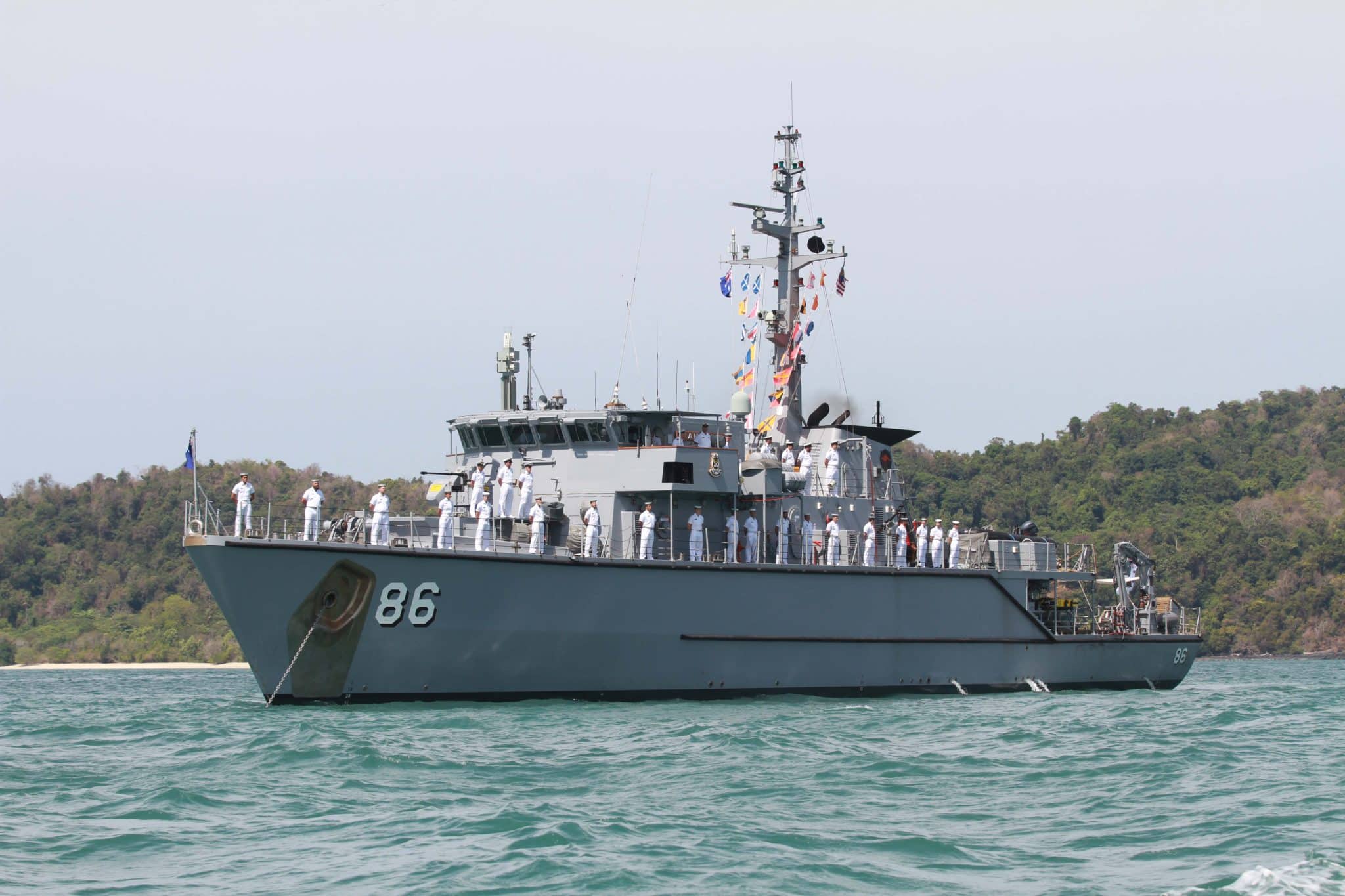
The Royal Australian Navy (RAN) has just two of an original six Huon-class minehunters left in service. Plus, two years ago, the service suspended renewal of its mine countermeasures capability that was to be delivered via Project Sea 1905. Looking at this evidence, some analysts believe Australia’s naval mine countermeasures (MCM) capability is atrophying. However, top brass in the RAN are satisfied that the navy will maintain a satisfactory capability against sea mines and underwater threats.
Rear Admiral Stephen Hughes, Australia’s Head of Navy Capability, spoke to Naval News at the Indo-Pacific 2025 maritime exposition in Sydney last November. He dismissed the idea of an MCM capability gap appearing.
“I’d theorise that the current capability we have at the moment meets minimal viable capability.”
Rear Admiral Stephen Hughes, Australia’s Head of Navy Capability
He insisted the RAN’s current mine warfare capability is “a risk profile we’re willing to take”.
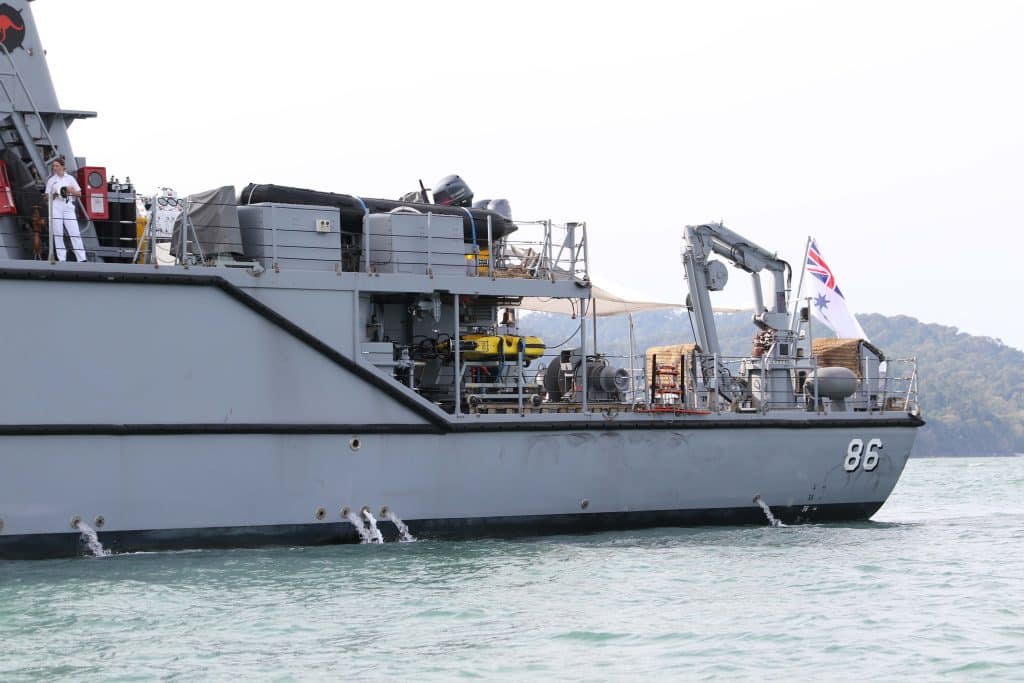
Project Sea 1905 (interestingly, the project number spells “MCMV” in Roman numerals) was suspended in April 2024. The aim of the project had been to give the RAN a containerised toolbox of scalable and versatile autonomous systems to achieve a world-class MCM capability. Simultaneously, replacement of Huon-class coastal minehunters and Leeuwin-class hydrographic survey ships based on Arafura-class hulls was cancelled.
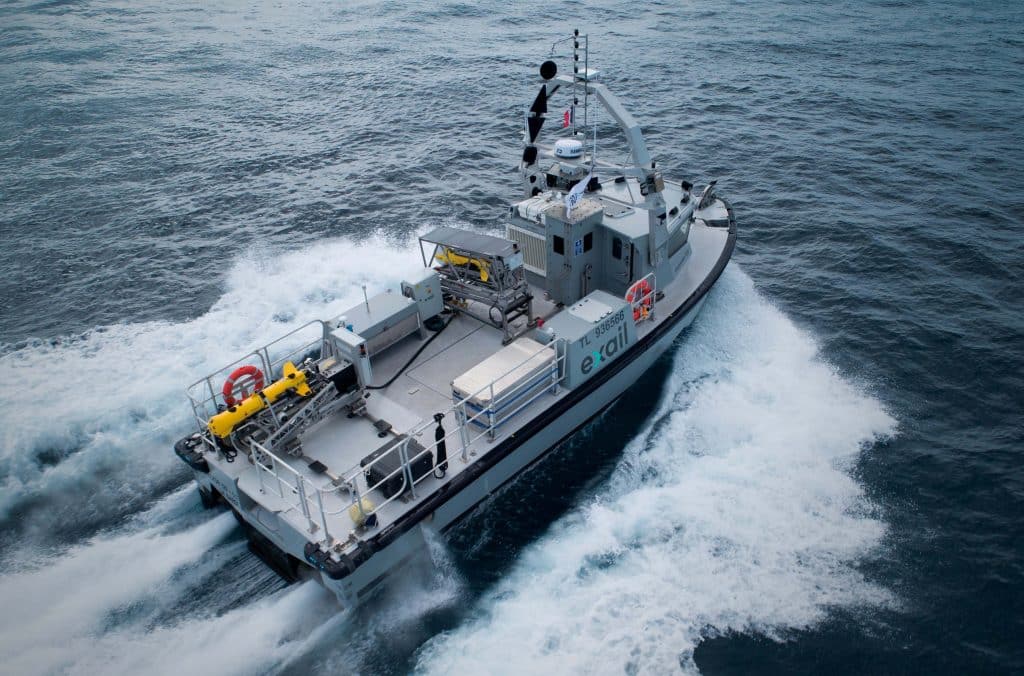
At the time of its discontinuation, Exail and Saab Australia had been shortlisted for Sea 1905. The former’s solution was based around what is currently being introduced by the Belgian and Dutch navies. Meanwhile, Saab was offering Leidos software, Sonartech Atlas unmanned surface vessels (USV) and unmanned underwater vehicles (UUV), Saab’s Double Eagle and Multi-Shot Mine Neutralisation System (MuMNS), and a SeaBytes mission management system.
Significantly, neither the 2024 National Defence Strategy nor last year’s Integrated Investment Program mentioned naval MCM at all. Defence told Naval News, though, that the RAN operates a “deployable mine countermeasures capability utilising crewed and uncrewed surface vessels paired with remote and autonomous underwater vehicles. Future capabilities, including optimising navy’s world-class mine clearance diving teams, will be explored as part of Defence’s investment in undersea warfare capabilities.”
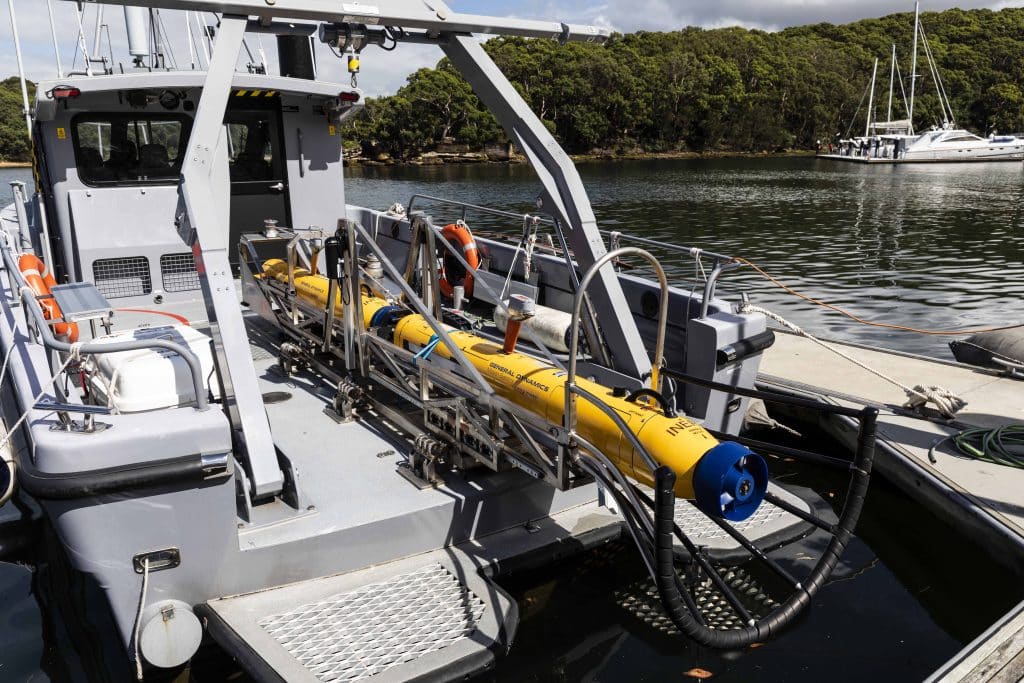
That deployable MCM capability was obtained under Project Sea 1778 Phase 1. Managed by Thales Australia, this project introduced four Bluefin-9 and three Bluefin-12 UUVs; eight SeaFox expendable mine neutralisation systems; three 11.6m-long MCM support boats and two USVs built by Steber International in around 2020. These received their final operating capability in Q1 of 2024.
Hughes, the two-star in charge of addressing naval capability, said MCM was still on the agenda, and obsolescence would be addressed in the coming 5-10 years. He said Sea 1905 is prioritised for Epoch 3 in the navy’s plan, i.e. in the early 2030s.
“What my challenge is,” he shared, “I have ageing platforms, systems that are costing me more to maintain and sustain. So what I have to work out is, how do I guarantee the government that with the in-service fleet I have a minimal viable capability that meets their risk threshold that they’ve told us about?”
As the final two minehunters are paid off over the coming few years, “How do I take those resources and releases – whether it’s dollars, workforce – and then rapidly replace them within that resource envelope with an equivalent minimal viable capability? It might be autonomous systems, it might be remote systems or it might be a deployable capability that I stick on the back of Arafura offshore patrol vessels or on the back of some other vessels which we’re getting through other processes, small utility craft, and then I’ve got to transition the workforce onto that.”
He pointed out: “I can’t decommission a minehunter unless I’m ready to replace it with something … So we’re in the process of working with some industry partners around what that roadmap looks like.”
Hughes also confirmed he has identified a rough budget gained per year for the MCM capability, “Then, over the next couple of years we’ll do that transition. We’ll get into an ever-greening, rolling cycle of reinvesting in that in the money we saved from that programme. Then, when government says, ‘Go hard with whatever the mine warfare, undersea warfare programme looks like,’ we’ll go hard with whatever that turns out to be.”
Has Australia’s naval MCM capability fallen victim to fiscal constraints? Many think so.
However, Hughes put Sea 1905’s abeyance down to Canberra’s priorities. “In other words, in order of all the priorities government has – nuclear-powered submarines, general-purpose frigates, long-range strike, army watercraft, etc. and when they stack and rack, their priority at the moment is about deterrence. It’s about reaching out through things like long-range strike, hardening northern Australia, and some of those other priorities in the National Defence Strategy 2024.”
Amidst the government’s priorities, Hughes expressed, “My view is, sure, if there was all the money in the world, we could do everything.”
He added, “I don’t think it’s a case of not enough money,” but rather fiscal priorities. For instance, he highlighted that, since becoming Head of Navy Capability, the government has approved close to A$42 billion (US$28 billion) in the maritime domain, excluding nuclear-powered submarines.