The two mine countermeasures vessels that Italy is forward-deploying in the Middle East area to participate to the international coalition to make the Strait of Hormuz free for navigation again, have left Augusta in Sicily on 15 May.
According to plans made public in the previous weeks, the task group could also include one each escort and logistics naval assets. Italy will contribute to the international effort once a credible and stable truce will be obtained and the national Parliament will authorize the mission under a legitimate international legal framework.
“The shared objective remains to foster, as quickly as possible, through coordinated action by the international community, a return to conditions of stability and normality in maritime navigation in the Hormuz area”, said the Italian Minister of Defence Guido Crosetto, echoing what the Minister of Foreign Affairs Antonio Tajani has previously highlighted to the Parliament’s Committees of Defence on 13 May announcing the forward-deploying of Italian Navy’s specialized units with escort and support vessels in the Middle East area, waiting for the Parliament approval to the international initiative, under a legitimate international legal framework, once a stable truce will be reached.
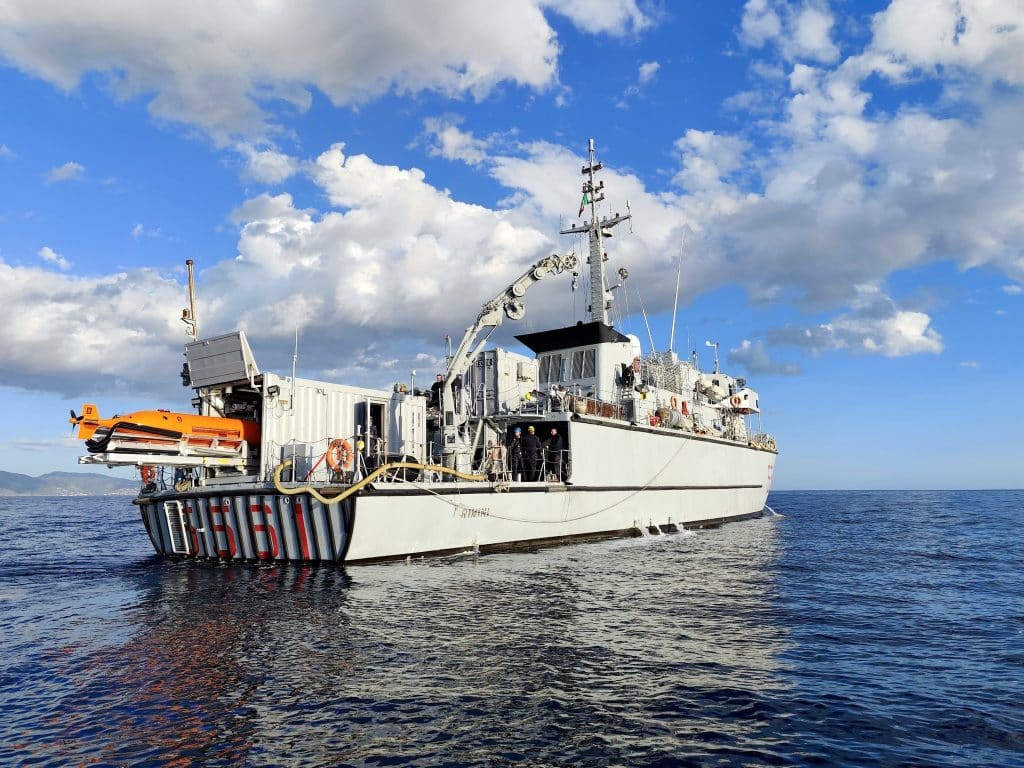
“We know, in fact, that the issue of naval mines in the Strait of Hormuz will have to be addressed sooner or later. Therefore, as mentioned, purely as a precautionary measure, considering the time required for the transfer and redeployment of assets, we are preparing for two minehunter units to position themselves relatively closer to the Strait,” said Crosetto. “Initially in the Eastern Mediterranean, subsequently in the Red Sea, within the framework of ongoing missions, “Mediterraneo Sicuro” (“Secure Mediterranean”) and “Aspides”, and always strictly within the framework authorized for Italy’s international missions,” he continued, adding that “these are specialized, highly technological assets that require weeks to be deployed in the area. This is precisely why early planning and pre-positioning become essential elements.”
No further details were released about the forward-deployed assets and the timing of the operations, but Naval News can confirm that Italian MoD and Navy has been planning and readied a task group including two specialized vessels of the Mine Countermeasures Forces Command (MARICODRAG), one escort air defence ship and one logistic support vessel.
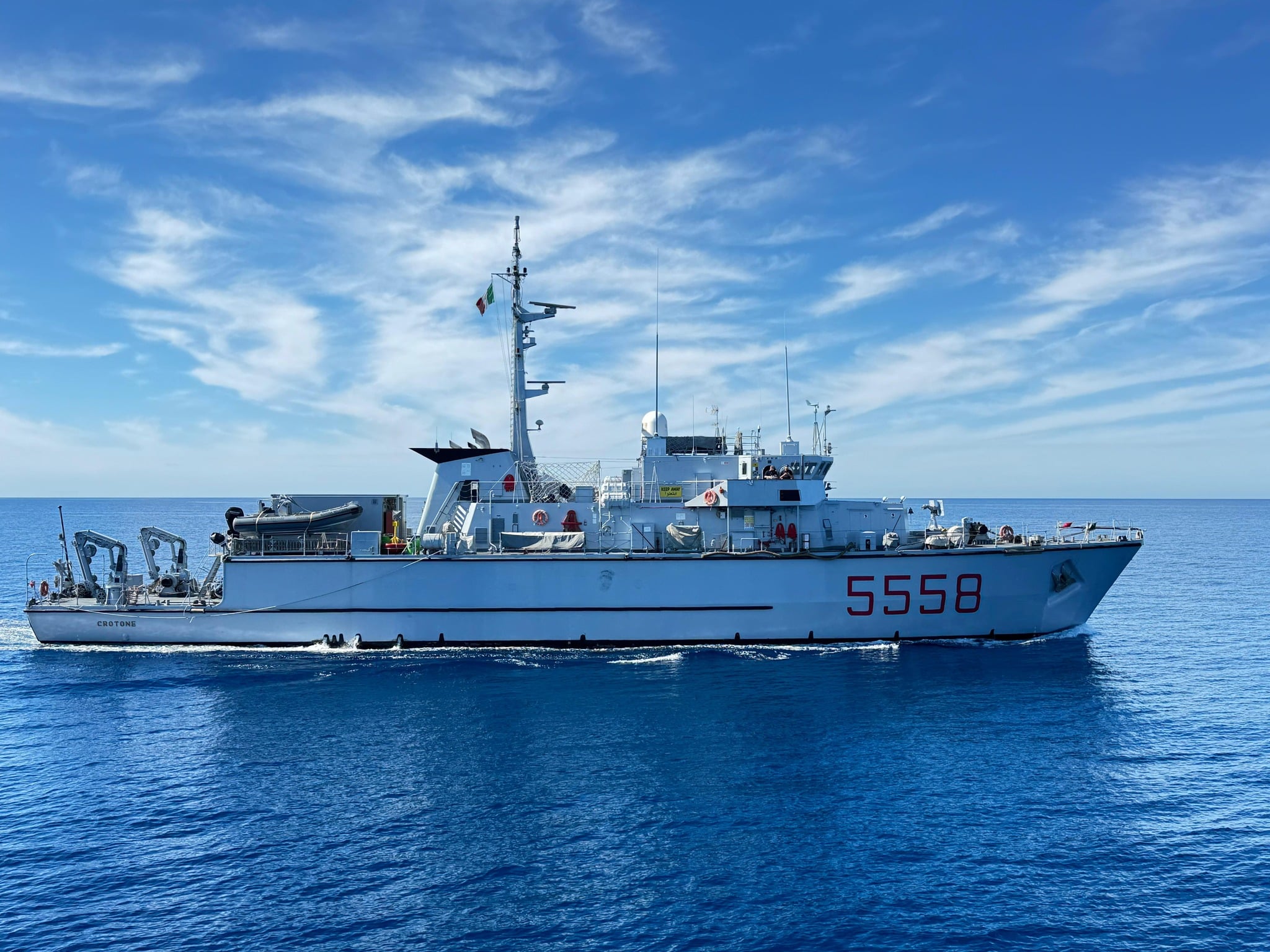
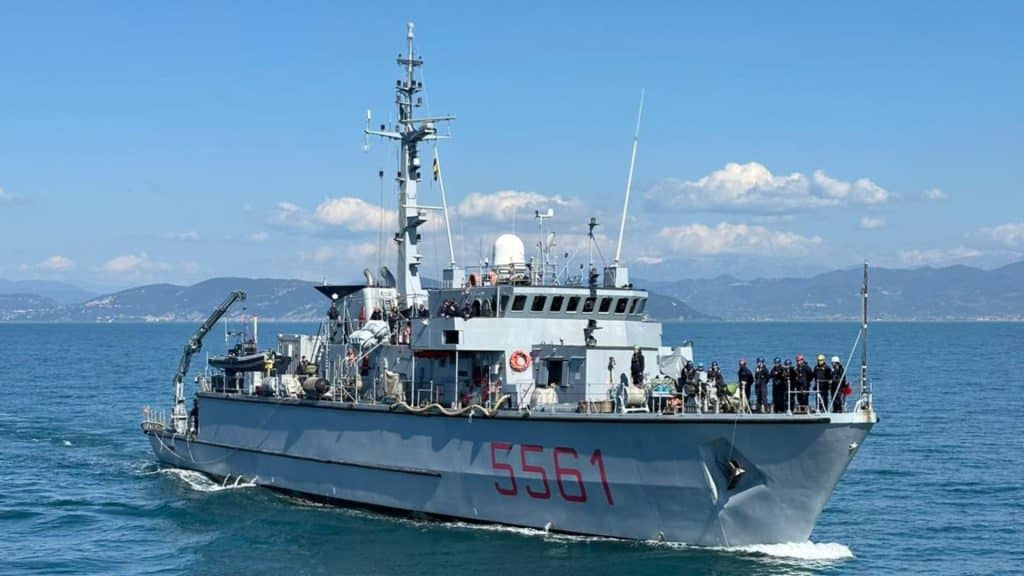
No further details were released about the forward-deployed assets and the timing of the operations, but the two specialized vessels were identified as Crotone (M 5558) and Rimini (M 5561) Gaeta-class MCMVs of the Mine Countermeasures Forces Command (MARICODRAG), which have left Sicily on 15 May, while the escort and logistic assets are expected to follow without an indicated timing. The forward-deployment destination port for the two MCMVs is expected to be Djibouti where the Italian Armed Forces have already a forward operating base and the two vessels could reach it in about a two-week timeframe depending on the planned activities. They are planned, but to confirmed, by an air defence escort platform, which according to the available assets and capabilities, is expected to be the Raimondo Montecuccoli MPCS/PPA (P 432) in the “Light Plus” configuration, alongside the newest logistic support vessel (LSS) Atlante (A 5336) of the two Vulcano-class in-service platforms. Personnel from the Italian Navy’s COMSUBIN Command is also expected to participate, including both the divers component (GOS, Gruppo Operativo Subacquei) to work side-by-side with MARICODRAG’s 60 meters qualified divers with Explosive Ordnance Disposal (EOD) capabilities, thanks to the hyperbaric chamber embarked on MCMVs, as well as special forces operators from GOI (Gruppo Operativo Incursori), together with San Marco Marine Brigade operators.
The Italian Navy 5th Naval Division/MCM Force Command has been silently preparing the mission with dedicated training activities in the last months alongside the continuous contribution to the national “Operation Fondali Sicuri” for the surveillance and protection of critical underwater infrastructures, which is the latest iteration of an activity MARICODRAG is pursuing since the 2010s, in addition to the participation to the Standing NATO Mine CounterMeasures Group 2 (SNMCMG2) specialized force and providing personnel to the embarked operational command of the “Operation Mediterraneo Sicuro” in addition to assets on a rotational basis. The escort and logistic support vessels were also involved in dedicated training and preparation activities, all under the helm of the Italian Navy’s Fleet Command (CINCNAV).
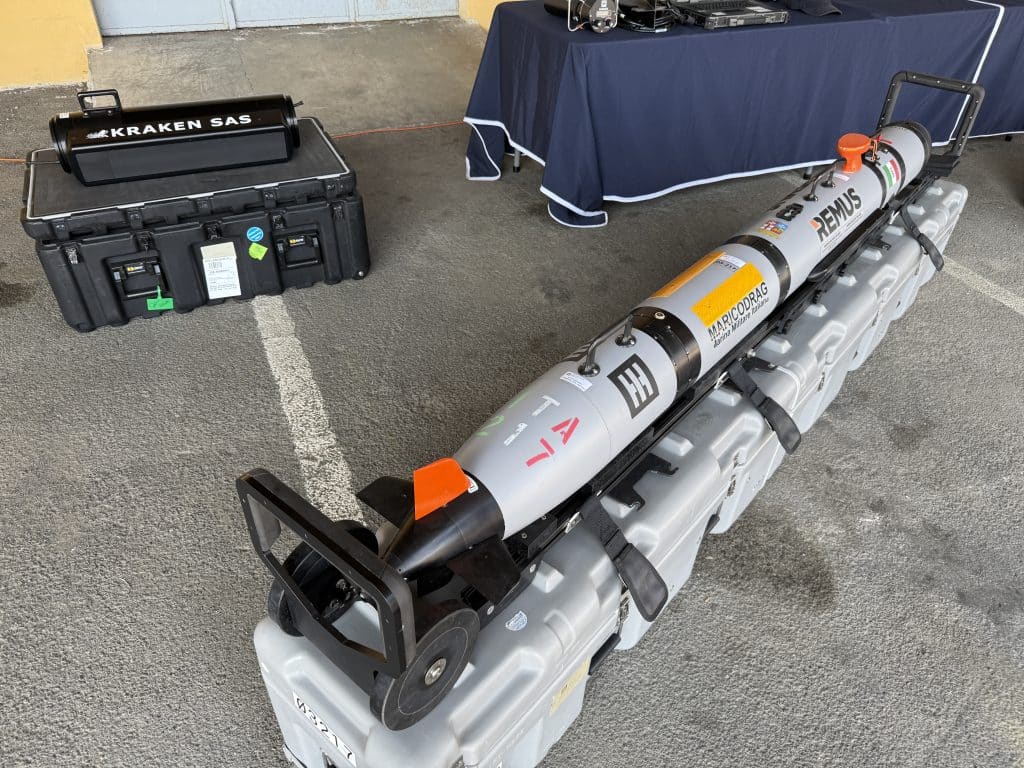
The latest iteration of the GRP (Glass-Reinforced Plastics) MCMVs developed and built by Intermarine for the Italian Navy between 1992 and 1996, the Gaeta class platforms were subjected to a Mid-Life Update programme which has provided an up-to-date mission suite and ship modifications. Today, these platforms are equipped with the Thales 2093 variable depth sonar (VDS) together with a MCM command, control and communication suite by Leonardo. Each Gaeta-class MCMV is equipped with a Pluto Plus and a Pluto Gigas ROV/AUV provided by Gaymarine that allow these platforms to operate up to 600 meters (Pluto Gigas) for MCM and conducted seabed and infrastructure surveillance operations. These vehicles are currently being enhanced thanks to a service life extension programme that, alongside their digitalisation, also includes new and more capable sonars. More recently, MARICODRAG has integrated the HII REMUS 300 AUVs, the latter having received also the latest generation high resolution Kraken Robotics Synthetic Aperture Sonar system, in addition to the already available REMUS 100. The MCMVs are equipped with an hyperbaric chamber for the divers detachment as well as launch and recovery cranes for the two embarked RHIBs as well as ROVs.
MARICODRAG became one of the first European operators of long endurance and deep operation AUVs, having inducted into service the first Kongsberg Maritime HUGIN vehicle for operations up to 3,000 meters depths in 2013. The Rimini, one of the two MCMVs expected to be involved in the new mission, was fitted to embark one 20’ and one 10’ containers as part of the launch, recover and command and control module for operating the same AUV, having the Command received a second HUGIN in late 2023 and more to come. The system’s air deployable module will allow the use by other Italian Navy ships or vessels of opportunity, in addition to expeditionary missions without naval platforms.
Interestingly, under an MoU signed in 1985 between the Italian MoD and the NATO Supreme Command (SHAPE), a MARICODRAG section manages the Mine Warfare Data Centre (MWDC) where all data regarding international waters seabeds and water column collected by NATO countries in the Mediterranean, Black Sea, Red Sea, Aden and Arabic/Persic Gulf are fused together and stored in order to provide a continuously updated database for future operations.
The MCMVs and logistic support vessel are planned to be escorted and defenced by an air defence platform which was identified in the Montecuccoli MPCS/PPA in the “Light Plus” configuration equipped with both guns (Leonardo 127 LW Vulcano and 76/62 SovraPonte with DART guided munitions) and the MBDA Italia SAAM ESD PPA air defence missile system including C2 and two 8-cell VLS for Aster 15 and 30 missiles in addition to the Leonardo X-band Kronos StarFire four fixed faces AESA radar for both air and surface operations. A key multi-role capability of the Thaon di Revel-class MPCS/PPAs are the two multi-purpose modular areas amidship and under the hangar and flight deck equipped with different apertures, cranes and movement equipment allowing the embarkation and operation of a wide range of payloads from special forces boats to containerized equipment and capabilities such as medical and additional personnel accommodations but also unmanned surface and underwater platforms. These capabilities could be very useful in case of needs for the mission. In addition to refuelling capabilities, the Atalante (A 5336) LSS is expected to be capable to support also the other assets of the coalition force thanks to the large spaces and the high level of medical capabilities alongside accommodation for additional personnel.
Naval News Comments
The Italian Navy MARICODRAG Command is not new to the Middle East operations and even if it hasn’t forward-deployed assets as other nations have been doing, its personnel and assets have been participating to “Operation Golfo 1” (1987-1988) and “Golfo 2” (1991), providing a key contribute to neutralize and clear the Persian/Arabic Gulf waters from Iranian mines.