Russia is investing heavily in a new generation of “super weapons” designed to bypass and potentially nullify conventional defenses. Foremost among them is Poseidon, an autonomous, nuclear-powered, nuclear-armed underwater weapon with effectively intercontinental range. Details about its newest dedicated carrier submarine, Khabarovsk, are only gradually coming into focus.
Russia continues to prepare the super-weapons revealed by President Putin in March 2018. These were described as ‘invincible’ and impossible to intercept. In the naval sphere this includes the Poseidon, a ginormous nuclear-powered nuclear-armed intercontinental torpedo.
Although often referred to as a drone, Poseidon is better thought of as a giant torpedo. And it is extremely expensive. Besides development costs, test platforms including several ships and a submarine, and special weapons handling facilities, it requires specialist nuclear powered submarines to be built to carry it. Now the second of these, Khabarovsk, is currently sitting in Severodvinsk in the Russian Arctic.
When she was launched in November last year very few photographs were allowed. State media only showed the stern and a glimpse of her fin (sail). The stern, where the propeller (‘screw’) is, is traditionally the most sensitive part of a submarine, yet not on a Poseidon submarine. Now, slowly, we have been able to piece together more details of her arrangement from satellite images and open sources. What is clear is that the submarine is intended solely to carry the Poseidon weapon.
New Details On The Khabarovsk-class Submarine
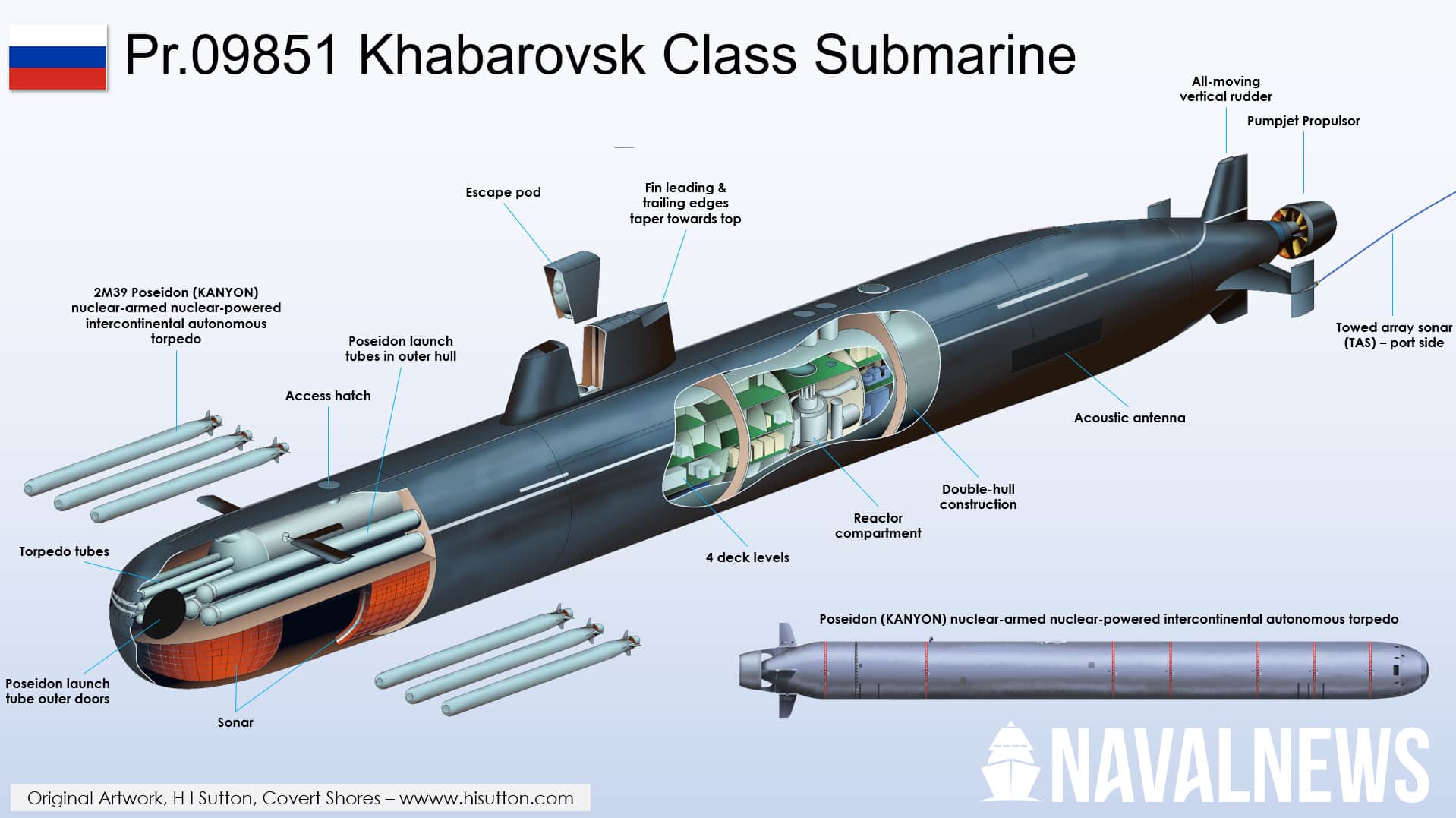
The submarine leverages existing design elements. It can be characterized as the back (stern) of a Borei-class ballistic missile submarine, and the front (bow) of the Belgorod, the first Poseidon-armed boat. Although these two types are among the largest, and longest, submarines in the world, the resulting Khabarovsk-class is somewhat shorter. This is because it lacks the midsection of either. On the Borei that part carries the vertical launch tubes for the Bulava ballistic missiles. And on Belgorod it is where the docking bay for deep-diving submarines is. All the same, the Khabarovsk remains a large submarine, around 135 meters (442 ft) long and around 13.5 meters (44ft) wide.
Her forward arrangement, where the Poseidon tubes and regular torpedo tubes are housed, is very similar to Belgorod. The Poseidon torpedoes, likely 6, are carried in two flooded hangars, one on each side. These are loaded, and shot, via very large hatches in the bow. These give the appearance of giant torpedo tubes. Between them a torpedo room carries the regular Heavyweight torpedoes.
Back-up Regular Torpedoes
The presence of the torpedo room squeezed between the Poseidon hangars is evidenced by the access hatches on the deck casing. This is supported by analysis of Belgorod which has a similar arrangement. It is reminiscent of Soviet Cold War cruise missile submarines such as the Papa and Charlie classes. Possibly Khabarovsk, like those, will feature an unusual double-bubble pressure hull to maximise internal space despite the narrow space between the Poseidon tubes.
How many regular torpedo tubes there are, and how many reloads are carried, isn’t yet clear. However, we can surmise that it will be many fewer than regular nuclear-powered attack submarines because there isn’t space for a large torpedo room. This underscores the relative importance of the Poseidon weapon in the submarine’s conception. It is a Poseidon carrier and nothing else.
Propulsion
Her aft section, lifted largely from the improved Borei-A-class (project 955A, NATO reporting name Dolgorukiy-II) will likely contain a single ОК-650V nuclear reactor. This will offer the submarine high levels of quietness, essential for stealth.
Unlike the Borei-class however the escape pod, which allows the crew to abandon ship in the case of an emergency, is located in the fin instead of the aft casing. This is in fact more typical of Russian submarines than the Borei’s novel arrangement. The fin is however quite small, at least compared to other Russian submarines of a similar size.
Poseidon
Khabarovsk is an all-in bet on the Poseidon weapon. Her capabilities as a regular attack submarine without this weapon, while still viable, are sorely compromised.
Poseidon (2M39, NATO reporting name Kanyon) is a strategic weapon designed to threaten coastal cities and strategic targets. Although much reporting on it is exaggerated or overly speculative, we can determine that operates as a weapon, not a general-purpose drone. Russia also claims that it can be used to attack tactical targets including aircraft carrier battle groups.
The longer-term impact of Poseidon has yet to be felt. It has to be taken seriously by NATO navies but has not become the focus or pivot which Russia might have been hoping for.