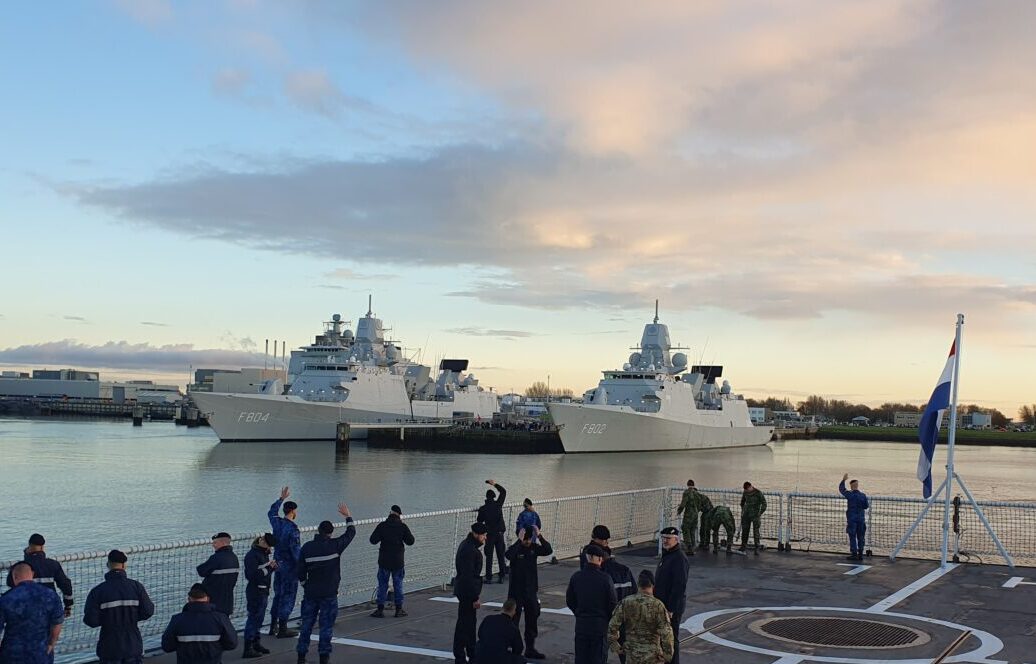
The Dutch Ministry of Defence intends to procure new air defense frigates to replace the ships of the “De Zeven Provinciën” class. In spring 2024, the then State Secretary at the Ministry of Defence in The Hague announced that Dutch industry, as well as Damen Naval and Thales, would play a key role in the project. Other nations could join the project, the State Secretary stated at the time.
By Lars Hoffman / hartpunkt
The German Armed Forces had already decided at that time to use the American Aegis command and control system for their future Type 127 air defense frigates, and not to cooperate with the Netherlands as they had with the predecessor class (F124). The latter, like the frigates of the De Zeven Provinciën-class, integrates radars from Thales Netherlands.
However, the Netherlands is now also considering the Aegis system. As a spokesperson for the Dutch Ministry of Defence told hartpunkt, the ministry sent a Letter of Request (LOR) for Price and Availability to the US in January. The response from the US arrived in April.
Within the Foreign Military Sales (FMS) process, such a Letter of Preliminary Order (LOR) is typically an information request to obtain a rough estimate of costs and potential delivery dates. The LOR does not necessarily have to result in a contract.
According to the spokesperson, the Dutch Ministry of Defence intends to use the information received to make a final decision regarding the Royal Netherlands Navy’s new air defense and command frigates. The ministry will inform the Dutch parliament of all further steps first, following standard procedure. Whether the Netherlands will actually consider procuring an Aegis command and control frigate remains to be seen.
Observers do not rule out the possibility that the ministry intends to use the information primarily to evaluate a potential in-house Dutch development. A potential obstacle to acquiring Aegis is that this radar system only integrates Raytheon’s SPY-6 and Lockheed Martin’s Spy-7 radars, with only the former being used by the US Navy on its ships. This would leave the national radar manufacturer, Thales Netherlands, with its own high-performance products, at a disadvantage.
With regard to the use of Aegis, the question now arises whether, in light of the experiences of the Iran-Iraq War and the resulting apparent consumption of anti-missile systems with low production capacities, the use of the SPY-6 for European navies is a sensible decision. Since this radar is part of a US Navy Program of Record, experts believe that the integration of European missiles would be virtually impossible.
Lockheed Martin, on the other hand, had previously advertised that the SPY-7 was also compatible with European-made guided missiles. This would mean Europe would not be dependent on whether enough missiles were produced in the US and whether Washington was willing to deliver them. Instead, European defense ministries could determine the availability of specific missiles based on their own production capacities. A first example of this fatal dependence on the US already exists: Switzerland painfully discovered that the US government can postpone the delivery of the Patriot air defense system by several years at short notice.
This article by Lars Hoffman was originally published in German language at hartpunkt.de. It has been translated and republished with authorization.