China is launching submarines at a pace unmatched by any other nation. Its latest design, a distinctive and innovative vessel that dispenses with the traditional sail, marks another step in the evolution of an increasingly capable and technologically advanced submarine force. With little official information available, understanding the purpose and capabilities of this new class depends largely on intelligence gathering and expert analysis.
As Western navies struggle to build more than one or two submarines concurrently, China continues to pump them out at an increasing rate. They have launched around 15-20 in the past five years, including at least 8 new classes.
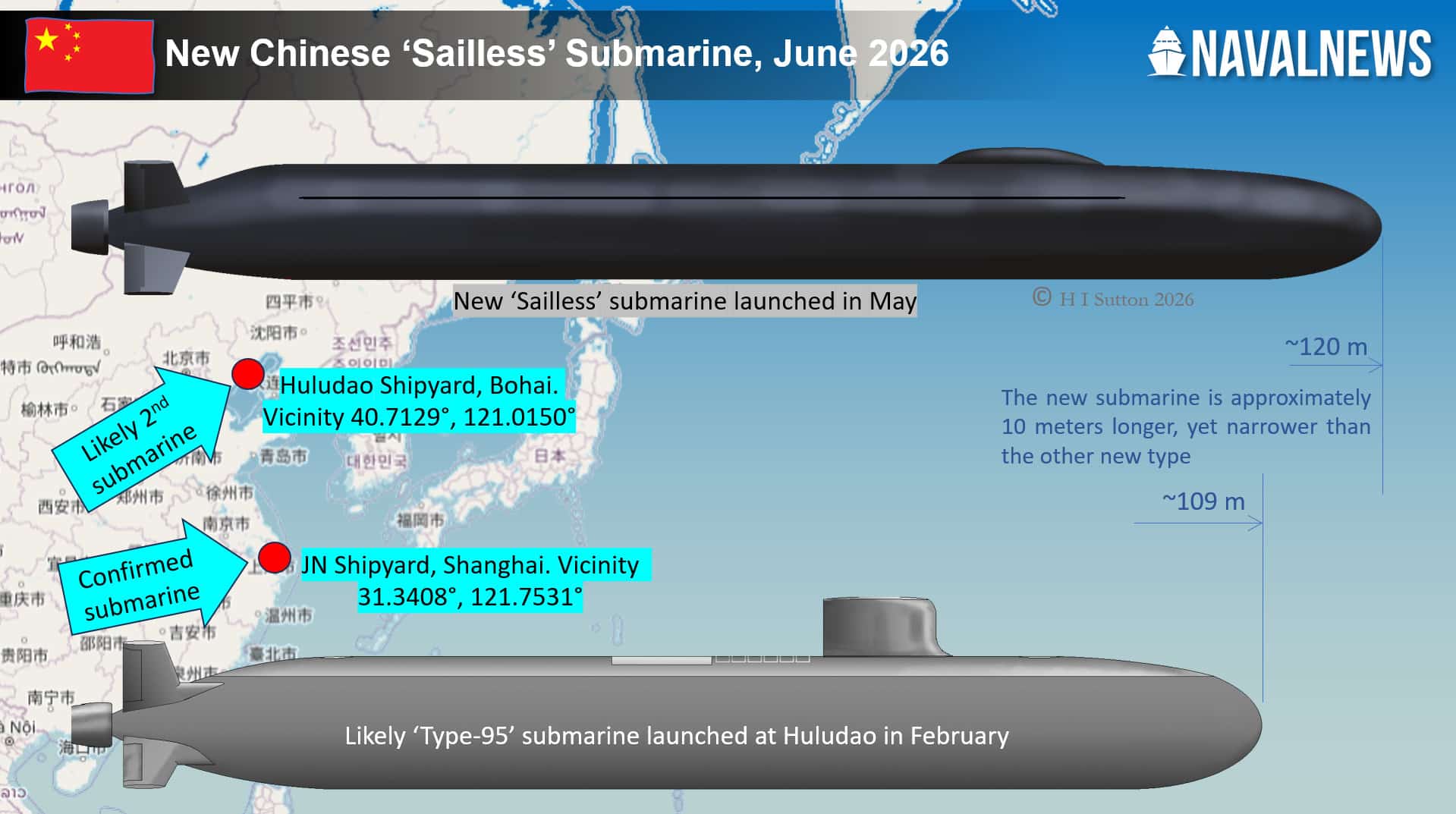
The latest, a previously unreported and unexpected type, has just been observed in Shanghai. The large, streamlined boat is noteworthy for its futuristic ‘sailless’ design.
New Submarine Launched
The new submarine has been visible in satellite imagery over recent days. On May 31st and June 1st, it was visible moored alongside a jetty barge at a fitting out basin outside the JN shipyard in Shanghai. Although best known for constructing large surface combatants, the shipyard has also been involved in submarine construction, though it has not previously built nuclear-powered submarines. The launch has not been publicised, and Chinese public sources have been silent.
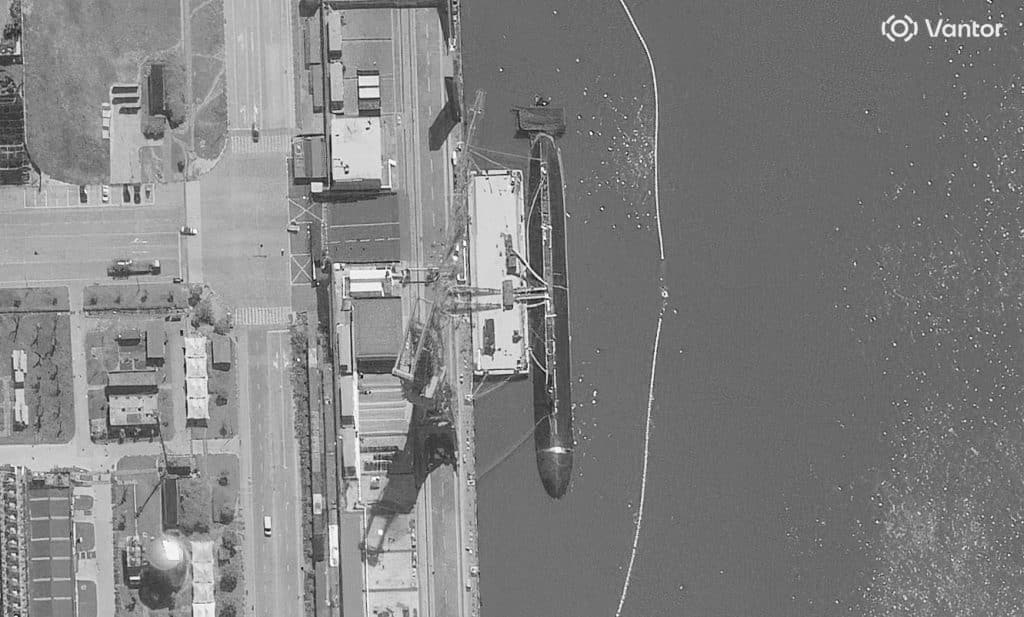
The main distinguishing features of the boat are its sleek bow, X-form rudders, and minimal sail. China has experimented with sailless submarines before with one being built at the same yard. In fact, the older boat is currently parked on the quayside there. The configuration is likely chosen to reduce drag.
In parallel, at around the same time another submarine may have been launched at the Huludao shipyard in the Bohai Sea. That shipyard is known exclusively for building nuclear submarines. Although not yet confirmed, it is speculated that this second submarine is of the same type as in Shanghai. The construction and launch of two boats at two shipyards would be significant.
Questions About Mystery Submarine Remain
The submarine is approximately 120 meters (394 ft) long and 10-11 meters (33-36 ft) wide. This makes it longer yet narrower than the other new submarine launched at Bohai in recent months. There is no question that this is a new Class. That boat, first reported in February, was provisionally identified as the long-anticipated Type-095 (also written -09V) attack submarine. At the time the boat met expectations and this identification made sense. However, with the emergence of this second, similar sized submarine, the question of which is the Type-095 is now open.
It seems unlikely that the new submarine is a ballistic missile boat (SSBN). That would likely be larger, especially given the large size of the latest JL-3 missile.
Questions remain regarding the new submarine’s role and propulsion. For the latter, a standard nuclear propulsion seems most likely given the boat’s size. If it is conventionally powered, then it is by far the largest conventional boat afloat anywhere in the world. China has also been developing a smaller ‘nuclear AIP’ propulsion where a low-power reactor acts as a form of air independent power (AIP). This is similar to other forms of AIP, Stirling generators and fuel cells, but likely offers greater power and effectively unlimited endurance. The first nuclear-AIP submarine, the Type-041 Zhou class, was launched at the Wuchang Shipyard in Wuhan in 2024. It is possible that the same concept is used in the new boat, although this seems less likely than traditional nuclear power.
The Chinese Navy (PLAN) feels under no obligation to reveal to outside observers its newest classes of submarine. Unlike other countries there is no public announcement of orders or, in many cases, launches. This is particularly true of first-of-class boats. Therefore analysts will have to look closely for any hints to resolve open questions.