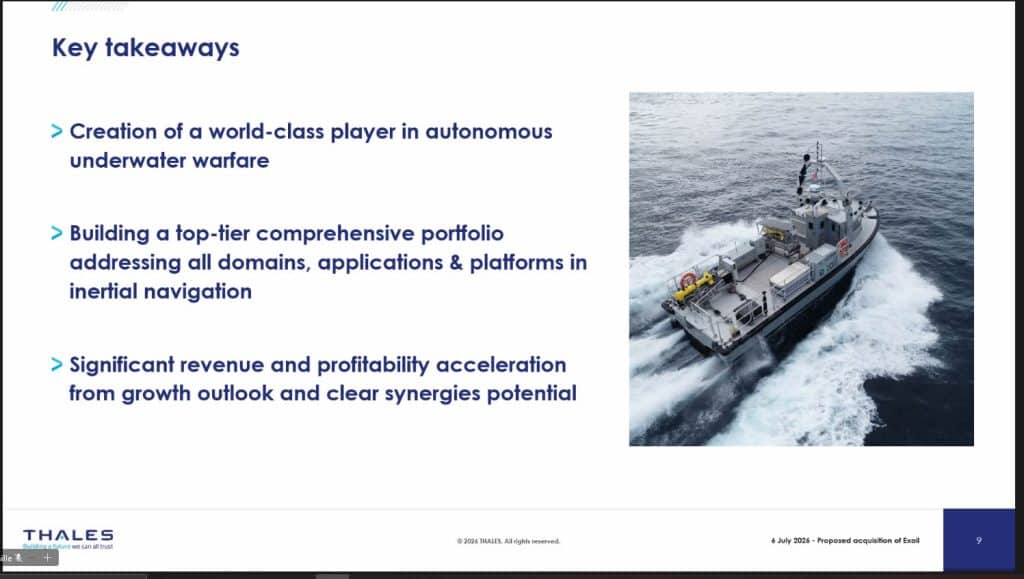
Thales has announced a binding agreement to acquire the Gorgé family’s stake in Exail Technologies with a view to launching a full tender offer. While the financial scale of the transaction establishes it as a heavyweight defense industry move, the true significance lies in its operational and technological rationale. By integrating Exail, Thales is assembling a full-spectrum portfolio specifically optimized to dominate the rapidly accelerating fields of autonomous mine countermeasures, uncrewed anti-submarine warfare (ASW), and resilient inertial navigation.
Consolidating the Mine Countermeasures (MCM) Market
The intersection of Thales’ and Exail’s portfolios represents a powerful synergy in the uncrewed maritime systems domain. Exail has established itself as a premier European player in naval robotics, notably through its flagship UMIS (Unmanned Mine Countermeasures Integrated System). This comprehensive ecosystem relies on cascading autonomous assets—including unmanned surface vessels (USVs) like the DriX, autonomous underwater vehicles (AUVs), and remotely operated vehicles (ROVs)—working collaboratively to detect, classify, and neutralize naval mines from a safe standoff distance.
Thales is already a prime tier-one systems integrator for critical MCM programs, such as the joint Anglo-French MMCM (Maritime Mine Counter Measures) project. Integrating Exail’s native robotics platform directly into Thales’ high-end sonar suites and command-and-control (C2) systems removes architectural friction. Instead of managing complex cross-vendor interfaces, Thales can now deliver a fully sovereign, vertically integrated turn-key uncrewed MCM solution to global navies.
Complementary Navigation Technologies
Beyond robotics, the acquisition reshapes the global market for high-precision naval navigation. Modern naval defense demands resilient positioning, navigation, and timing (PNT) capabilities that can operate flawlessly in GPS-denied or heavily jammed environments.
The two companies bring entirely complementary expertise in optical gyroscopes:
- Thales relies historically on Ring-Laser Gyroscope (RLG) technology.
- Exail is a world leader in Fiber-Optic Gyroscope (FOG) systems, which offer solid-state reliability and extreme precision for prolonged underwater deployments.
By merging RLGs and FOGs under one roof, Thales effectively secures a comprehensive, dual-technology portfolio capable of equipping everything from surface combatants and strategic submarines to guided effectors and aerospace platforms.
Eyes on Autonomous Anti-Submarine Warfare (ASW)
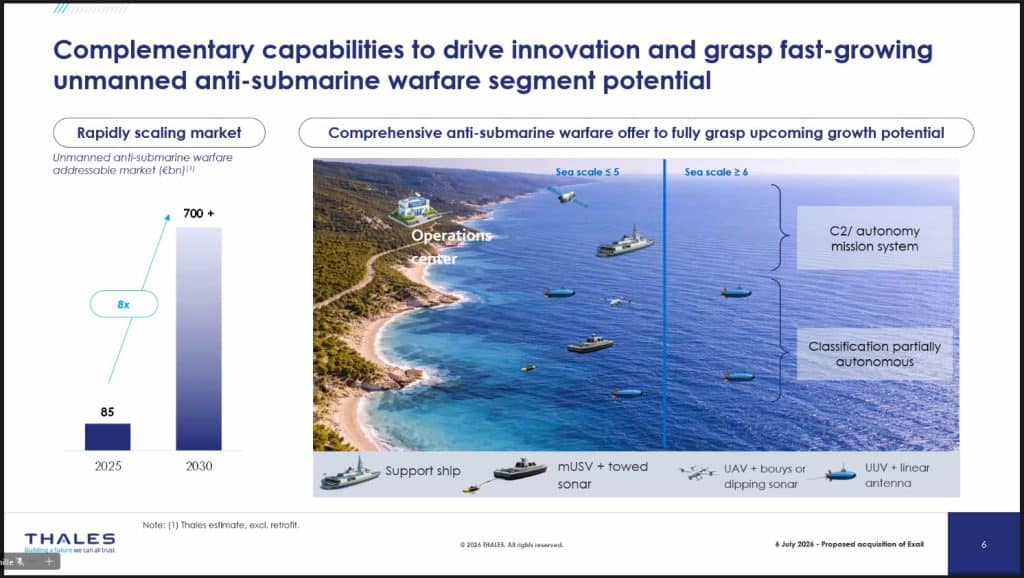
While mine warfare provides the immediate industrial crossover, the long-term operational prize lies in Anti-Submarine Warfare (ASW). The proliferation of quiet, conventional submarines is forcing navies to look toward uncrewed, high-endurance assets to maintain maritime domain awareness.
Combining Thales’ world-class acoustic sensors, towed arrays, and processing algorithms with Exail’s highly efficient autonomous surface vehicles—like the DriX—creates an ideal incubator for uncrewed ASW. By leveraging joint R&D in artificial intelligence and machine-to-machine autonomy, the combined entity will be well-positioned to field persistent, uncrewed sensor networks capable of hunting submarines across vast expanses of ocean.
Furthermore, both companies are deeply invested in quantum sensors. Bringing Exail’s advanced photonics and quantum capabilities into Thales’ multi-billion-euro annual R&D engine accelerates the timeline for next-generation, un-jammable quantum navigation systems.
Enhancing European Technological Sovereignty
Importantly, Exail’s product line remains strictly ITAR-free. For Thales, maintaining an entirely European, ITAR-free supply chain for critical technologies like inertial navigation and maritime robotics is a massive competitive advantage. It ensures absolute freedom of action for European defense forces and simplifies export pathways to a growing global client base seeking sovereign defense alternatives.
The transaction is expected to close its initial phases by Q3 2027, paving the way for a full combination by early 2028. For the global naval defense market, the message is clear: Thales is doubling down on the underwater domain, assembling the full spectrum of sensors, autonomy, and navigation required to lead the uncrewed naval era.