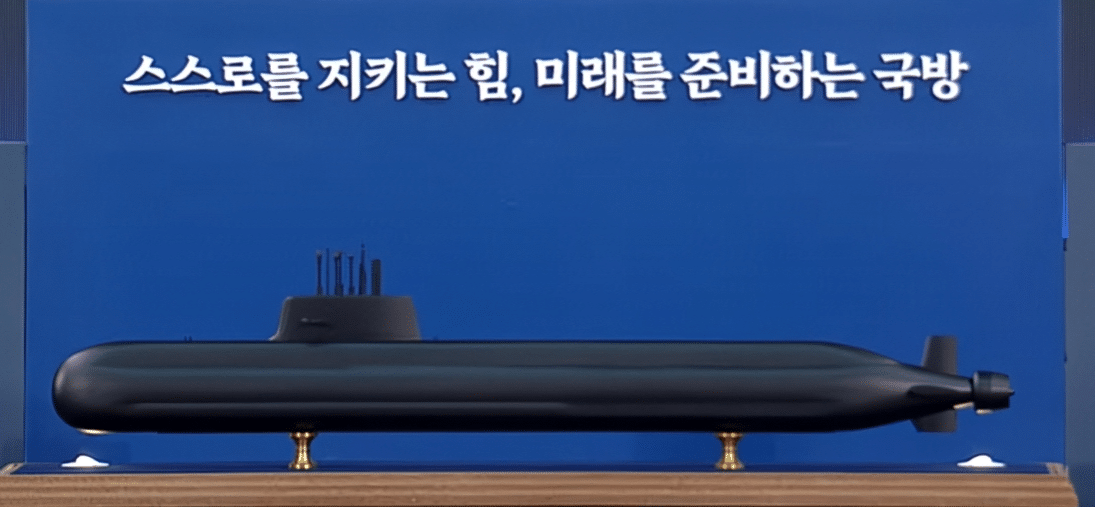
South Korea’s MND has issued a legislative notice for a special act establishing the legal framework, nuclear safety, and procurement path for its Jangbogo-N attack submarine program. The Republic of Korea Navy aims to launch its first nuclear-powered attack submarine in the mid-2030s.
South Korea’s plan to field nuclear-powered attack submarines has taken another significant step forward, with the Ministry of National Defense (MND) issuing a legislative notice for a proposed special act designed to establish a comprehensive legal framework for the acquisition, operation and nuclear-safety management of the future Jangbogo-N submarines.
On July 29, the ministry published the proposed Special Act on the Acquisition, Operation and Safety Management of Nuclear-Powered Submarines for public consultation. The consultation period will remain open until September 7, after which the ministry plans to submit the bill to the National Assembly. The defense ministry has identified enactment of the special act before the end of 2026 as a policy objective, although the proposal remains subject to further government review and parliamentary approval before it can become law.
Although the legislative notice does not itself authorize submarine construction, it represents an important step in converting South Korea’s nuclear-powered submarine ambitions into a structured national program.
Strict Non-Proliferation Language
One of the most significant parts of the draft is its explicit non-proliferation language. The proposed legislation states that the program is not intended for the development, manufacture, possession or use of nuclear weapons, and that nuclear material must not be diverted for nuclear weapons purposes or used in a way that could undermine confidence in the international non-proliferation regime. It also incorporates commitments to comply with the Nuclear Non-Proliferation Treaty and cooperate with verification procedures involving the International Atomic Energy Agency and other relevant international organizations.
By placing these commitments in the proposed legislation, Seoul is seeking to reinforce the distinction between naval nuclear propulsion and nuclear armament as it advances the program. This will be particularly important in maintaining confidence in Washington and among international nuclear-safeguards institutions as South Korea moves into the sensitive field of naval nuclear propulsion.
Legal framework for Jangbogo-N
The case for a dedicated law stems from the unusual nature of the program. According to the Ministry of National Defense, South Korea’s existing legal framework has limitations in governing nuclear-powered submarines as a single program because they combine a military weapon system with nuclear propulsion for the first time in the country’s history. Their development and operation therefore involve several areas of law, including defense acquisition and nuclear-safety management.
At the center of the proposed act is a new governance structure for the program. It provides for the preparation of a basic program plan and the establishment of a Nuclear-Powered Submarine Strategy Committee under the prime minister, while bringing acquisition, operation and safety management under a dedicated legal framework.
Nuclear safety accounts for a substantial part of the bill. The draft provides for a long-term nuclear-safety plan, safety assessments and inspections, approval requirements for naval reactors and fuel-related facilities, and rules for the management of radioactive waste and spent fuel.
The framework also extends to the people and industrial base needed to sustain the program. Provisions cover personnel certification, education and training, reporting and inspections, specialist institutions, workforce development, industrial-base support and international cooperation. Universities and research institutions could also be designated and supported as training institutions for specialist personnel.
Acquisition procedures would also be streamlined. The bill would allow Jangbogo-N to be exempted from the project feasibility study normally required for major defense acquisition programs, shorten research and development and test and evaluation periods, and provide greater flexibility in applying cost-calculation rules to related defense contracts.
The legislative effort builds on two major steps taken since late 2025. In the November 2025 U.S.-ROK Joint Fact Sheet, the United States stated that it had approved South Korea’s construction of nuclear-powered attack submarines and would work with Seoul on the requirements of the project, including possible arrangements for sourcing nuclear fuel.
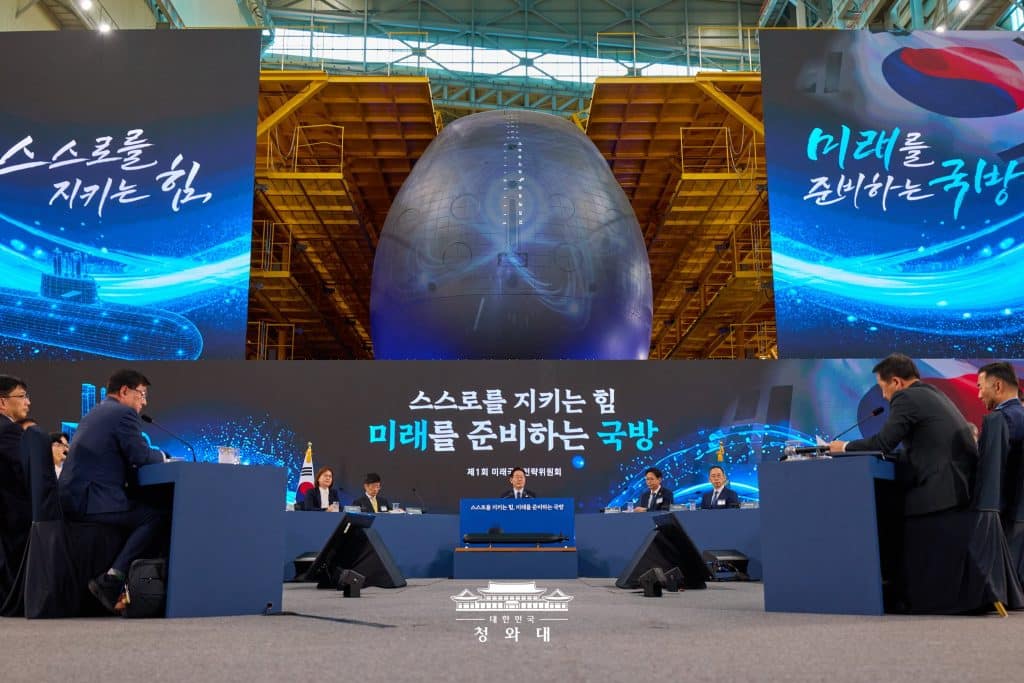
The Ministry of National Defense followed on May 26 with the Basic Plan for the Development of Nuclear-Powered Submarines, announced at the first meeting of the Future Defense Strategy Committee in Jinhae, Changwon. The government formally named the undertaking the Jangbogo-N Project and set a target of launching the first submarine in the mid-2030s and placing it into operational service in the late 2030s.
The submarines are to be developed and built in South Korea, drawing on technologies accumulated in the country’s civilian nuclear and shipbuilding sectors to increase self-reliance in acquisition and long-term maintenance. The reactor fuel will be low-enriched uranium (LEU), while the propulsion system is to be developed for long-cycle operation to minimize the need for fuel replacement. The government also plans to manage the submarine, propulsion system and nuclear fuel through a total life-cycle approach covering design, construction, operation, maintenance, fuel management and eventual decommissioning.
The basic plan did not disclose the displacement of the submarines or the number of vessels to be built. South Korean media have reported that military planners are considering an approximately 8,000-ton design and a fleet of at least three boats, although those figures have not been officially confirmed.
One major issue remains unresolved. Seoul has yet to announce a finalized mechanism for obtaining the low-enriched uranium required for the reactors. Nuclear-fuel arrangements therefore remain one of the key outstanding elements of Jangbogo-N even as the program’s legal and institutional framework continues to take shape.
North Korea adds urgency to Jangbogo-N
North Korea identified a nuclear-powered submarine as one of its major strategic weapons goals at the 2021 Workers’ Party Congress. By late 2025, state media had released images of what they described as an 8,700-ton nuclear-powered submarine under construction, although the status of its reactor, propulsion system and missile-launch complex remains unclear.
Pyongyang has also accelerated the wider modernization of its navy. The introduction of the 5,000-ton Choe Hyon-class destroyers, together with assessments by South Korean officials that Russia may have provided technical assistance to North Korean naval programs, has raised concerns that Moscow could help Pyongyang overcome some of the technical barriers still facing its submarine development.
Those concerns have grown as military cooperation between Russia and North Korea deepens. South Korean Defense Minister Ahn Gyu-back said in October 2025 that North Korea had likely received Russian assistance for its submarine program.
North Korea already possesses nuclear weapons and has spent years developing submarine-launched ballistic missiles. If Russian assistance helps it integrate a reliable SLBM system with a nuclear-powered submarine, an operational sea-based nuclear capability could emerge sooner than previously expected. For South Korea, that possibility strengthens the case for maintaining momentum in urgently developing and building its nuclear-powered submarine, whose endurance and sustained underwater speed would make it particularly valuable for prolonged surveillance and tracking of high-priority submarine targets.
Dedicated organizations for Jangbogo-N
According to the MND and the Defense Acquisition Program Administration (DAPA), amendments establishing and expanding dedicated organizations for the Jangbogo-N program were approved by the Cabinet on Aug. 11 and will take effect on Aug. 14.
Under the reorganization, the MND will upgrade its Nuclear-Powered Submarine Acquisition Task Force into the Nuclear-Powered Submarine Policy Planning Bureau, which will oversee policy, legislation, international cooperation, nuclear fuel arrangements and nuclear safety regulation.
DAPA, meanwhile, will expand its Korean Submarine Program Office into the Nuclear-Powered Submarine Program Office. The reorganized office will include one team responsible for the design and construction of the nuclear-powered submarine and another dedicated to developing the nuclear propulsion system, including the reactor.