Argentina is taking a major step toward rebuilding its long-neglected naval capabilities, outlining plans to acquire three new submarines and two multimission frigates as part of its 2027 national budget.
The draft 2027 national budget, submitted to Congress on 15 September, includes authorisation for the government to secure up to US$2.3 billion in financing for three submarines and US$1.2 billion for two multimission frigates.
However, inclusion in the draft budget does not constitute a formal procurement decision or guarantee that contracts will be signed. According to the document, both acquisitions remain strictly dependent on Argentina securing financing under terms deemed acceptable by the national government.
Submarine Program: Contenders and Regional Synergy
Sources mention that Naval Group and thyssenkrupp Marine Systems (TKMS) are closely following this submarine requirement. Specific details regarding the configurations offered, industrial offset arrangements, and delivery schedules have not yet been publicly disclosed.
Should Naval Group’s Scorpène be selected, Brazil could play a significant industrial role. Through the ongoing PROSUB program, the Itaguaí naval complex and Itaguaí Construções Navais (ICN) have established the robust infrastructure, specialized workforce, and industrial expertise necessary to construct the Brazilian Navy’s Riachuelo-class submarines—a design directly derived from Naval Group’s Scorpène family.
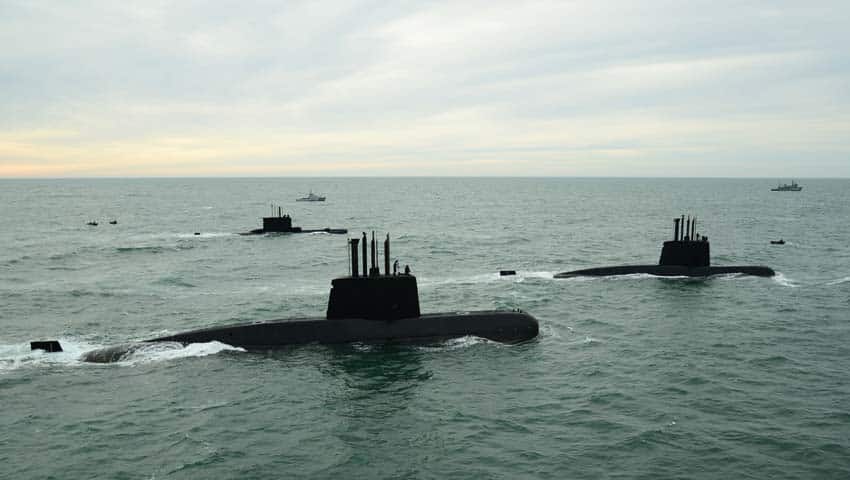
This acquisition would allow Argentina to finally restore an operational submarine capability that has remained effectively suspended since the tragic loss of the TR-1700-class submarine ARA San Juan and its 44 crew members in November 2017.
The Argentine Navy currently retains the Type 209 submarine ARA Salta and the TR-1700-class ARA Santa Cruz. Neither vessel currently provides the service with a fully operational seagoing capability, forcing Argentina to rely on cooperation with foreign navies to maintain baseline submarine-related training and anti-submarine warfare (ASW) proficiency.
Frigate Program: Assessing European and Regional Designs
The frigate modernization program is currently at a less mature stage. While no firm industry offers have been submitted, the Argentine Navy has been actively evaluating various European options. The Italian FREMM is also said to be considered. Additionally, a design derived from the Brazilian Navy’s newly emerging Tamandaré-class frigates could surface as a candidate.
Based on the German MEKO A-100 design and heavily adapted to Brazilian specifications, the Tamandaré-class is currently being built in Brazil by Águas Azuis—a consortium comprising TKMS, Embraer Defense & Security, and Atech. Consideration of a related design could pave the way for deeper regional industrial cooperation, though no formal Argentine requirement or active negotiation has been officially confirmed.
These new vessels would kickstart the long-overdue renewal of Argentina’s aging principal surface combatants. The Navy’s current surface fleet centers on four Almirante Brown-class destroyers (MEKO 360 design) and six Espora-class corvettes (MEKO 140 design), all commissioned between the 1980s and early 2000s.
Fiscal Realities
The naval proposals form part of a wider 2027 defense budget proposal totaling approximately 8.07 trillion Argentine pesos (roughly $5.3 billion). While this represents a nominal increase of roughly 20 percent over the 2026 allocation, it remains outpaced by domestic inflation recorded between budget cycles.
Consequently, external financing will be the ultimate decisor for whether these ambitious naval programs advance from planning to procurement. Nonetheless, the draft budget stands as one of the clearest official signals in recent years that Buenos Aires intends to aggressively pursue the recovery of both its submarine arm and high-end surface combatant capabilities.