The six-month project by Hanwha Ocean marks the ROK Navy’s first outsourcing of comprehensive depot-level maintenance for a surface combatant, signaling a major shift toward private-sector fleet sustainment.
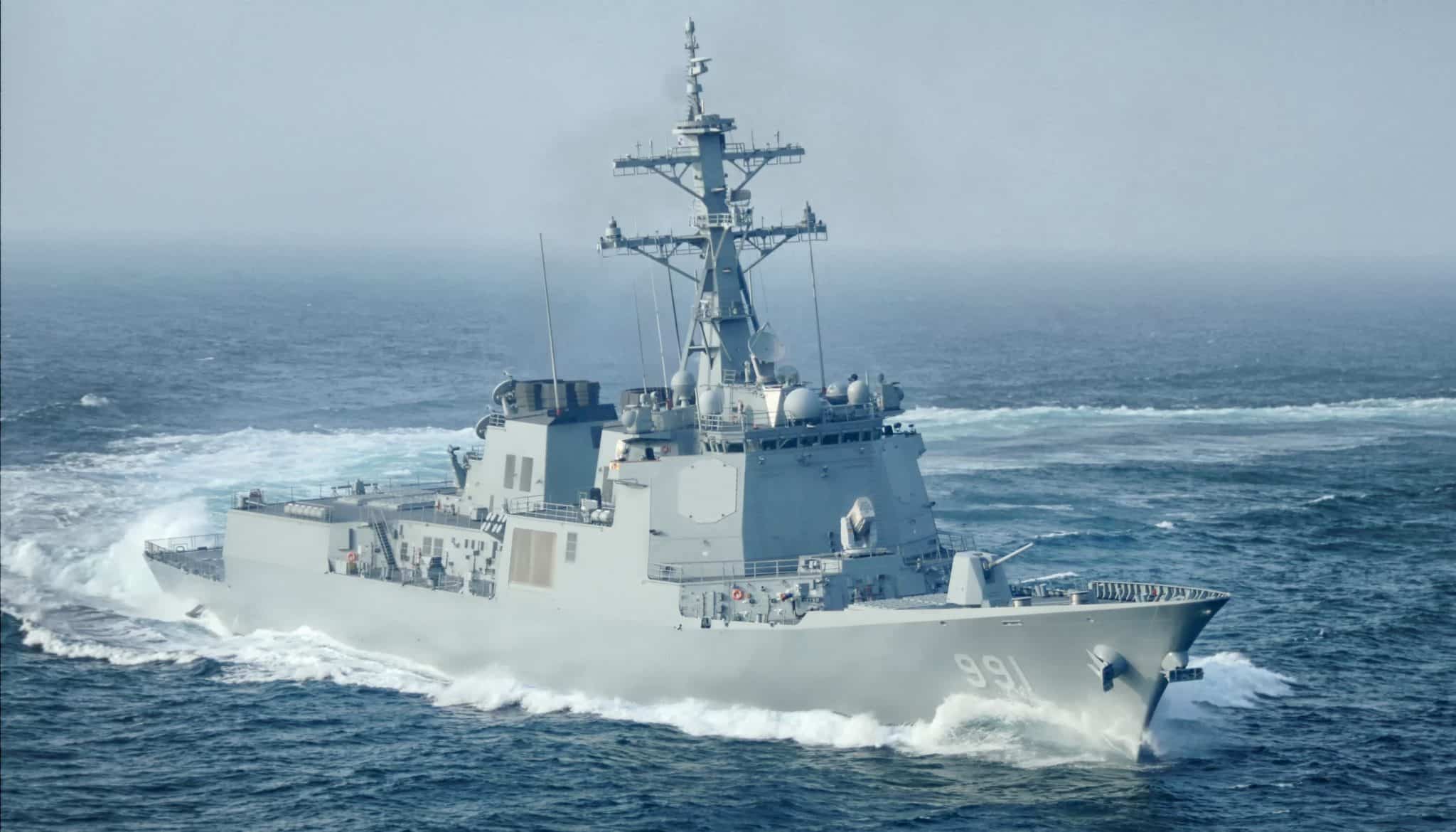
The Republic of Korea Navy (ROKN) has signed a landmark maintenance, repair, and overhaul (MRO) contract with Hanwha Ocean for the 7,600-ton Aegis destroyer ROK S Sejong the Great (DDG-991). According to the Navy, this is the first time the service has outsourced a surface ship’s comprehensive depot-level overhaul to a private company.
Signed on August 27, work is scheduled to begin in September 2026 and run through March 2027, spanning an estimated six-month period. By leveraging private-sector personnel, infrastructure, and technical expertise, the ROKN aims to ease the maintenance burden on the ship’s crew, allowing sailors to focus more intensely on core combat duties and operational training.
Hanwha Ocean will partner with specialist equipment companies, alongside small and medium-sized MRO firms handling selected areas. The Navy stated that key mission-critical equipment will be serviced directly by original equipment manufacturers (OEMs) to ensure performance standards are fully restored.
Furthermore, South Korea’s Defense Agency for Technology and Quality (DTaQ) will apply the government’s standardized inspection manual for naval MRO to major work packages for the first time. Periodic inspection criteria under the Ship Safety Act will also be utilized to evaluate the vessel’s overall safety compliance.
Closer military–industry cooperation
Historically, surface ship depot-level maintenance has centered on organic Navy facilities. Naval support units handled work within internal capabilities, while overflow requirements were contracted out piecemeal through the service’s logistics system.
Naval News understands that the ROKN now envisions a hybrid model where internal maintenance units work side-by-side with a civilian prime contractor responsible for coordinating specialized MRO firms.
This cooperative framework relies on shared technical support, transparent maintenance-record sharing, and integrated military-commercial infrastructure. Rather than supplanting Navy facilities, the goal is to forge a flexible, resilient support network. This concept aligns with strategic blueprints outlined by the ROKN in 2024, which detailed an MRO contractor framework capable of managing integrated scheduling, safety compliance, performance oversight, and spare-parts logistics.
Manpower pressures and the road to 2040
This transition is heavily driven by long-term workforce constraints. Naval News understands that the ROKN anticipates the retirement of highly experienced maintenance personnel, combined with a broader national decline in available military manpower, will increasingly constrain its ability to sustain an expanding fleet using uniformed personnel alone.
ROKN projections indicate that by the 2040s, military resources alone could meet less than half of the service’s overall ship-maintenance demand.
These human-resource pressures are compounded by the rapid introduction of increasingly sophisticated naval systems, which demand advanced technical oversight. Consequently, the ROKN plans to expand this integrated MRO model progressively through the 2030s, paving the way for full-fleet implementation by 2040. Public planning documents have identified DDGs, DDH-II destroyers, FFG frigates, and PKG guided-missile patrol craft for future integrated depot-level overhauls and capability upgrades.
The current MRO contract for ROKS Sejong the Great is an early step toward that longer-term support structure.
Looking ahead, the ROKN also intends to bake MRO considerations into newly introduced capabilities—including maritime unmanned systems—starting from the requirements phase through design, construction, and operation, ensuring life-cycle sustainment is baked in from day one.