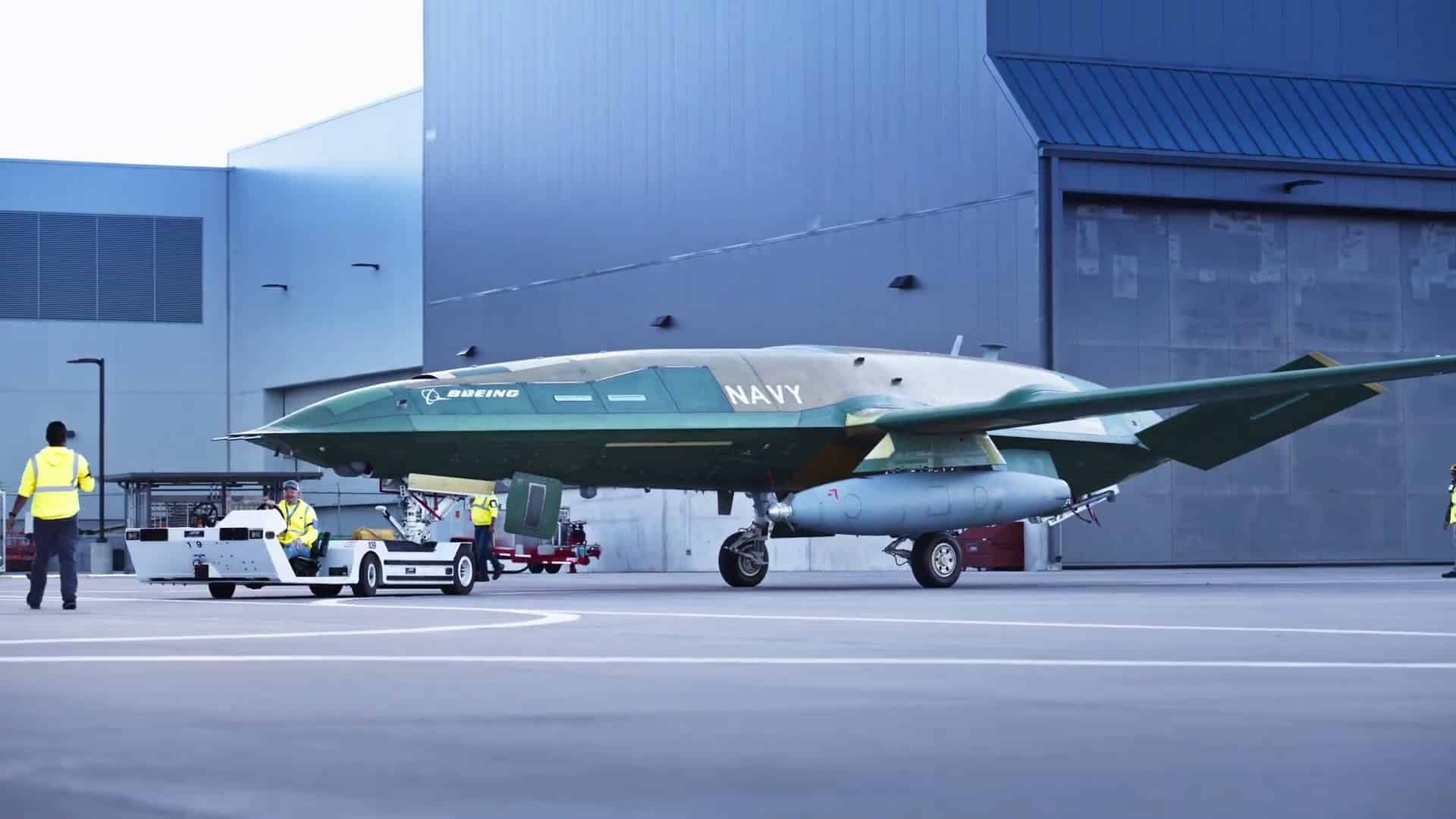
The U.S. Navy and Boeing have officially launched production of the MQ-25A Stingray, advancing the carrier-based unmanned refueler toward 2029 fleet integration.
The U.S. Navy awarded Boeing a $562 million fixed-price incentive contract for Lot 1 Low-Rate Initial Production (LRIP) of the unmanned aerial refueler. The landmark agreement funds three Lot 1 MQ-25A aircraft alongside advanced procurement funding for long-lead components to support an additional three aircraft under Lot 2. Initial deliveries of these critical uncrewed assets are slated to begin in 2029.
This production milestone comes on the heels of the MQ-25A’s successful first flight from MidAmerica St. Louis Airport in Mascoutah, Illinois. During the roughly two-hour flight, the aircraft demonstrated flawless autonomous taxi, takeoff, flight, and landing capabilities, while validating basic flight controls, engine performance, and handling characteristics under ground control station commands. That successful flight paved the way for Milestone C approval, formally transitioning the program out of the Engineering and Manufacturing Development phase and into production.
As the world’s first operational, carrier-based unmanned aircraft designed for refueling, the Stingray is poised to transform Carrier Strike Group operations. By absorbing the routine aerial refueling duties traditionally assigned to crewed tactical aircraft, the MQ-25A will relieve F/A-18E/F Super Hornets of tanker tasks. This shift allows the air wing to dedicate vital pylons and aircraft capacity entirely to strike missions and ordnance, ultimately extending the operational reach, flexibility, and lethality of the fleet.
With the production line active and initial builds underway at Boeing facilities, the Navy-Boeing team is focused on mitigating technical risks, preparing operator training programs, and executing subsequent full-rate production decisions as the Stingray marches toward fleet introduction.
About MQ-25A
The MQ-25A features a wing-body-tail airframe spanning 51 feet in length with a 75-foot wingspan that folds down to 31.3 feet for compact aircraft carrier deck handling. Powered by a single Rolls-Royce AE 3007N turbofan engine generating over 10,000 pounds of thrust, the aircraft is designed to meet strict performance metrics for carrier operations. The U.S. Navy’s core requirement specifies that the Stingray can deliver between 14,000 and 16,000 pounds of fuel to tactical jets at a range of 500 nautical miles (approx. 926 kilometers) from the carrier, significantly expanding the striking distance of the air wing.
With the production line active and initial builds underway at Boeing facilities, the Navy-Boeing team is focused on mitigating technical risks, preparing operator training programs, and executing subsequent full-rate production decisions as the Stingray marches toward fleet introduction. As highlighted in previous Naval News video reporting from Sea Air Space featuring Boeing’s MQ-25 program leadership, scale models of the MQ-25 Stingray—originally designed primarily as an aerial tanker—have demonstrated armed configurations carrying Long Range Anti-Ship Missiles (LRASM), underscoring a broader shift toward expanding carrier strike reach through uncrewed capabilities.