Oshen, the Plymouth-based maritime sensing and data company, is demonstrating a world-first ‘acoustic picket line’ capability at REPMUS26, the largest maritime robotics exercise.
Oshen press release
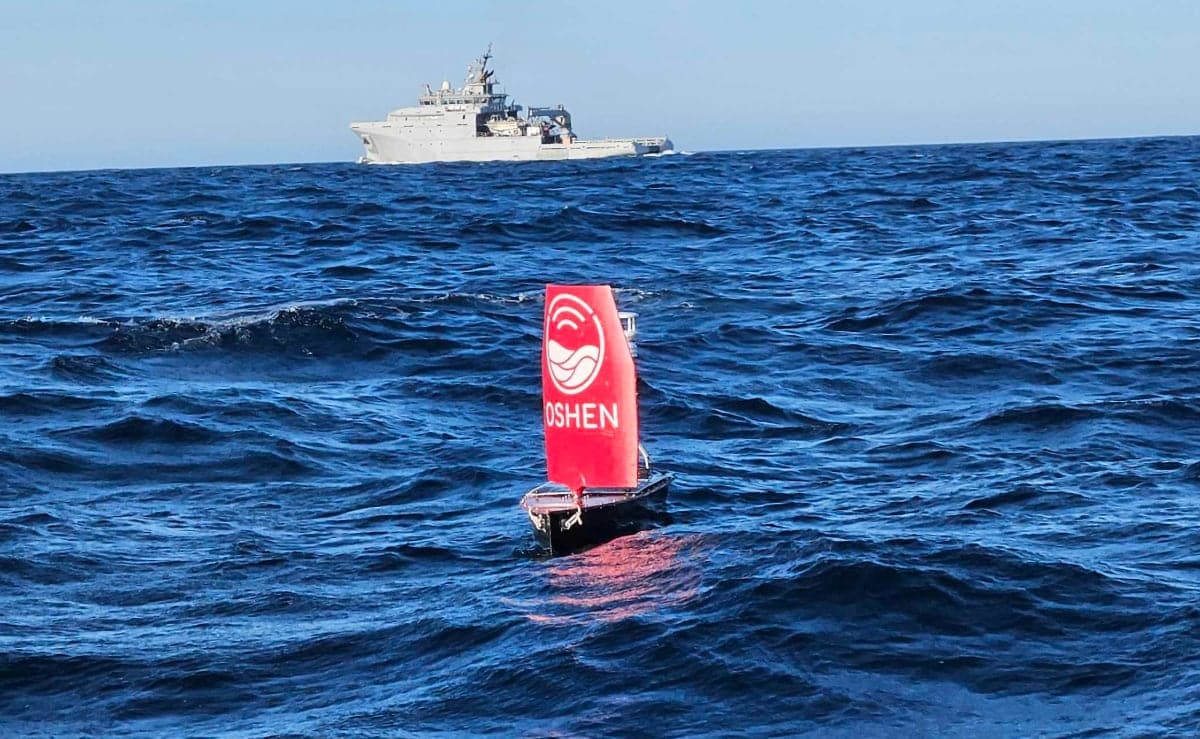
During the month-long event, now underway, it is deploying six of its iconic 1.2m (4’) long robotic sailboats, each fitted with a hydrophone, to create a distributed surveillance network. This is being tested against live targets for the first time.
Passive sonar monitoring traditionally involves surface vessels pulling platforms fitted with up to 100 hydrophones behind them. These provide excellent local sensing and bearing-finding capability but are sensitive to noise pollution from the towing vessel or nearby ships, and cover a limited area. Oshen’s approach is to have many small, low-cost sensors spread over a wide area to increase the likelihood of detections. A fleet, or constellation, of C-Star autonomous boats, each with its own hydrophone from Systems Engineering and Assessment, can hold position to create an acoustic barrier across any given stretch of water – such as the Greenland, Iceland, UK gap (GUIK). Its shape and density can be adjusted in response to the threat picture while multi-perspective monitoring can identify the location, not just bearing, of a target. This can then help cue the use other assets such as towed arrays.
Network resilience is key. Designed for long endurance and challenging environments, C-Stars are the only Uncrewed Surface Vessel (USV) to have survived and transmitted data from inside a Category 5 hurricane. Being small and sitting low in the water, C-Stars are difficult to spot (or attack). Even if they are detected, the distributed network creates strategic ambiguity: adversaries cannot easily determine which vessels are active or what sensors they are carrying. In the event that individual units are lost, the network as a whole can easily adapt.
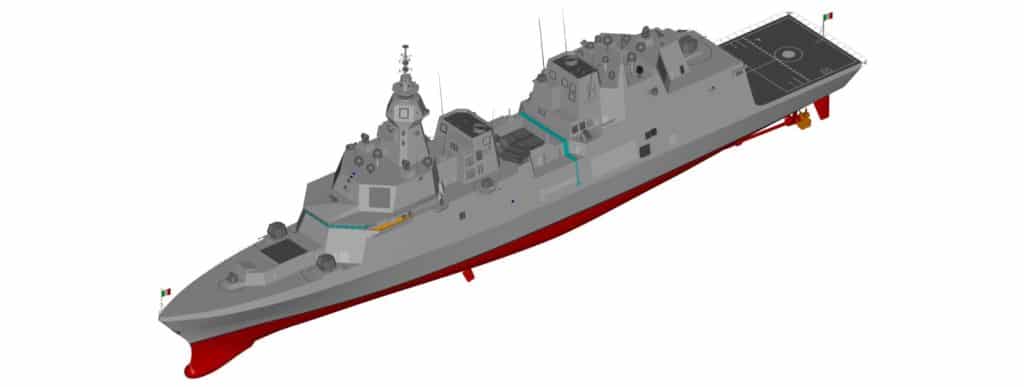
REPMUS is designed to test not just new robotic technologies but also command and control across a mixed fleet in a congested, kinetic environment. With the vessels taking part ranging from 50kg C-Stars to 3,000 tonne manned frigates, coordination and interoperability are vital.
In the months leading up to the exercise, Oshen’s engineers worked closely with Navy counterparts to ensure that its command software would integrate seamlessly with NATO’s. Care was taken to ensure that data from C-Stars would not overwhelm communication channels, and that information would be provided to users at the right time, in the appropriate format. To that end, C-Star readings are being integrated into to a central database, with detailed forecasts then being shared amongst Alliance partners. The team also worked hard to ensure that systems designed for large, powered vessels could also accommodate small, sail-powered robots.
REPMUS26 represents an important milestone in Oshen’s fast-developing relationship with naval defence forces, both in the UK and abroad. The company currently has three active projects with the Royal Navy, including the UKDI DASA programme, and holds a Cooperative Research and Development Agreement (CRADA) with the US Navy covering single-beam sonar applications. Next month, eight C-Stars will take part in the Maritime Big Play exercise in San Diego, testing the acoustic picket line concept in a US context.
Gordon Jones, Defence and Oceanography Lead at Oshen, said: “A defensive network built from a host of individual hydrophone platforms behaves very differently to one built from a handful of expensive towed arrays. It is wider, more resilient and harder for an adversary to characterise. REPMUS is the first real test of that model against live targets, and it points the way to how persistent undersea surveillance can be evolved.”
Anahita Laverack, CEO of Oshen, said: “REPMUS embodies what our technology is designed to do: take a capability that normally depends on a handful of expensive assets and turn it into something that can be deployed at scale, cheaply and continuously. There are many potential applications, including an acoustic picket line to help protect the GIUK Gap.”