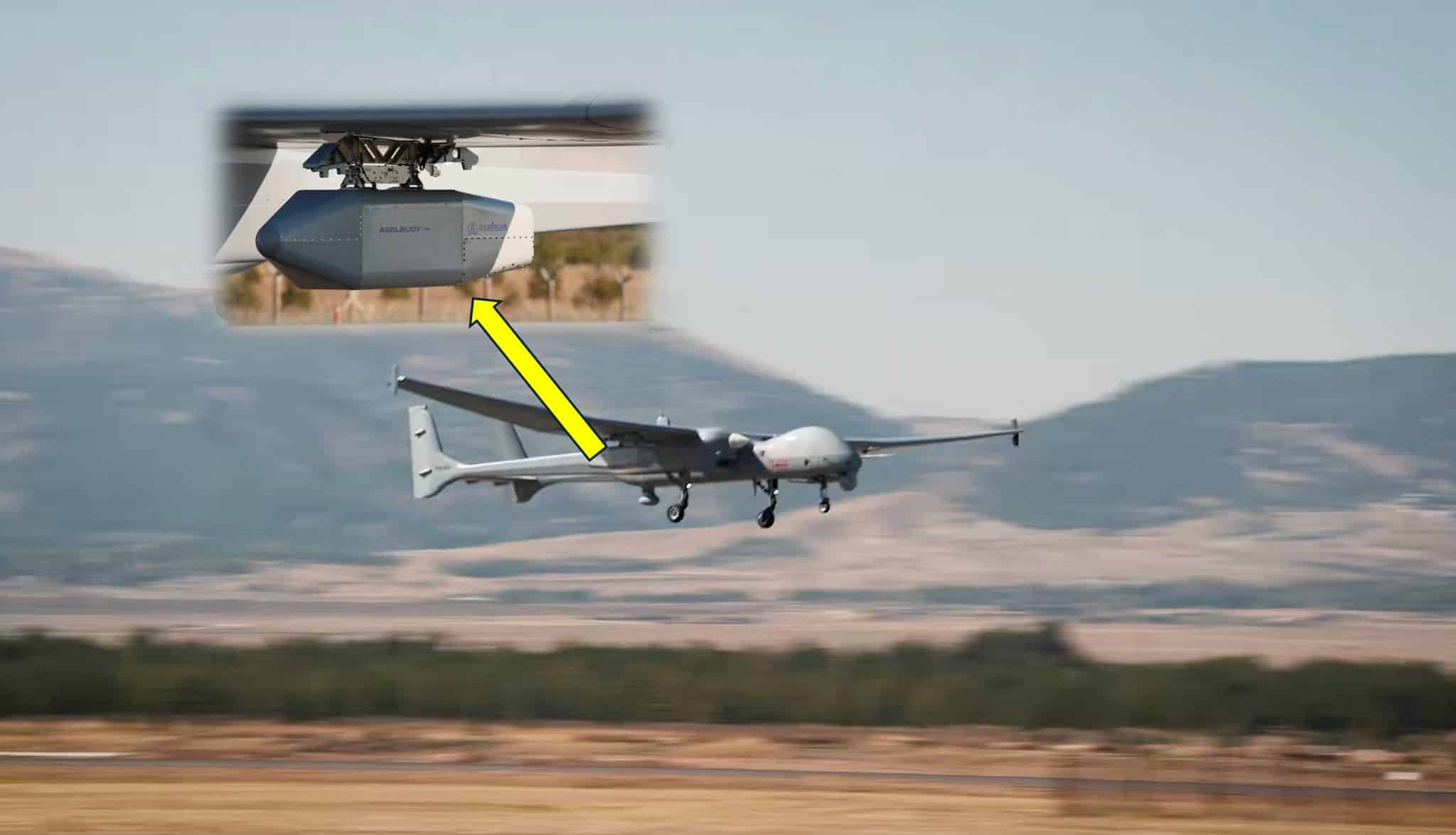
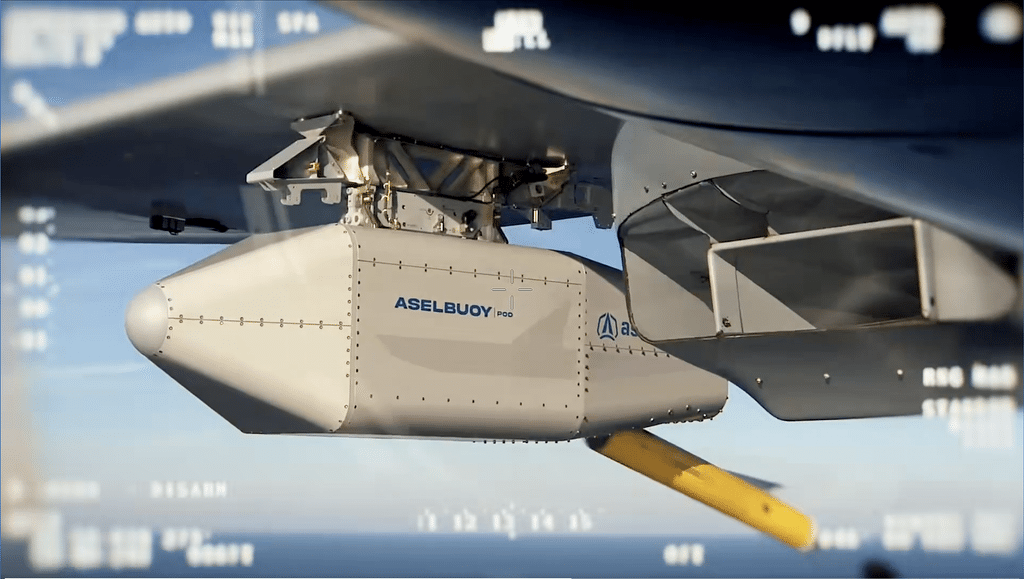
Turkish Aerospace’s Aksungur unmanned aerial vehicle released three ASELSAN aselBUOY 100P passive sonobuoys into the Mediterranean during the Turkish Navy’s TURNAs-26 unmanned systems exercise.
The UCAV took off from Ankara and transited to the exercise area off Antalya (around 400 km) under satellite control, powered by the indigenous TEI-PD170 engine. In the mission area, it carried three aselBUOY 100P units and one additional sonobuoy in a pod, descended to 1,000 feet to release them, then climbed to 6,000 feet to begin listening. Aksungur remained on station for roughly four hours, relaying acoustic data to a transfer centre integrated into the ground control station in Ankara, where underwater targets were detected from the processed signals. Carriage, release, listening and evaluation at a remote site were thus exercised in a single sortie.

The milestone follows a similar step by Baykar’s Bayraktar TB3, which released two sonobuoys from a wing-mounted dispenser pod while operating from the deck of TCG Anadolu during the Denizkurdu-I/2026 exercise in September, coordinating directly with a Turkish Navy maritime patrol aircraft. That flight made the TB3 the first Turkish unmanned aircraft to deploy sonobuoys in an operational maritime environment, and only the second platform of its class worldwide after General Atomics’ MQ-9B SeaGuardian. At TURNAs-26 the TB3 repeated the feat from Anadolu, using Baykar’s indigenous dispenser system, while Aksungur flew its own sonobuoy pattern from land.
About aselBUOY 100P

The aselBUOY 100P is a NATO A-size passive directional sonobuoy weighing 10 kg and measuring 120 mm in diameter. It listens at depths of 30 or 150 metres, transmits over a range of up to 20 km, and scuttles itself at the end of a programmed operating time of up to eight hours. ASELSAN launched the effort as a self-financed project in late 2015 and ran its first air-launch trials from a Cessna turboprop in 2018. Serial production followed the first contract with the Turkish Naval Forces Command, and the company has since worked on launching pods tailored to Turkish drones — the ASELBUOY POD carried by Aksungur — while standing up an artificial intelligence centre with the Navy to train detection models on underwater acoustic data.
TURNAs-26 Unmanned Systems Exercise

Held between 19 and 27 October in the Gulf of Antalya and the Eastern Mediterranean, TURNAs-26 was the Turkish Navy’s first exercise built entirely around unmanned systems. It gathered 18 ships, 11 aircraft, 41 systems from 17 defence companies and some 1,300 personnel, among them nine UAVs, seven unmanned underwater vehicles and nine unmanned surface vessels.
Scenarios ranged from covert ISR with the LÜFER UUV and mine detection with NETA, GAVIA, OSKA and DERİNGÖZ, to swarm attacks by KARGU loitering munitions, an explosive-free kinetic intercept of a TALON target drone by the radar-equipped TUNGA-X, and the destruction of a kamikaze USV by the TOLGA close-in weapon system aboard TCG Beykoz. “Future naval warfare will be fought with unmanned vehicles,” Admiral Ercüment Tatlıoğlu, Commander of the Turkish Naval Forces, said after the distinguished observer day.
Naval News comments
Aksungur is the longest-legged aircraft in the Navy’s unmanned fleet. The twin-engine MALE design spans a 24-metre wing, lifts more than 750 kg of payload to a 40,000-foot ceiling and, according to TUSAŞ, stays airborne beyond 50 hours, with work under way toward roughly 60 hours and 1,250 kg. The Turkish Navy took its first example in October 2021. That endurance is what allows the type to absorb a share of the maritime patrol mission, relieving manned aircraft of a portion of their tasking.
Removing the crew from the equation changes the arithmetic of persistence. Sortie length becomes a question of fuel and maintenance rather than human fatigue, so the aircraft can hold a patrol box or a chokepoint under watch for far longer than a manned MPA or a shipborne helicopter. The result is persistent surveillance, and through it the detection and classification work that feeds the recognised maritime picture.
Aksungur was already useful in anti-submarine operations before this week. A drone that lingers over a suspected transit route for the better part of a day narrows the windows in which a diesel-electric boat can snort or surface to charge batteries, forcing it to stay deep, slow and quiet, and disrupting the rhythm of its patrol. Adding the ability to seed sonobuoys and listen to them raises that contribution: the aircraft now carries its own subsurface sensor layer into the fight, and can push its acoustic efforts to a higher level whenever a commander asks for them.
Aksungur and the TB3 are only part of the picture. Surface vessels such as MARLIN and SANCAR, equipped with subsurface sensors and weapons, and unmanned underwater vehicles from ASELSAN and STM point to a layered ASW architecture in which air, surface, and subsurface unmanned systems share the same acoustic picture. For the Turkish Navy, that combination promises to bring a different breath to anti-submarine operations.