Turkish naval special forces employed DATUM’s LÜFER fibre-optic-guided underwater reconnaissance and attack vehicle during the TURNAs-2026 unmanned maritime systems exercise. The exercise took place in Antalya Bay between October 19 and 27, 2026.
Developed by Istanbul Technical University-based DATUM Denizaltı Teknolojileri Uygulama ve Mühendislik AŞ for Turkish Navy commandos, LÜFER combines underwater reconnaissance and surveillance functions with an optional explosive payload. The company said the system was successfully used by SAT naval special forces during the exercise, which brought together unmanned maritime systems.
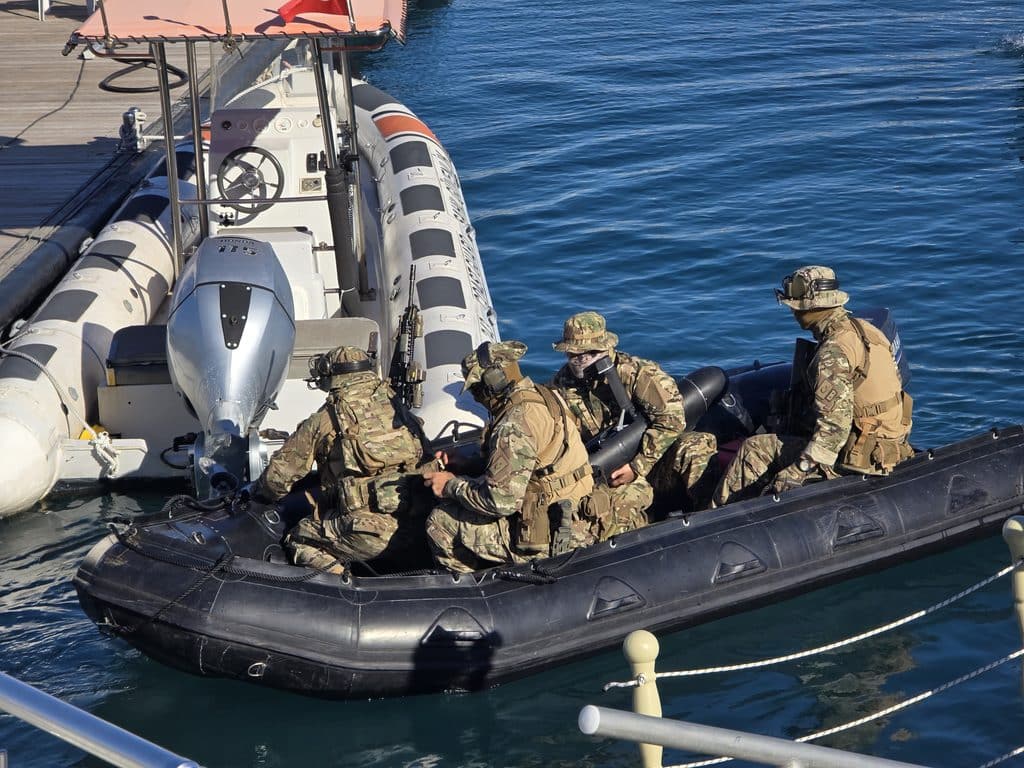
During the VIP day scenario, SAT commandos deployed LÜFER from an inflatable boat at a safe distance from the intended landing beach. The vehicle was used to conduct remote reconnaissance ahead of the landing. The scenario subsequently included drone strikes against targets identified ashore, placing the underwater reconnaissance activity within a broader amphibious special operations sequence.
DATUM first unveiled LÜFER at Teknofest 2026 Mavi Vatan. Resembling a miniature torpedo, the vehicle measures 1.2 metres in length and weighs 13 kilograms without its explosive payload. Its compact dimensions are intended to allow a single operator to carry the system, supporting deployment by small teams without requiring a dedicated launch platform.


The vehicle carries an internal spool containing up to 15 kilometres of fibre-optic cable. This provides the connection between the operator and the underwater vehicle, enabling remote control and the transmission of high-definition camera imagery. According to DATUM, the wired connection allows communications to be maintained in environments where intensive electronic warfare prevents reliable wireless communications.
LÜFER was developed to support control from shore, inflatable boats, helicopters and underwater positions. In its reconnaissance configuration, the system allows naval commandos to inspect an area remotely while remaining at a safer distance. When fitted with an explosive warhead, it can also be used as a one-way underwater attack vehicle.
The company describes the attack configuration as intended to disable vessels by damaging vulnerable components rather than necessarily sinking them. Camera imagery provides the operator with visual feedback during the approach. DATUM states that the explosive payload was designed to enable attacks capable of putting even larger vessels out of action.
Alongside LÜFER, DATUM displayed its larger KOFANA fibre-optic-guided mine-carrying and attack vehicle at TURNAs-2026. The two platforms share software and fibre-optic communications technology, although KOFANA is designed for substantially different payload and deployment requirements. DATUM lists an 80-kilometre fibre-optic communications link for the larger vehicle.
KOFANA is designed to carry a single Malaman naval mine. Depending on mission requirements, it can deliver the mine and return to base, remain positioned underwater for subsequent use, or employ the carried explosive in a one-way attack role. The company presents the platform as a means of covertly delivering naval mines into contested areas, supported by its wired communications and low acoustic signature.
The two systems therefore address different scales of underwater operations: LÜFER provides a portable reconnaissance and attack capability for commandos, while KOFANA accommodates a much heavier mine payload. DATUM states that both unmanned underwater vehicles are being developed using the company’s own funds.
About LÜFER and KOFANA
LÜFER

LÜFER is a portable, fibre-optic-guided unmanned underwater vehicle developed for naval special operations. Its principal disclosed characteristics include:
- Length: 1.2 metres.
- Weight: 13 kilograms, excluding the explosive payload.
- Fibre-optic cable capacity: Up to 15 kilometres.
- Sensor: HD camera.
- Roles: Reconnaissance, surveillance and optional one-way attack.
- Control locations: Shore, inflatable boats, helicopters and underwater positions.
KOFANA

KOFANA is a large unmanned underwater vehicle designed for covert mine delivery and optional underwater attack missions. According to DATUM’s brochure, its specifications include:
| Battery | 150 kWh lithium iron phosphate |
| Beam | 1 metre |
| Communications | 80-kilometre fibre-optic link |
| Cruising speed | 4 knots |
| Displacement | 4 metric tonnes |
| Diving depth | 50 metres; 2,000-metre option advertised |
| Height | 1.37 metres |
| Length | 7.1 metres |
| Maximum speed | 10 knots |
| Navigation | GNSS, inertial navigation system and Doppler velocity log |
| Payload | Bottom mines weighing up to 700 kilograms |
| Propulsion | 11 kW electric propulsion system |
The company brochure also lists a handheld control station and a high-resolution camera. Transport options include a towed slipway trailer, transport aircraft and a medium-duty truck, with tailored designs available for individual naval requirements.