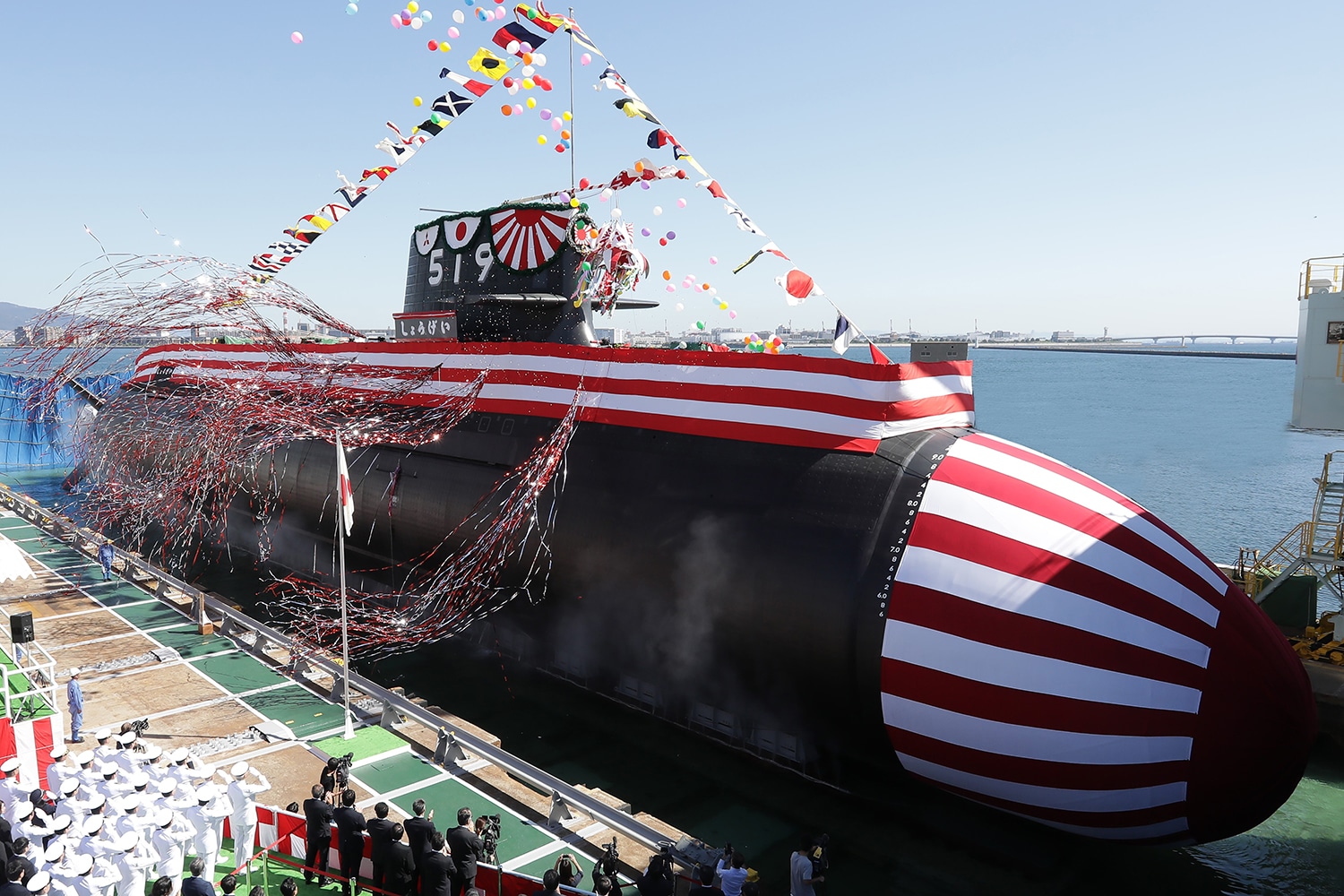
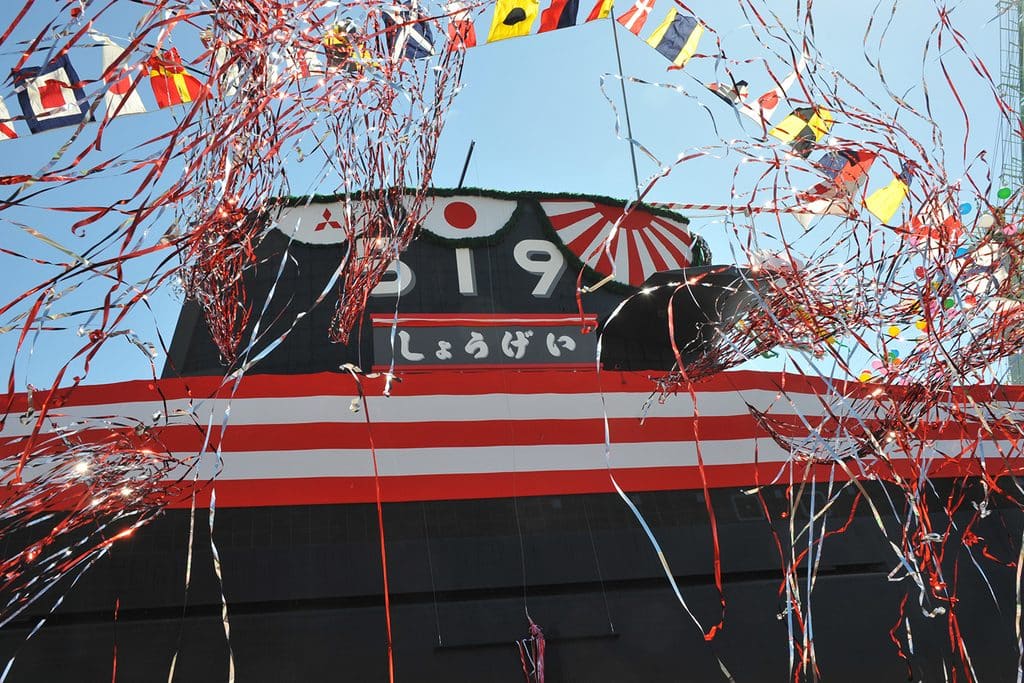
On October 8, Japan’s Mitsubishi Heavy Industries (MHI) launched the seventh Taigei-class diesel-electric attack submarine, “Shogei” (しょうげい), for the Japan Maritime Self-Defense Force (JMSDF), as Japan considers nuclear propulsion as a possible option for its future submarines.
The new 3,000-tonne submarine, with pennant number SS-519, entered the water during a naming and launching ceremony at MHI’s shipyard in Kobe City, Hyogo Prefecture.
Like the fourth Taigei-class submarine, “Raigei,” and its successors, “Chogei” and “Sogei,” “Shogei” will be equipped with the new, higher-output Kawasaki 12V 25/31 diesel engines. The submarine, which has a construction cost of about 80.5 billion yen ($509 million), is scheduled to be delivered to the JMSDF in March 2028.
The name “Shogei,” written as 翔鯨 in Chinese characters, can be translated as “Soaring Whale.” This is the first time that the JMSDF has named a vessel “Shogei,” and the former Imperial Japanese Navy had no vessel with this name.
According to the JMSDF, the submarine has an overall length of 84 meters, a beam of 9.1 meters, and a standard displacement of about 3,000 tonnes.
Taigei-class SSK weapons
The Taigei-class employs the same torpedo countermeasures system incorporated into the last four Soryu-class submarines. It uses Japan’s newest Type 18 torpedo, which succeeds the Type 89. The new torpedo features improvements in propulsion, target detection, and processing. The class is also capable of launching the UGM-84L Harpoon Block II anti-ship missile against surface targets. The missile has a reported range of 248 kilometers.
Why Japan is considering nuclear-powered submarines
The Taigei-class submarines use large-capacity lithium-ion batteries to improve their underwater endurance and operational capabilities. However, conventional diesel-electric submarines must operate their diesel engines to recharge their batteries, requiring them to rise to a shallow depth and use a snorkel for air intake and exhaust. This increases the risk of detection.
Their batteries also drain more rapidly during sustained high-speed operations. As a result, conventional submarines cannot match nuclear-powered submarines in combining sustained high speed, long-distance transit and extended submerged operations.
As the Chinese Navy expands its activities in the Western Pacific, the ability to deploy rapidly over long distances and remain submerged for extended periods is becoming increasingly important for Japan.
Under Japan’s three national security documents adopted in December 2022, the Ministry of Defense (MoD) in Tokyo is pursuing the development and eventual acquisition of submarines equipped with vertical launching systems (VLS) capable of launching long-range stand-off missiles.
On July 6, 2026, Japan’s Acquisition, Technology & Logistics Agency (ATLA) awarded Mitsubishi Heavy Industries a 3.9 billion yen (about $24.6 million) contract for research into the total ship optimization design of the next-generation VLS-equipped submarine. The research is scheduled to run from fiscal 2026 through fiscal 2029.
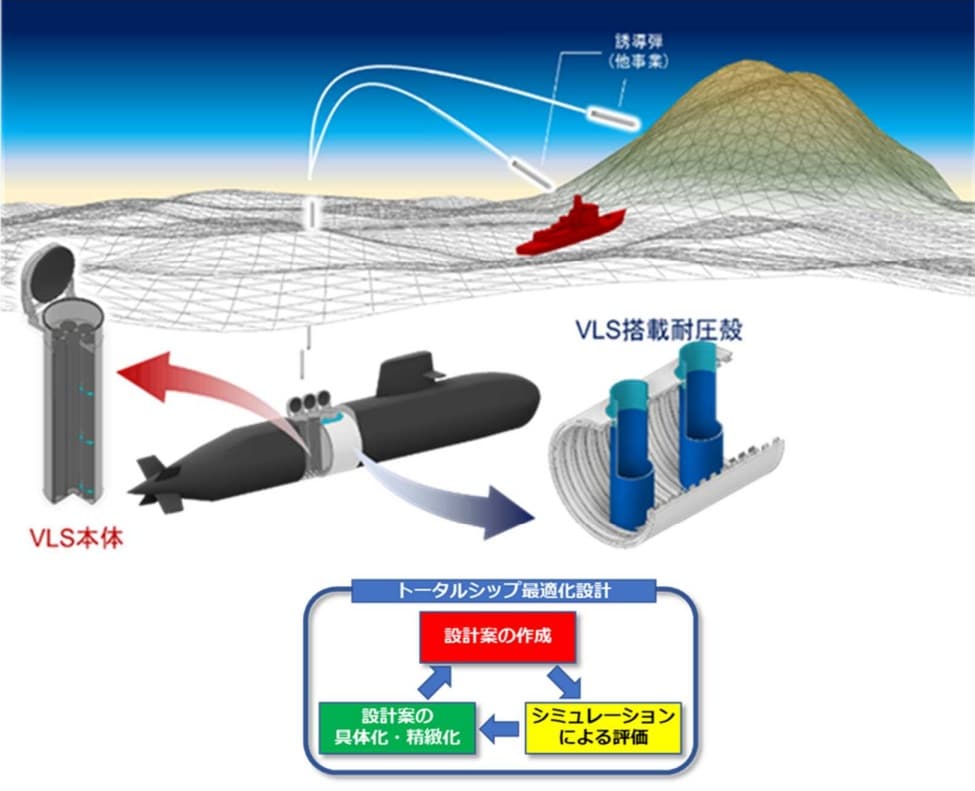
Integrating VLS could require significant changes to submarine design, potentially including a larger hull. More advanced sonar systems and the operation of unmanned underwater vehicles (UUVs) could also increase onboard power requirements. However, the amount of energy available to conventional submarines while submerged remains limited by their battery capacity.
In September 2025, a panel of experts advising the MoD recommended further research and technological development on VLS-equipped submarines, including consideration of what it described as “next-generation propulsion.” The recommendation did not explicitly call for nuclear propulsion, and Japan has not decided whether its future VLS-equipped submarines will be nuclear-powered.
On September 11, 2026, Defense Minister Shinjiro Koizumi reiterated that Japan would not rule out nuclear-powered submarines as it considers revisions to its three national security documents by year-end. Speaking at a press conference, Koizumi said nuclear-powered submarines can remain submerged and operate for extended periods while maintaining much higher speeds than conventional submarines. He emphasized that these characteristics could allow submarines to carry out their missions while ensuring a higher level of safety for their crews.
Such capabilities could give submarine commanders greater operational flexibility and improve crew survivability when attempting to evade enemy anti-submarine warfare operations.
However, Koizumi also acknowledged significant disadvantages, including higher costs, the need for larger hulls, specialized expertise for nuclear propulsion systems, and potentially greater underwater acoustic signatures than conventional submarines.
Introducing nuclear-powered submarines would also require Tokyo to address issues involving nuclear safety, personnel training, maintenance infrastructure and the long-term operation of naval reactors.
For now, Japan has made no decision to acquire nuclear-powered submarines. The central question is what missions its future submarine force will be expected to perform, and which propulsion system would best meet those requirements while protecting the safety of its crews.