Navantia has successfully launched the second F110-class frigate, Roger de Lauria (F112), for the Spanish Navy four months ahead of schedule in Ferrol.
Navantia press release
Navantia has held the launching ceremony of the F112 frigate “Roger de Lauria” in Ferrol (A Coruña). The vessel, the second in the F110 programme for the Spanish Navy, entered the water for the first time at high tide.
The event was attended by the Secretary of State for Defence, María Amparo Valcarce; the Regional Minister for the Presidency, Justice and Sport of the Xunta de Galicia, Diego Calvo; the Chair of the State Industrial Holding Company (SEPI), Belén Gualda; the Spanish Government Delegate in Galicia, Pedro Blanco; and the Mayor of Ferrol, José Manuel Rey. Also in attendance were the Director-General for Armament and Materiel (DIGAM), Aniceto Rosique; the Chief of Staff of the Spanish Navy (AJEMA), Admiral Antonio Piñeiro; and the Chairman of Navantia, Ricardo Domínguez.
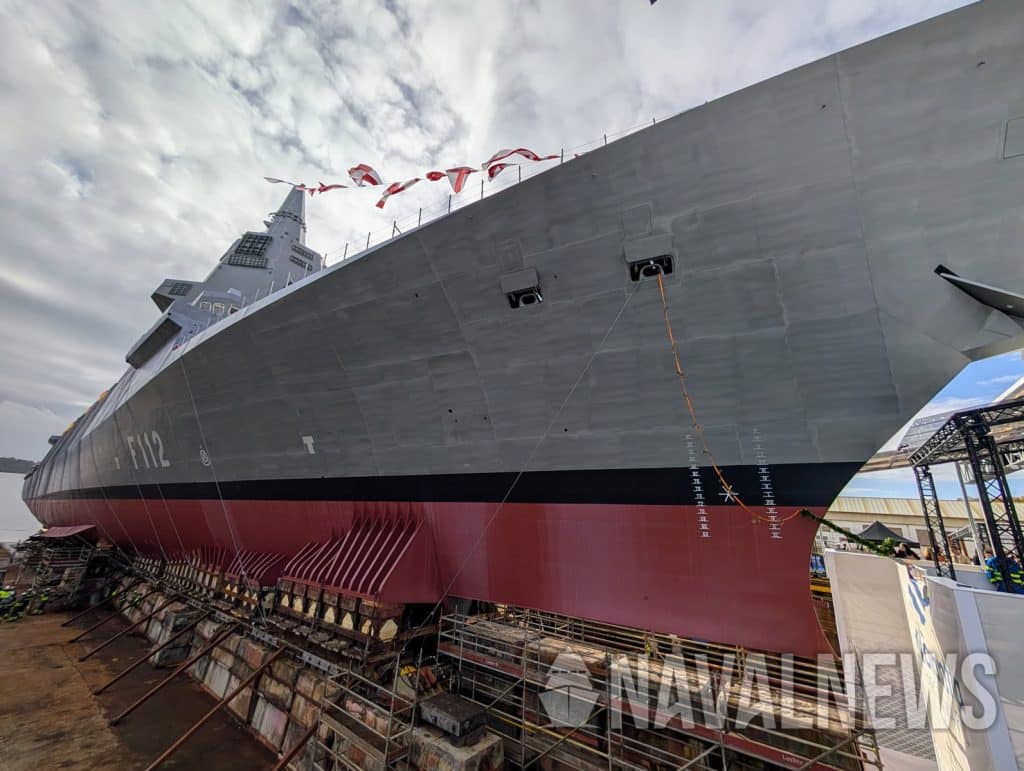
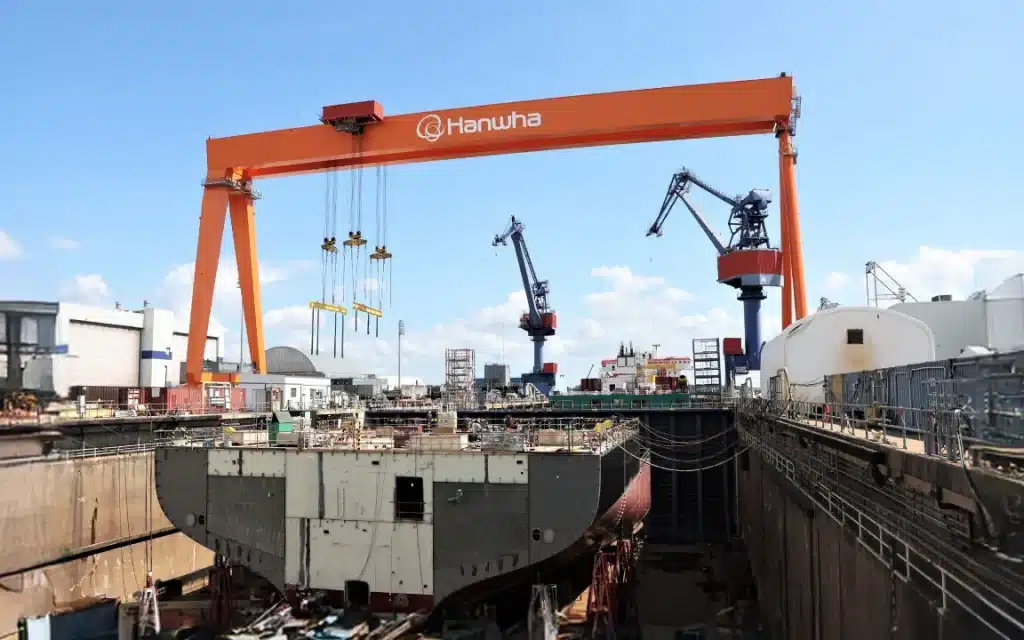
This second frigate in a five-ship series was built on Slipway 3 at the shipyard. Navantia employees and their families, partner companies and other guests attended the moving ceremony, during which the frigate, after being blessed by military chaplain Vicente Hernández Chumillas, slid into the sea to the sound of the Spanish national anthem performed by the Northern Marine Regiment Band.
The F112 frigate, named after Roger de Lauria, admiral of the fleets of the Crown of Aragon and Sicily, and sponsored by his descendant Almudena de Arteaga, was launched four months ahead of the delivery schedule agreed with the Ministry of Defence. As was the case with the F111 frigate, its level of installation and assembly is far higher than usual at this stage of construction.
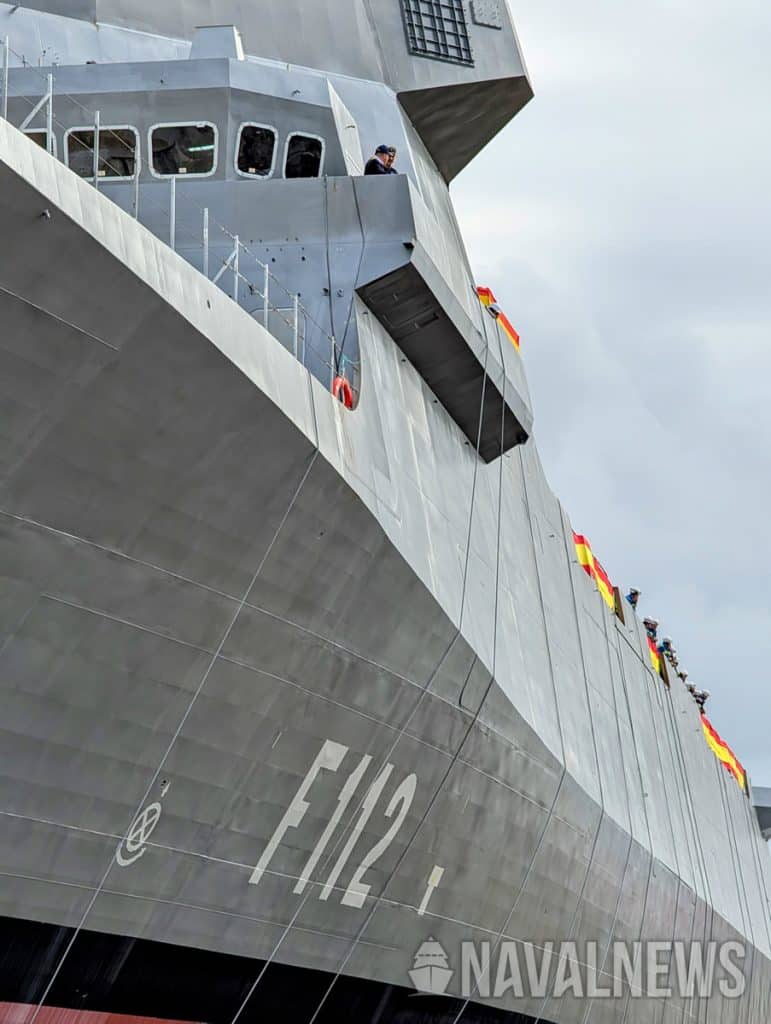
From this point onwards, construction of the vessel will continue alongside the shipyard quay until its delivery in 2029. The next two frigates in the series are already in production in Ferrol: five blocks of the F113 are on the slipway, while initial work on the F114 is under way at the new Digital Block Factory. The F111 frigate, the first vessel in the series, is in the systems installation and start-up phase and is scheduled to begin sea trials in 2027.
Strategic Autonomy and Skilled Employment
The F110 programme strengthens the Spanish Navy’s capabilities and represents a major industrial and technological development for Navantia and its partner companies. It reinforces Spain’s strategic autonomy, supports exports and generates around 9,000 jobs over more than ten years, involving approximately 500 companies across the country.
The Secretary of State for Defence, Amparo Valcarce, expressed her appreciation for Ferrol and its naval and industrial community, “deeply linked to the history of the Spanish Navy”, as well as for the shipyard workers, auxiliary and supplier companies, and all the professionals involved in building these frigates. She also thanked the Spanish Navy and the Directorate-General for Armament and Materiel for their joint work in implementing the F110 programme, which “incorporates the development of industrial capabilities and a technological transformation of particular importance to Spanish shipbuilding”.
“As her sponsor, this bond of blood and tradition will unite me in spirit with the frigate, her steel, and her crew on each and every one of her future voyages, accompanying her in thought and in heart wherever duty may take her. May the sea be kind to you, may your missions strenghthen peace and security for all, and may you always be a safe haven for the men and women who will make up your crew”, wished the ship’s sponsor, Almudena de Arteaga.
“The frigate ‘Roger de Lauria’, like its predecessor ‘Bonifaz’, faithfully reflects Spain’s commitment to innovation and technological sovereignty. Each vessel in this series creates highly skilled jobs, promotes R&D&I and strengthens the Spanish naval industry’s international leadership,” noted Antonio Piñeiro, Chief of Staff of the Spanish Navy (AJEMA).
For his part, Navantia Chairman Ricardo Domínguez thanked all employees for their dedication and effort in delivering the programme, which, “with technological developments such as the digital twin, the Integrated Services System and the suite of latest-generation sensors, antennas and radars, is a symbol of Spanish innovation. We are convinced that it will become an international success, just as the F100 frigates did in their day”.
“This achievement reflects sound planning, exemplary institutional cooperation with the Ministry of Defence and the Spanish Navy and, above all, the tireless work of those who make it possible. This frigate bears the mark of thousands of people whose daily work turns our commitments into reality,” said Eduardo Dobarro, Director of the Frigates and Intervention Vessels Business, in his welcoming remarks.
A Capability for Today and Tomorrow
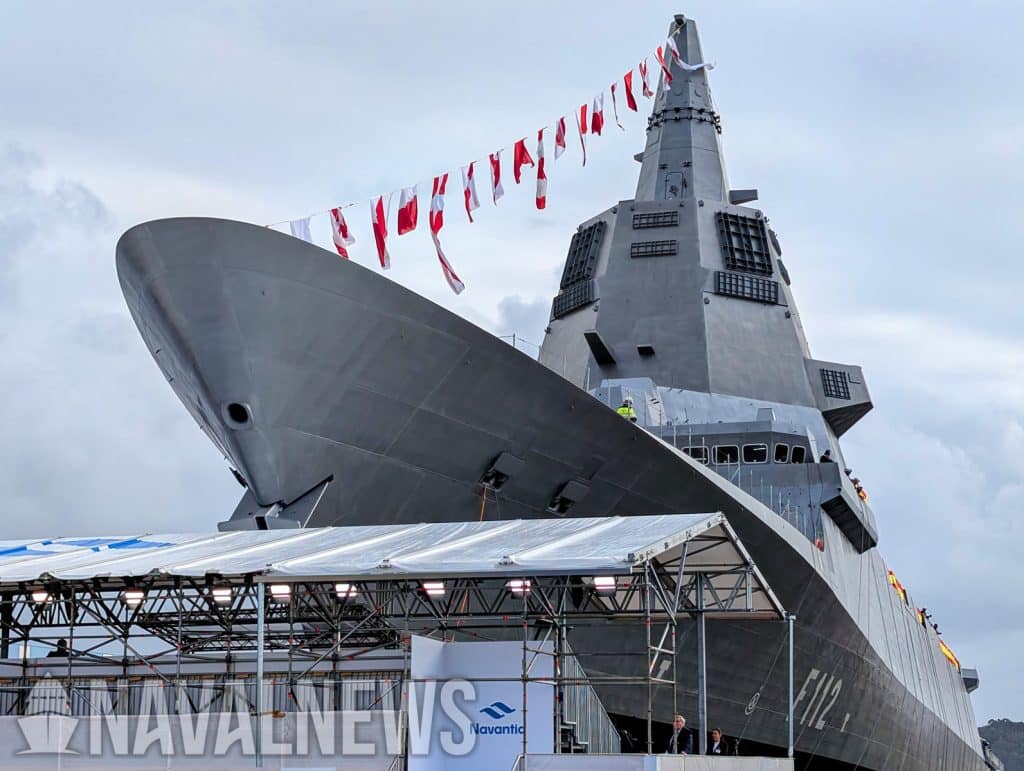
The F110 programme comprises the construction of five escort vessels. Designed to respond to a range of operational scenarios, the frigates will be prepared to counter air, surface and submarine threats, operate alongside other units and support civilian authorities in maritime security missions.
Through this programme, Navantia will provide the Spanish Navy with a new generation of highly digitalised and automated vessels. The digital twin and the sensor network of the Integrated Services System will enable data-driven decision-making, enhance safety, reduce crew requirements and incorporate unmanned vehicles into operations.
One of the platform’s main strengths is its potential for growth and evolution. Its design facilitates the incorporation of additional capabilities without requiring a fundamental redesign of the platform.
Spanish industry plays a leading role in the programme: 65% of the content comes from domestic suppliers, combined with technologies provided by international partners. The F110 is also one of Navantia’s strategic projects.
Solutions developed by the company include the core of the SCOMBA combat system and the Integrated Platform Control System (SICP), as well as engines and other systems manufactured at Navantia’s facilities in the Bay of Cádiz and Cartagena.
One of the principal technological innovations is the digital twin, a virtual replica of the vessel developed by Navantia together with the Spanish Navy and the Directorate-General for Armament and Materiel. Powered by sensors and technologies such as the Internet of Things, cloud computing and machine learning, this tool will support data-driven management and help optimise the frigate’s operation and maintenance.
The digital twin is complemented by the Integrated Services System (SSI), a neural network connected to sensors installed in the vessel’s lighting infrastructure. Developed jointly with the Spanish Navy and the University of Vigo, the system helps consolidate an innovation ecosystem around the F110 programme.
The frigate will be equipped with SCOMBA, the combat system developed by Navantia’s Systems business unit. Considered the vessel’s “brain”, it will process information from sensors, radars and weapons in real time. It is complemented by the integrated mast, installed in the superstructure, which optimises use of the electromagnetic spectrum and reduces the vessel’s radar signature.
– End –