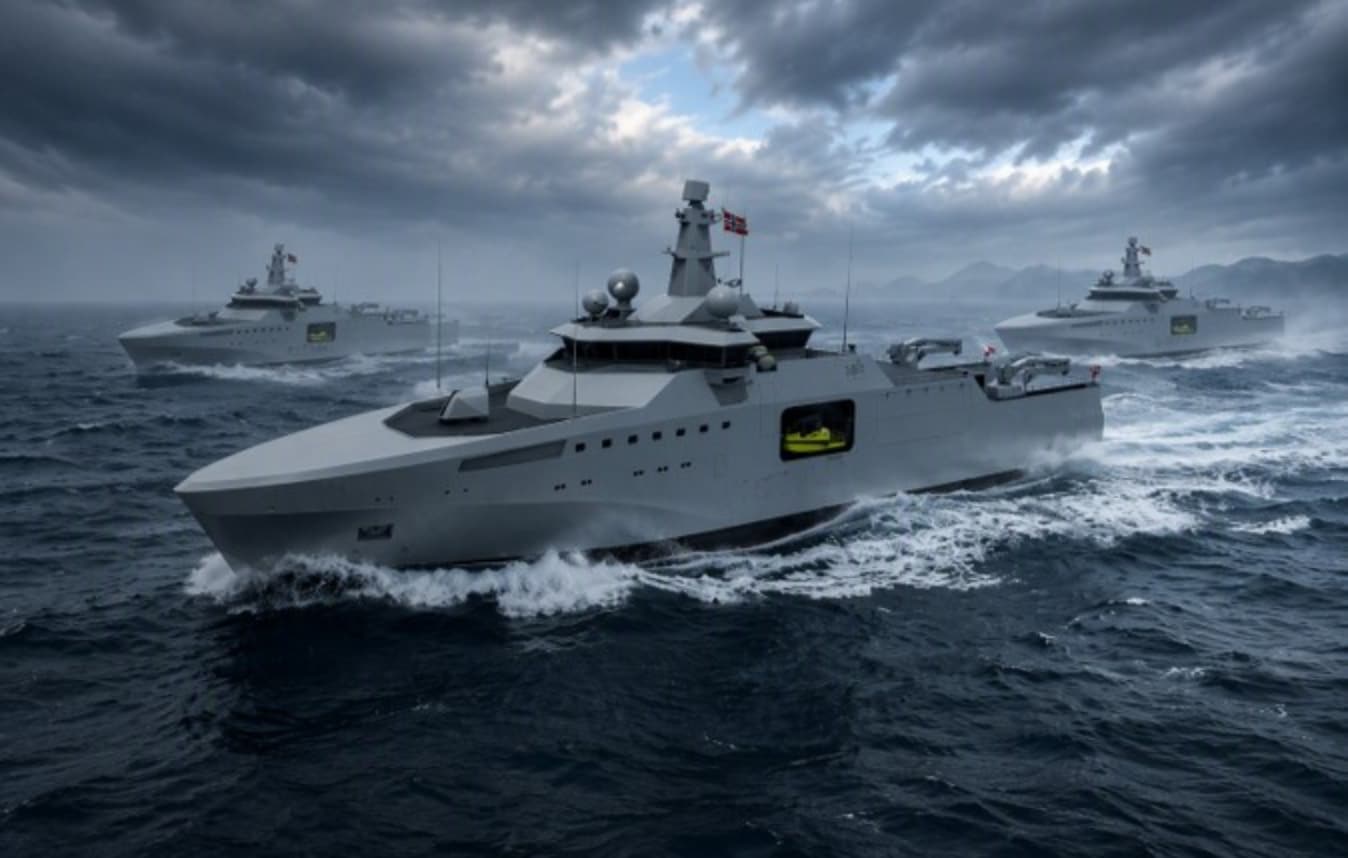
The Royal Navy will acquire three Offshore Support Vessels—with options for three more—to operate uncrewed mine countermeasure systems and support NATO’s northern flank as part of the wider UK-Norway Type 26 partnership.
UK MoD press release
UK and European security will be bolstered by a new Royal Navy commitment to acquire three new mine-hunting motherships.
Under the deal, the UK will buy three new ships which will act as motherships for uncrewed mine-hunting systems, boosting UK security by making the detection and disposal of sea mines safer, quicker and more effective. An additional £90m investment was announced in the Defence Investment Plan for the acquisition.
The agreement between the UK and Norway supports the export of Type 26 Global Combat Ships to Norway, the UK’s biggest-ever warship export deal by value, which supports 4,000 jobs across the UK supply chain, including more than 2,000 at BAE Systems’ Glasgow shipyards.
Defence Secretary Wes Streeting and his Norwegian counterpart, Tore O. Sandvik, confirmed the UK’s commitment to the programme at the Atlantic Future Forum in Oslo today, further strengthening the two nations’ shared commitment to tackling security threats.
The vessels are a key step in building the Hybrid Navy and a major step in the UK’s defence partnership with Norway. They will be central to the Royal Navy’s modernisation of its mine-hunting capability, keeping sailors further from danger and supporting anti-submarine warfare capabilities on NATO’s northern flank.
Defence Secretary Wes Streeting MP said:
This deal strengthens our ability to protect freedom of navigation, which is critical to our security and our economy.
By using the biggest sustained increase in defence spending since the Cold War to put the latest modern technology in the hands of our Sailors, we are helping to keep them safe and ensuring they have the tools to protect our shores.
This agreement also shows how the UK-Norway partnership helps both our countries, and our allies, meet the challenges of a more dangerous world.
The Royal Navy will receive the first of three Offshore Support Vessels in 2031, known as “standardised vessels” in Norway, with an option to buy an additional three vessels.
The threat from Sea Mines has been brought into sharp focus following Iran’s illegal mining of the International Strait of Hormuz, which has caused major disruption to the global trade in energy. Acquisition of the globally deployable Offshore Support Vessels will ensure the UK stays at the forefront of safeguarding international freedom of navigation from fast-evolving mine threats.
The agreement will see the UK join Norway’s major naval programme, the P1118 Standardised Vessel Programme.
Norwegian Defence Minister Tore O. Sandvik said:
The United Kingdom’s procurement of Norwegian Standardised Vessels will further strengthen our strategic partnership, rooted in the Lunna House agreement. Operating similar platforms will enhance our navy-to-navy cooperation and further improve our ability to operate seamlessly together, protecting and safeguarding NATO’s northern flank.
Alongside Norway’s £10 billion procurement of Type 26 frigates in December 2025, the new agreement means the two navies will operate similar ships, strengthening interoperability between two close NATO allies.
The Offshore Support Vessels will be delivered through the government-to-government Maritime Capability Partnership Framework (MCPF) between the UK and Norway.
The announcement was made at Atlantic Future Forum in Oslo, where further maritime and industrial commitments were also highlighted. These include Arondite’s £35 million investment over five years to open an Oslo office and grow its European operations.
Atlantic Net, a £90 million contract awarded by the Ministry of Defence and Royal Navy to Ocean Infinity, will combine autonomous and uncrewed systems with advanced sensors to detect and monitor underwater threats across the North Atlantic. Discussions among allied navies were held through the International Sea Power Conference (ISPC), convened by the First Sea Lord, General Sir Gwyn Jenkins.