Commissioning of the Coast Guard’s newest fast response cutter (FRC) took place Aug. 11, 2025, in Kodiak, Alasla. Coast Guard Cutter Earl Cunningham is the second of three FRCs to be stationed in Kodiak, and the 59th FRC to be commissioned.
USCG press release
The U.S. Coast Guard commissioned its newest cutter, Coast Guard Cutter Earl Cunningham (WPC 1159), for official entry into its service fleet during a ceremony held in Kodiak, Monday.
The ceremony was presided over by Adm. Kevin Lunday, acting commandant of the Coast Guard. Members of the Cunningham family were also in attendance, including the cutter’s sponsor, Penney Helmer, granddaughter of Earl Cunningham.
“Commissioning the USCGC Earl Cunningham strengthens our ability to control, secure, and defend Alaska’s U.S. border and maritime approaches, protect resources vital to our economic prosperity, and respond to crises throughout the Aleutian Islands,” said Adm. Lunday. “This crew will honor the heroic legacy and selfless devotion to duty exemplified by Petty Officer Cunningham in the years ahead.”
The Earl Cunningham is the 59th Fast Response Cutter (FRC) in the service and the second of three FRCs scheduled to be homeported at Coast Guard Base Kodiak. The crew of the Cunningham primarily serves in and around the Aleutian Islands, Bering Sea, Gulf of Alaska, and North Pacific Ocean. The cutter is designed for missions such as search and rescue; fishery patrols; drug and migrant interdiction; national defense; and ports, waterways, and coastal security.
The namesake for the cutter, Petty Officer 2nd Class Earl Cunningham, enlisted in the Coast Guard in 1928 and was appointed as a surfman. On February 8, 1936, Cunningham volunteered to rescue two ice fishermen that were trapped in the water on Lake Michigan. Cunningham was able to reach them on his skiff and pulled them out of the water. However, adverse weather conditions prevented them from returning to shore.
Three days later, one of the fishermen walked 9 miles across the ice onto shore to safety. The other died trying to make it across the ice with him. Cunningham had died and was found on February 12, frozen in place, still manning the oars of the rescue skiff.
For his ultimate sacrifice, Cunningham was awarded the Gold Life Saving Metal posthumously. He was survived by his wife Helen and three sons.
Cunningham had also previously served in the Army and fought in the trenches of France during World War I, leaving the service as a corporal to eventually join the Coast Guard.
The Coast Guard has ordered a series of new FRCs to replace the 1980s-era Island-class 110-foot patrol boats. Supported by historic investments made possible through President Trump’s One Big Beautiful Bill Act, the legislation provides nearly $25 billion – the largest single funding commitment in Coast Guard history – including $1 billion dollars for additional FRCs.
The FRCs feature advanced command, control, communications, computers, intelligence, surveillance and reconnaissance equipment, and over-the-horizon cutter boat deployment, enhancing the Coast Guard’s operations to control, secure, and defend the U.S. border and maritime approaches. These new assets and capabilities continue the Coast Guard’s modernization through Force Design 2028, an initiative introduced by Secretary of Homeland Security Kristi Noem to transform the Coast Guard into a more agile, capable and responsive fighting force.
The commissioning ceremony is a traditional milestone in the life of a cutter that marks its entry into active service and represents the cutter’s readiness to conduct Coast Guard operations.
-End-
About Sentinel-class Fast Response Cutter
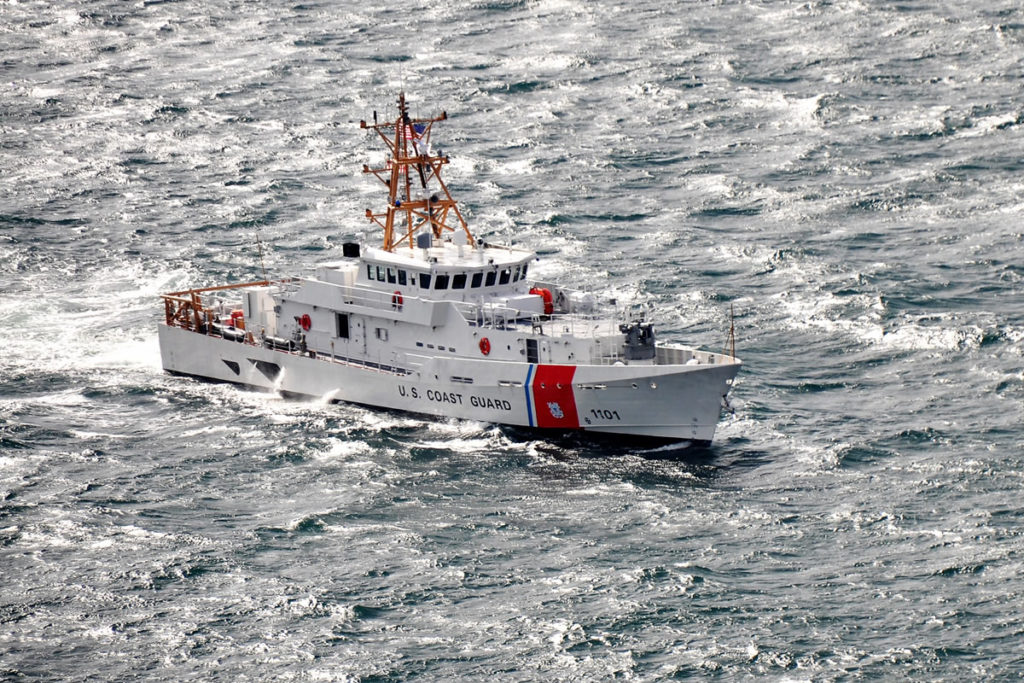
FRCs have a maximum speed of over 28 knots, a range of 2,500 nautical miles and an endurance of five days. The ships are designed for multiple missions, including drug and migrant interdiction; ports, waterways and coastal security; fishery patrols; search and rescue; and national defense. They feature advanced command, control, communications, computers, intelligence, surveillance and reconnaissance equipment; over-the-horizon cutter boat deployment to reach vessels of interest; and improved habitability and seakeeping.
The FRC are built by the Louisiana-based firm Bollinger Shipyards, using a design from the Netherlands-based Damen Group, with the Sentinel design based on the company’s Damen Stan 4708 patrol vessel.
USCG Sentinel-class FRC features
- Enhanced response time with a minimum top speed of 28 knots
- Ability to conduct missions on moderate seas up to transit speed for eight hours in all directions
- Ability to survive on very rough seas up to loiter speed for eight hours in all directions
- Armed with a stabilized 25-mm machine gun mount and four crew-served .50-caliber machine guns
- Fully interoperable command and control systems with Coast Guard existing and future assets and with the departments of Homeland Security and Defense

USCG Sentinel-class FRC characteristics
- Number Planned: 60
- Length: 154 feet
- Beam: 25 feet
- Draft: 9 feet 6 inches
- Displacement: 353 long tons
- Maximum Speed: 28+ knots
- Range: 2,500 nautical miles
- Endurance: Five days
- Crew: 24