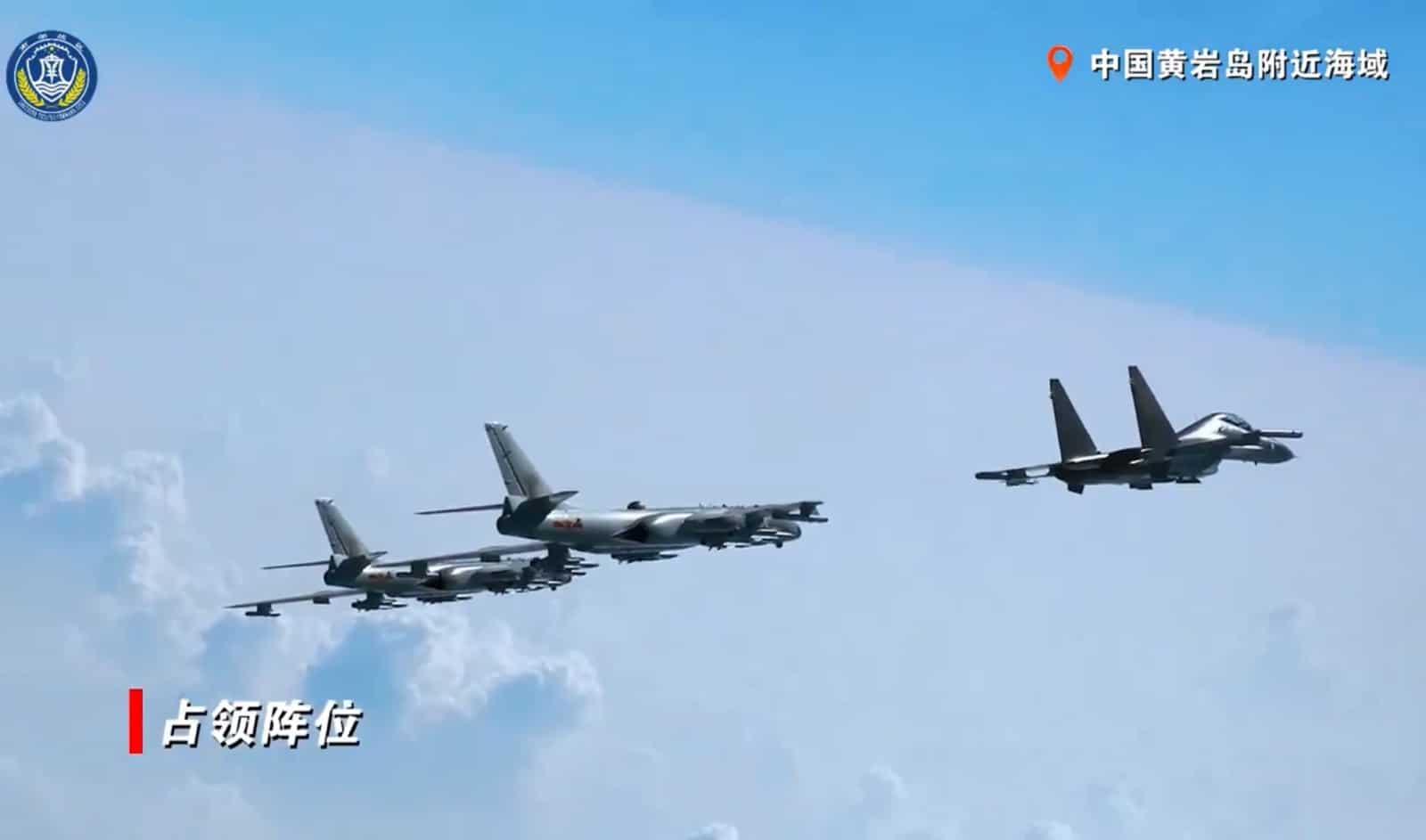
MANILA, Philippines — A pair of heavily-armed Chinese anti-ship bombers and their fighter escort flew over Scarborough Shoal in a combat exercise meant to deter Manila amid the largest Philippine military exercise in years.
The People’s Liberation Army’s Southern Theater Command (PLA STC) claimed that its forces conducted a combat readiness patrol at the disputed South China Sea maritime feature on Thursday. Beijing’s military command for the region stated that these patrols “serve as an effective countermeasure to cope with all sorts of rights-violation and provocative acts.” The deployment invovled two Type 054A frigates – the Bayanner (551) and Tongliao (554), the Type 056A corvette Hanzhoug (648) and J-16 fighters during the drill. One of the J-16s appeared to be equipped with a single YJ-91 cruise missile, a Chinese derivative of the Russian KH-31 that comes in anti-ship and anti-radiation variants.
While H-6 bomber patrols are a common sight over Scarborough Shoal, their increased payload of YJ-12 supersonic missiles come amid the largest U.S.-Philippine Balikatan exercise to date. With 17,000 participants, this year’s Balikatan has seen an increased focus on maritime strike activities against conventional adversaries and the maiden participation of full-fledged Japanese combat forces. A large multi-national maritime exercise also occurred off Northern Luzon, which consisted of 11 vessels from the Philippines, U.S., Japan, Australia and Canada. The flotilla was shadowed by at least four Chinese warships during their exercises, including a Type 815-class spy ship.
In recent years, the annual series of military drills have shifted toward the defense of Manila’s northernmost territories near Taiwan – a shift that China has noted. Prior to the start of Balikatan, a Chinese state media opinion editorial highlighted that the Philippines allowed foreign powers such as the U.S. and Japan to establish “military footholds that are located dangerously close to China’s Taiwan island and Chinese reefs and islands in the South China Sea.”
PLAN Carrier and Surface Action Group Bracket Luzon Amid Balikatan

Beijing’s increased presence during this year’s Balikatan includes the deployment of numerous warships and surveillance vessels. The carrier strike group (CSG) Liaoning (16) has been operating in the South China Sea since the onset of the U.S.-Philippine-led drills. China’s first aircraft carrier transited the Taiwan Strait before its ongoing operations.
While China fields a large network of artificial island bases equipped with ports and airfields within a short distance of the metropolitan Philippines, Beijing occasionally stages its growing carrier force in increasingly complex exercises in the South China Sea. In 2024, the PLA Navy (PLAN) conducted its first-ever dual CSG drills in the waters.
The PLA STC also highlighted the combat drills of a surface action group staged to the east of Luzon a few days after the beginning of Balikatan.Led by the 10,000-ton Type 055-class guided-missile destroyer Zunyi (107), the formation held live-fire exercises in a location that would threaten U.S. and Philippine forces attempting to reinforce Manila in the event of a conflict. Eastern Luzon’s bays and ports have received increased attention from Washington and Manila as alternative routes for American forces and resupply into the Southeast Asian country during recent exercises.
Traditional points of disembarkation of Subic and Manila Bays would be held under threat in a potential conflict involving the U.S.-Philippine alliance and China due to the PLA STC’s large arsenal of missiles, strike aircraft and warships. Since the early 2020s, American and Philippine planners have examined the use of more austere locations in the Southeast Asian archipelago’s east and south.