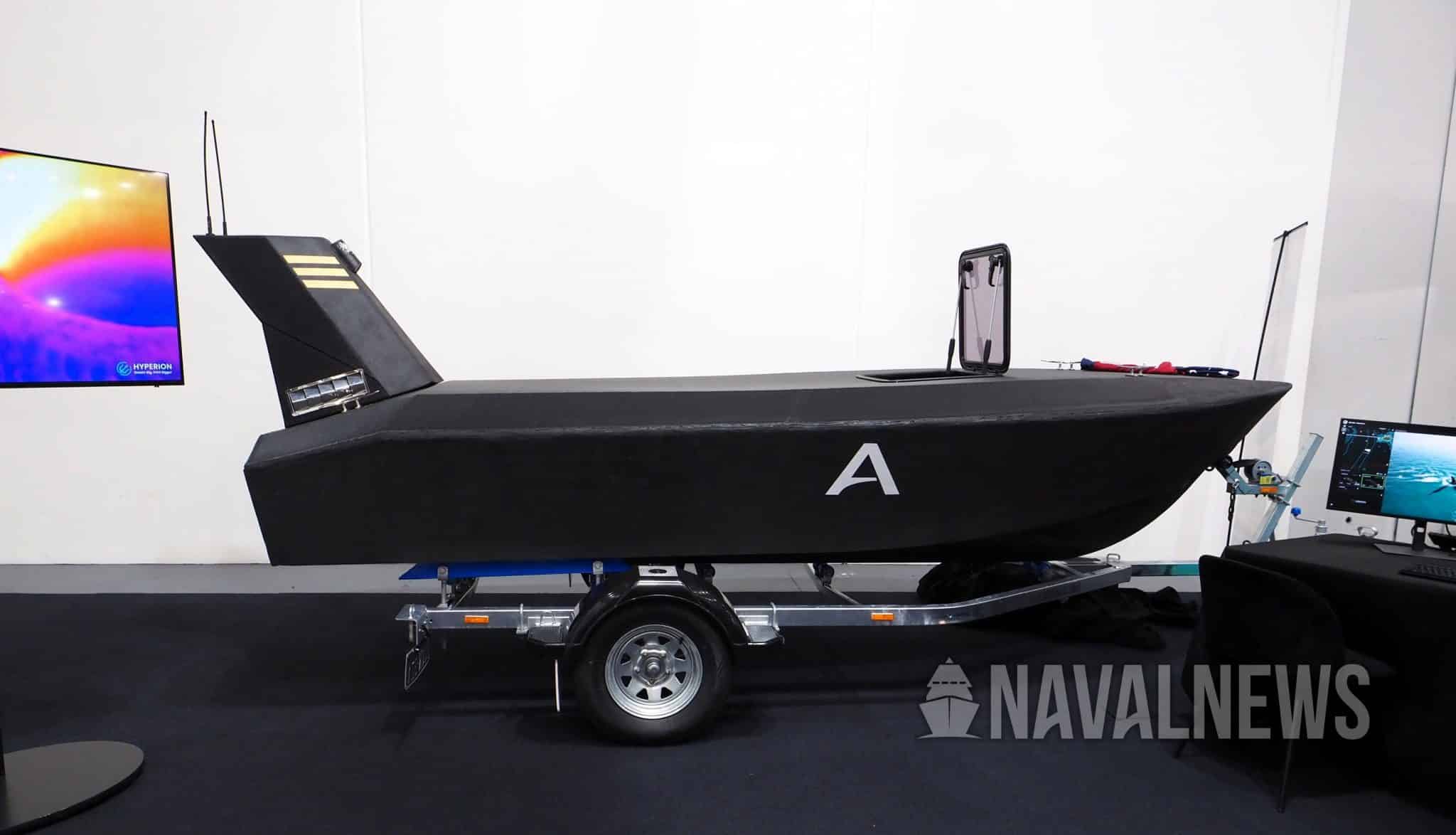
Australian company Hyperion Systems has revealed a compact uncrewed surface drone dubbed the Astra 460, featuring a 3D-printed hull at this week’s Indian Ocean Defence and Security Conference (IODS) 2026 in Perth, Western Australia. Hyperion specialises in additive manufacturing, also called 3D printing, in conjunction with portable robotics for civilian and military applications.
In this context the WA-based company also displayed its “Titan Cell” containerised 3D printing solution which Hyperion dubs “factory-in-a-box” due to its small infrastructure footprint and transportability.
Astra 460 USV
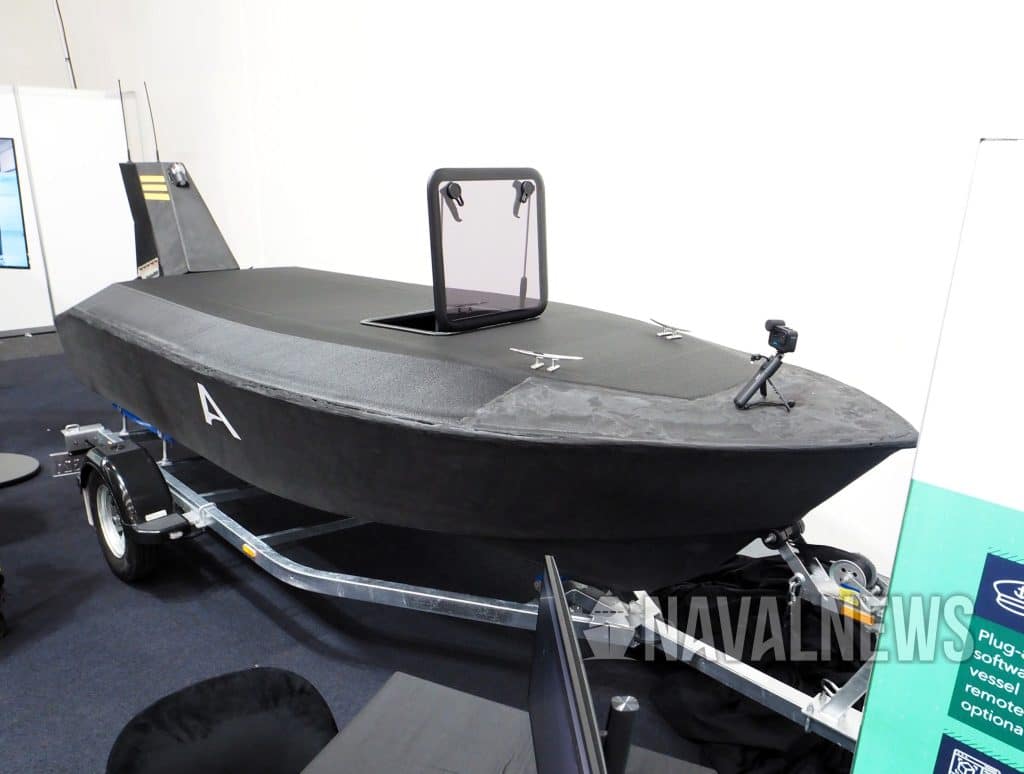
The Astra 460 USV is a compact uncrewed surface vessel with a length of 4,60 m, a beam of 1,67 m and a draft of 0.3 m. The 3D printed hull consists of high-density polyethilene (HDPE) assembled in large format additive manufacturing (LFAM). Notable traits of HDPE for nautical environments are its anti-fouling qualities and high impact resistance.
Astra 460 supports propulsion through an internally mounted waterjet or alternatively an outboard engine. Performance specifications are a top speed of 40 knots and a cruise speed between 20 and 30 knots. The USV has a range of approximately 100 nautical miles. Hyperion does not specify payloads, outlining a partner-led approach based on customer requirements.
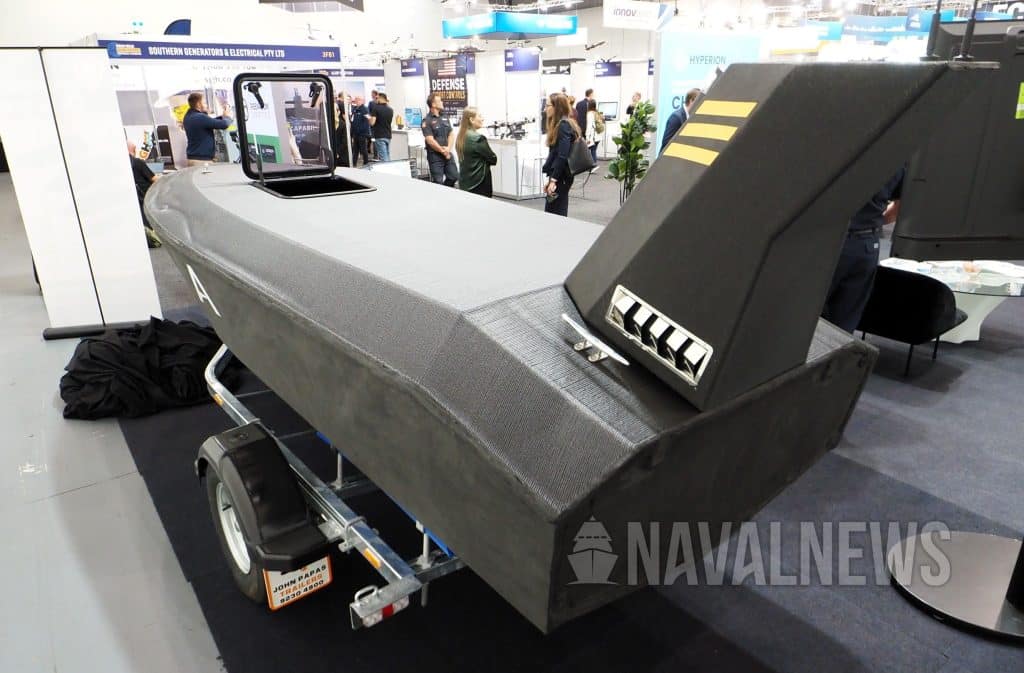
The designer for the vessel is WA-based marine architect company Versatile Marine. Hyperion-associated Astra Marine promotes the Astra 460 as part of its “Blackfin” family of autonomous vessels. The product range also also includes larger adaptions such as the Astra 840 at a length of 8,40 m.
Greenroom Robotics provides autonomy stack GAMA for USV operation
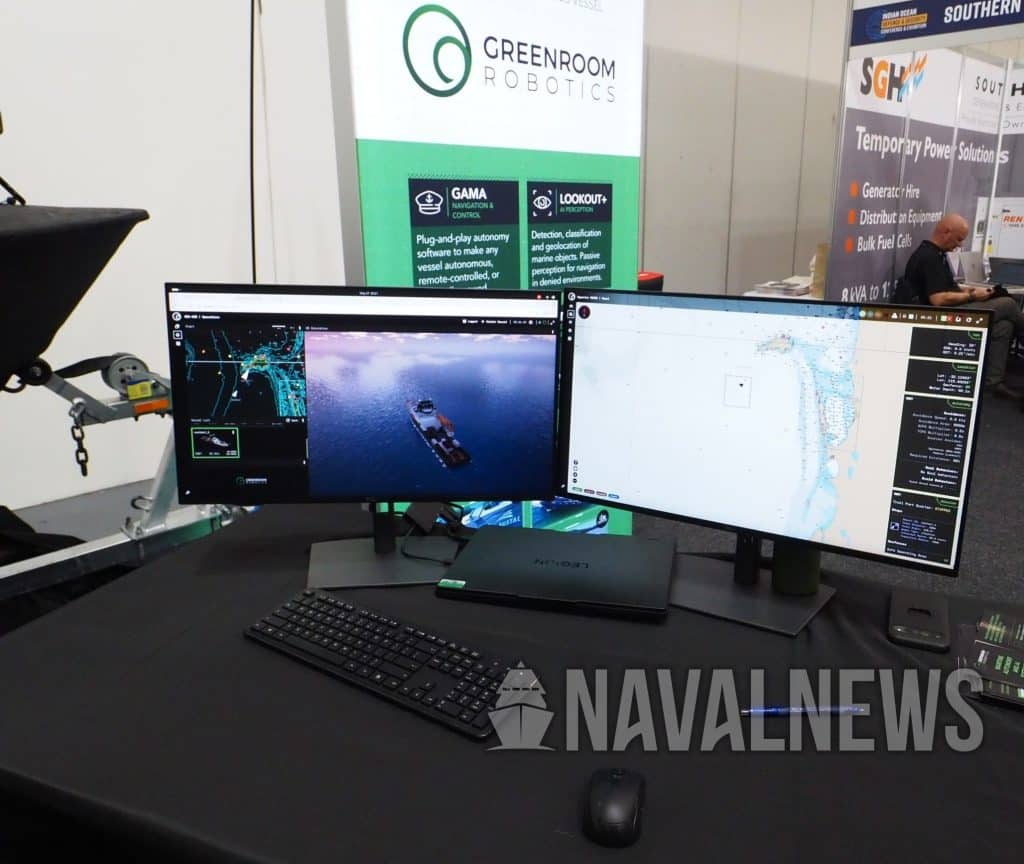
The provider for the autonomy stack managing the Astra 460 USV is Australian software developer Greenroom Robotics. The company contributes its GAMA software stack for remote-controlled and fully autonomous operations. Naval News has previously reported on GAMA in the context of Greenroom Robotics’ collaboration with Austal Australia. The two companies had integrated GAMA on the AROS Platform Controller for command and control of autonomous surface vessels.
The Hyperion-press release details that an undisclosed European navy will evaluate an initial prototype for an 8 metre-variant of the Astra USV at a maritime exercise later this year. Meanwhile, the company will commence their own sea trials of the Astra 460 before the end of May.
TitanCell “Factory-in-a-box”
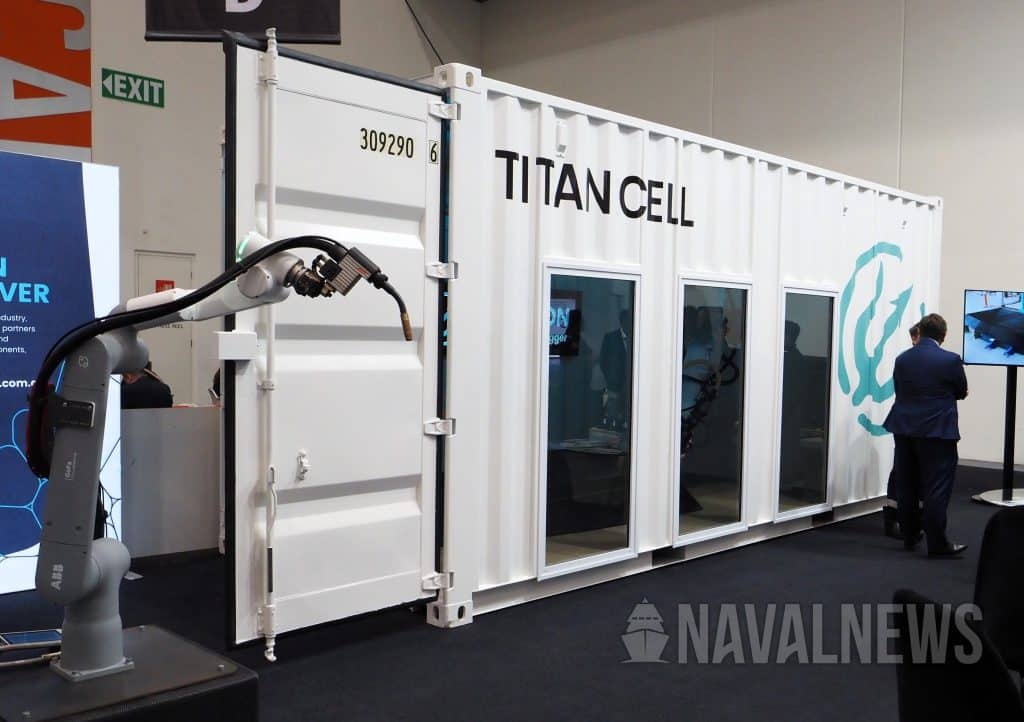
In line with its credentials as a specialist for additive manufacturing Hyperion Systems combined the presentation of the Astra 460 with the display of the TitanCell portable 3D printing facility. As Hyperion CEO Joshua Wigley detailed in conversation with Naval News, TitanCell is a showcase for the decentralised approach the company takes to manufacturing. TitanCell appeared at IODS 2026 in a 20 foot ISO container. This setup can print products measuring 4 metres in length, and 2 metres each in width and height. The company presently readies a 40 foot ISO container-solution capable of printing parts or complete hulls up to 10 metres. TitanCell is also able to initiate a print outside the container, slightly extending the length of the finished product.
A single machine such as integrated into TitanCell can produce two Astra 460 USV hulls per week. According to the press release, Hyperion presently provisions for the production of ten units per month. However, as Wigley explains, existing production capacity may already provide in excess of 40 hulls per month. This volume accounts for five machines presently available for manufacturing. Ultimately, according to Wigley Hyperion can scale to more than 100 units per month, if such demand exists. The complete process of printing and fitting out a single Astra 460 takes approximately seven days.
Additive manufacturing in austere locations touted for naval & defence requirements
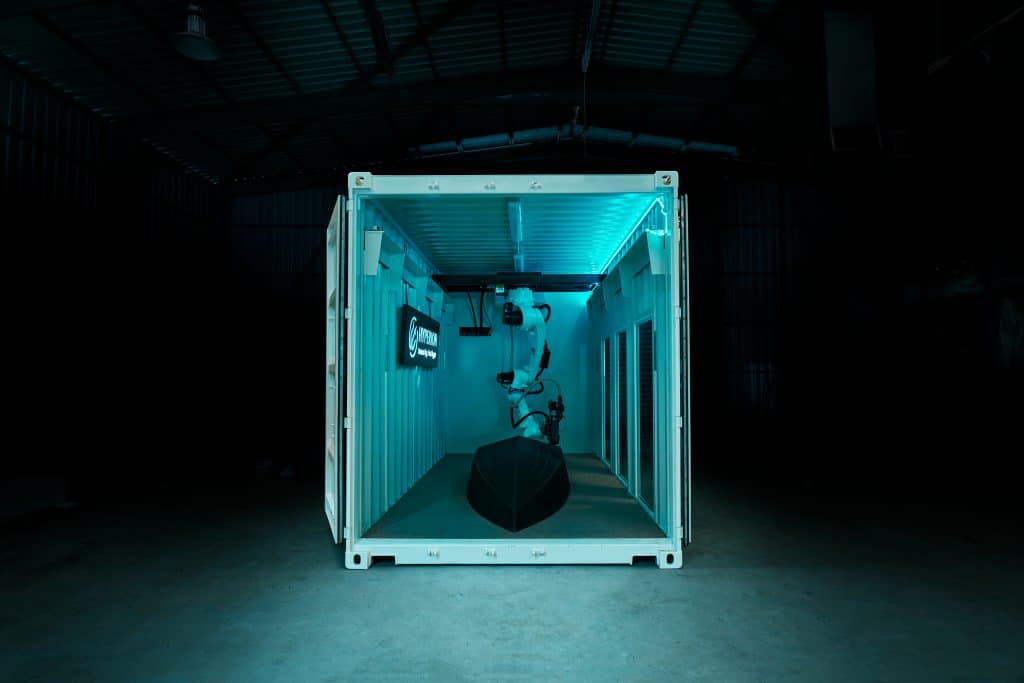
Infrastructure requirements for TitanCell cater to austere environments. For the required three phase power-supply a TitanCell can pair with an additional 10 foot-container accommodating a battery and solar system. Such a configuration may offer a complete off grid-solution. Thanks to the ISO container footprint and flexible interface for power TitanCell could see integration for military use onboard ships. In this regard the Hyperion proposal benefits from an increasing number of naval vessels including warships designed from the outset for flexible accommodation of ISO container-sized modular payloads. The design also allows land-based operation via any truck capable of accommodating the prerequisite 20 or 40 foot-container.
The container displayed at IODS 2026 will see further use after the event within a remote Australian community for the conversion of plastics into furniture, boats and pontoons. This deployment also considers a promotional purpose outlining the benefits of robotics and additive manufacturing in wider parts of Australian society.