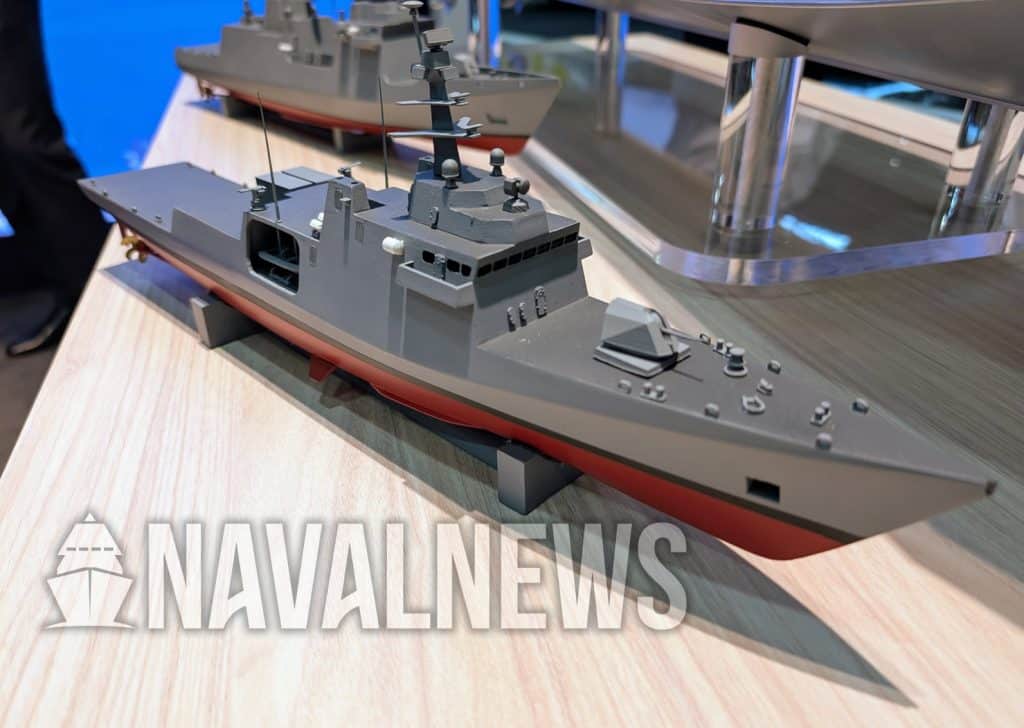
Australian Henderson-based shipbuilder Austal has presented the Vantage-family of large optionally crewed surface vessels (LOSV) at Indopacific 2025 in Sydney this week.
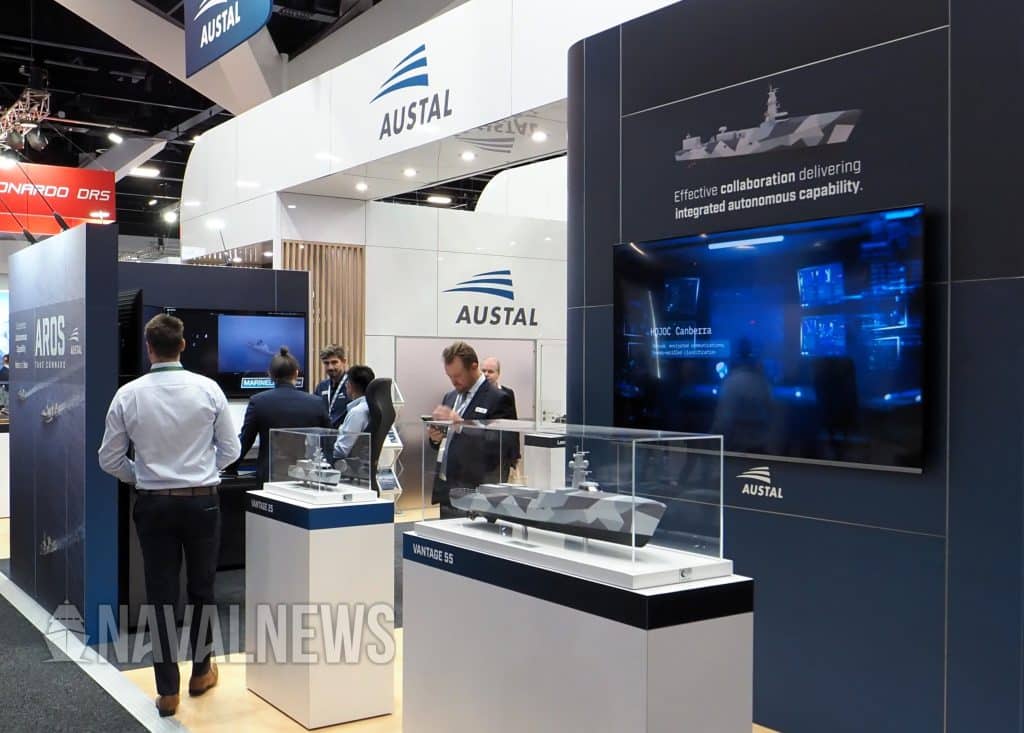
Additionally, the compay also showcased their AROS (for Autonomous and Remotely Operated Ships) Platform Controller-suite. The product intends to provide a standardised control interface for uncrewed and optionally crewed surface vessels.
The Vantage family of surface drones
At Indo Pacific 2025 Austal displayed two models for the Vantage-range of multirole surface drones. The Vantage 25 and Vantage 55 according to Austal represent “two points on a spectrum”, with exact specifications depending on customer requirements.
Both designs feature a monohull configuration with a small bridge for optional crewed operations, and a payload bay covering approximately two thirds of the hull. The layout approximates the design of offshore supply vessels, similar to a variety of efforts on USVs, including in the United States. The Vantage 55 would have an overall length of 55 metres, and include diesel electric propulsion. The smaller Vantage 25, at a respective length of 25 metres, features a more conventional diesel propulsion. Both designs are capable of a 25 knot top speed and a 12 knot cruise speed. The range is 6,000 nautical miles at 12 knots.
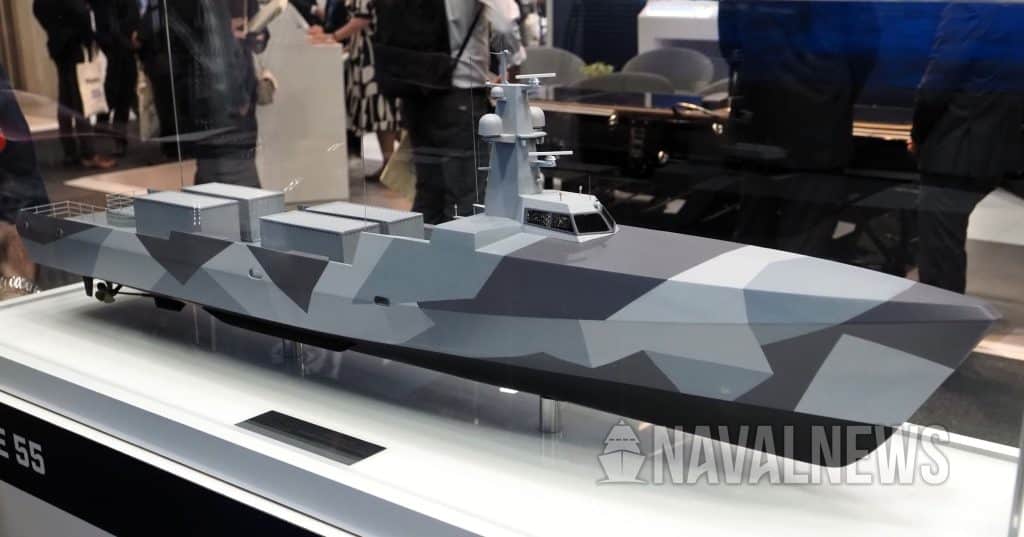
Austal in discussion with Naval News underscored the trans-oceanic nature of the vessels. The Vantage family intends to escort crewed surface combatants, performing missions ranging from ASW over minelaying to anti-surface and strike missions. The drones would carry payloads in modular containers within the large storage bay aft. The larger Vantage 55 also includes a stern launch bay that could fit RHIBs, small drones, mines, or notionally see adaption for towed payloads.

Austal emphasises the concept-stage of the presentation, with further development depending on adequate interest, including by the Royal Australian Navy.
AROS Drone Command & Control Platform
Austal Australia also presented what the company dubs the AROS Platform Controller at the Indo Pacific Maritime Exhibition. The presentation included a full-scale solo operator console showcasing the functionality of the networked system.
The overall AROS suite consists of the platform controller itself, the navigational autonomy system GAMA, developed by New South Wales-based Greenroom Robotics, and MARINELINK Prime. MARINELINK Prime enables remote diagnostics and engineering functions for AROS-controlled drones. Greenroom Robotic’s GAMA drives the boat or drone in question through the company-developed remote control unit. The design is system agnostic and can provide autonomous operation for crewed vessels or drones up to 100 metres in length.

AROS experienced a notable boost at Indo Pacific 2025 with Austal receiving approval in principle from classification society DNV for its Platform Controller-design. Certification is an important and frequently underappreciated aspect of bringing novel technologies and designs, including drones, to operational maturity.
Operational implications of drone development for naval forces
Naval services worldwide display a persistent ambition to operationalise drones for a variety of applications. Increasingly, the challenge will be to safely operate large number of designs across sea and air spaces.
Operational resilience thanks to enhanced autonomy and sophisticated command and control continues to be a significant challenge in this regard. With AROS and the Vantage-concept Austal Australia appears set to offer an intriguing capability addressing future requirements.