The Royal Navy is navigating one of the most demanding periods in its modern history. The 2025 Strategic Defence Review set a clear direction: a more powerful but, more affordable, hybrid fleet, blending crewed and uncrewed platforms into an integrated, lethal force. At the same time, the threat environment has shifted dramatically. Drone strikes on sovereign territory, asymmetric attacks on commercial shipping, and the return of peer-state submarine competition have moved from theoretical risk to operational reality, often in the space of months, not years.
Sponsored by:

For the Royal Navy and Royal Fleet Auxiliary, that means every platform in the fleet needs to deliver more capability, more reliably, at a sustainable cost. And that starts with sensors.
HENSOLDT UK, offers a portfolio of radar and navigation systems that directly addresses this challenge. From surface combatants and patrol vessels to submarines and shore-based installations, these are proven, in-service capabilities already trusted by the Royal Navy, Royal Fleet Auxiliary and more than 30 other navies worldwide. Every system is supported through life by HENSOLDT UK’s British team delivering real social value and sustaining sovereign industrial capability.

Seeing more: Mk11 SharpEye
For any vessel operating in congested or contested waters, the ability to navigate safely while maintaining a surveillance picture is non-negotiable. But not every platform has the space, weight margins or budget for separate systems to do each job.
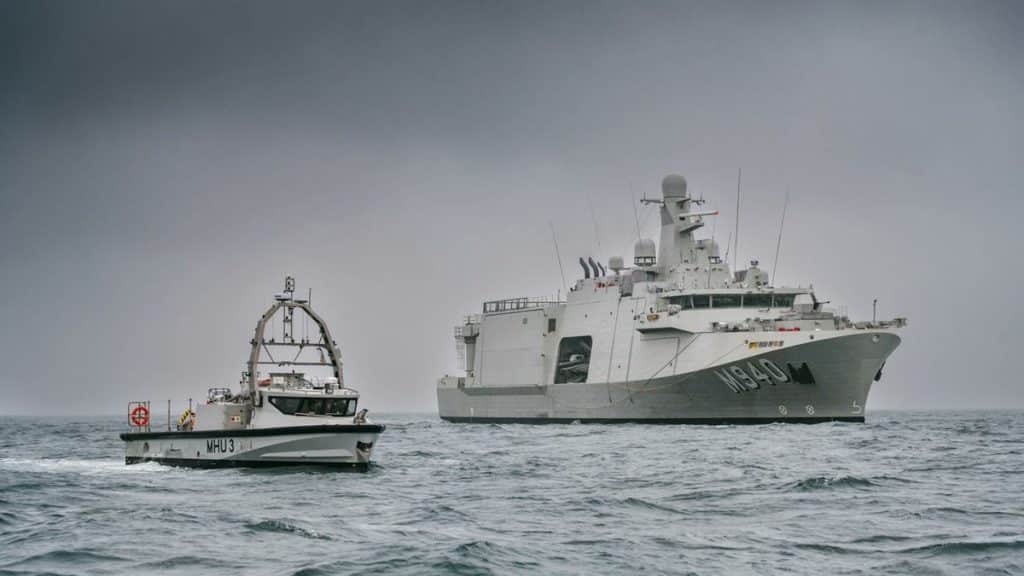
The Kelvin Hughes Mk11 SharpEye solves this by combining navigation and naval surveillance in a single, solid-state radar. Its pulse Doppler technology detects small targets, even in heavy sea clutter and poor visibility, while its Low Probability of Intercept mode keeps the platform discreet in contested environments. This same capability can also support the detection of small aerial targets, augmenting wider onboard drone detection solutions as part of an integrated system. Maintenance-free and built around a carbon-fibre housing with a direct-drive motor, the Mk11 is designed for high reliability and low through-life cost. Available in both X-band and S-band, with an optional IFF antenna integrated into the turning unit, it is already the chosen radar of more than 30 navies and is ideally suited to the offshore patrol vessels, surface combatants and auxiliary frigates that form the backbone of modern fleets.
One bridge, one picture: the Integrated Navigation Bridge System
As vessels accumulate sensors, systems and data feeds over successive upgrades, the bridge can become a crowded environment of disparate screens and interfaces, increasing operator workload at precisely the moments when clarity matters most.
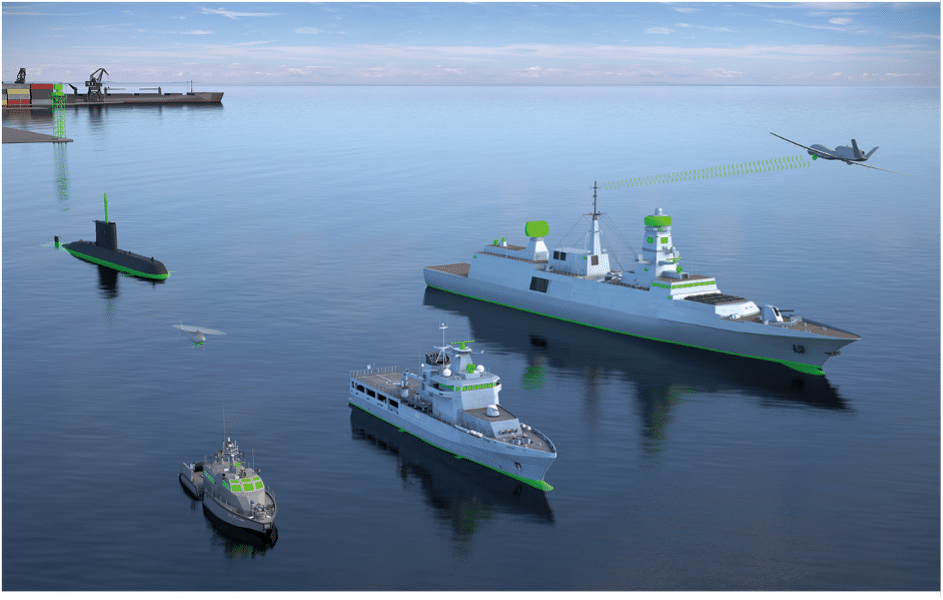
The Kelvin Hughes Integrated Navigation Bridge System (INBS) replaces that complexity with a single, secure, integrated platform. Designed around the navigator, it connects radar, W/ECDIS, conning and sensor feeds through a unified interface that presents critical information on demand with minimal effort. Its patented three-button operation and common track labelling across all displays reduce the risk of miscommunication and allow operators to focus on the task at hand. With a modular architecture and standard interfaces, INBS can be tailored to any vessel and integrates seamlessly with HENSOLDT’s wider product family. It is fully compliant with IMO requirements and NATO ANEP-77, and provides enhanced cyber resilience as standard.

Affordable 3D air surveillance: Quadome
The threat to surface vessels from missiles, fast jets and unmanned aerial systems is no longer confined to high-end warfighting scenarios. Yet many platforms lack the 3D air surveillance capability needed to detect, track and respond to airborne threats.
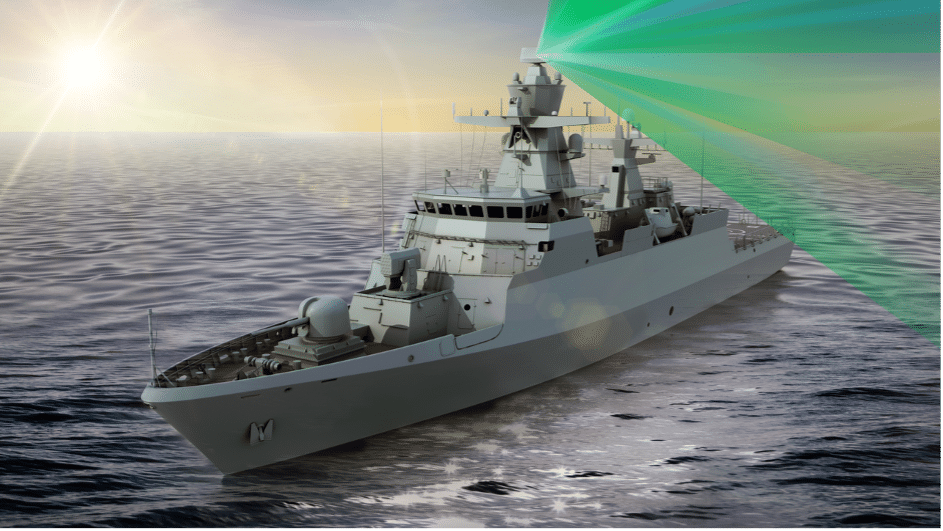
Quadome changes this. A compact, dual-mode naval radar, it delivers medium-range 3D air and surface surveillance with fast-track initiation, self-defence mode, helicopter support and the ability to track over 1,000 targets simultaneously, all at a price-to-performance ratio that makes advanced air surveillance accessible to platforms that would otherwise go without. Its software-defined architecture ensures the system remains relevant as threats evolve, while low mass and lifecycle costs make it a realistic fit for vessels built to a budget. For a fleet being asked to do more with fewer hulls, Quadome offers a step-change in survivability without a step-change in cost.
Stealth meets awareness: SharpEye Submarine Radar
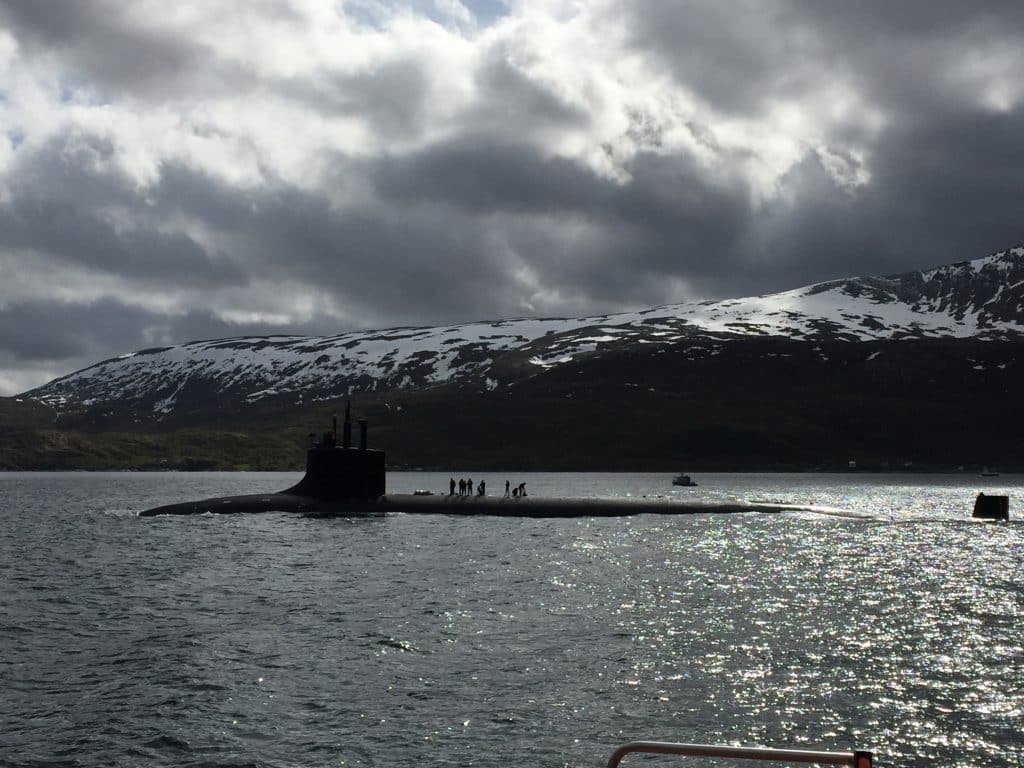
With the UK’s submarine enterprise entering its most significant period of investment in a generation, from the in-service Astute class to the future Dreadnought and SSN-A platforms, the demand for capable, discreet submarine radar has never been higher.
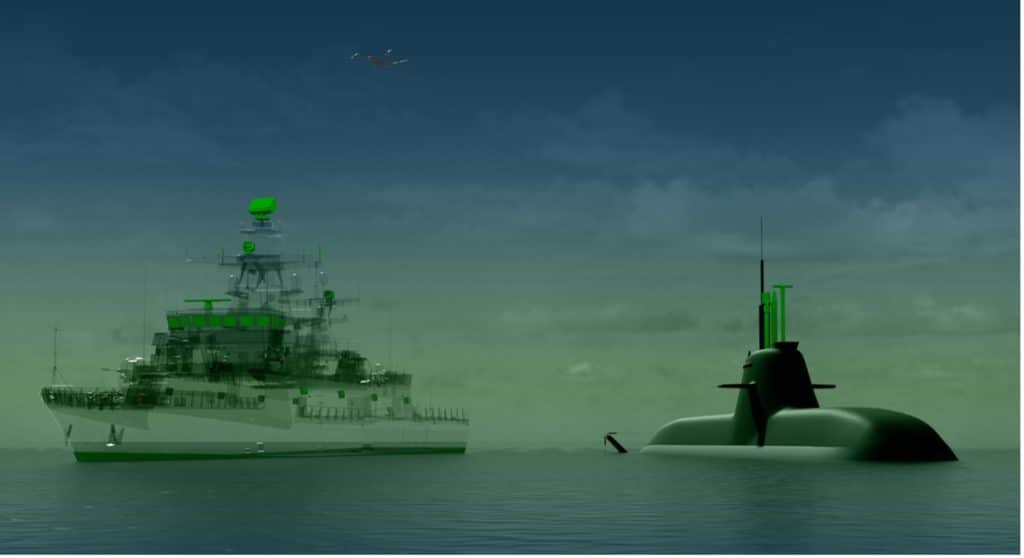
The Kelvin Hughes SharpEye Submarine Radar is designed for the unique operating environment of the submarine: powerful surface detection and navigation from periscope depth, with a Reduced Probability of Intercept signature that minimises the risk of counter-detection. Available in both downmast hull-penetrating and upmast non-hull-penetrating configurations, it automatically detects, tracks and prioritises threats, reducing operator workload and improving response times. Its Doppler technology filters out sea clutter to identify genuine threats, including small, fast-moving surface contacts, even in heavy weather.
Closing the short-range gap: SPEXER 2000
The proliferation of low-cost drones and fast attack craft has created a short-range detection gap that traditional radar systems were never designed to fill. The Royal Navy’s recent calls for rapidly deployable counter-UAS capability reflect just how pressing this challenge has become.
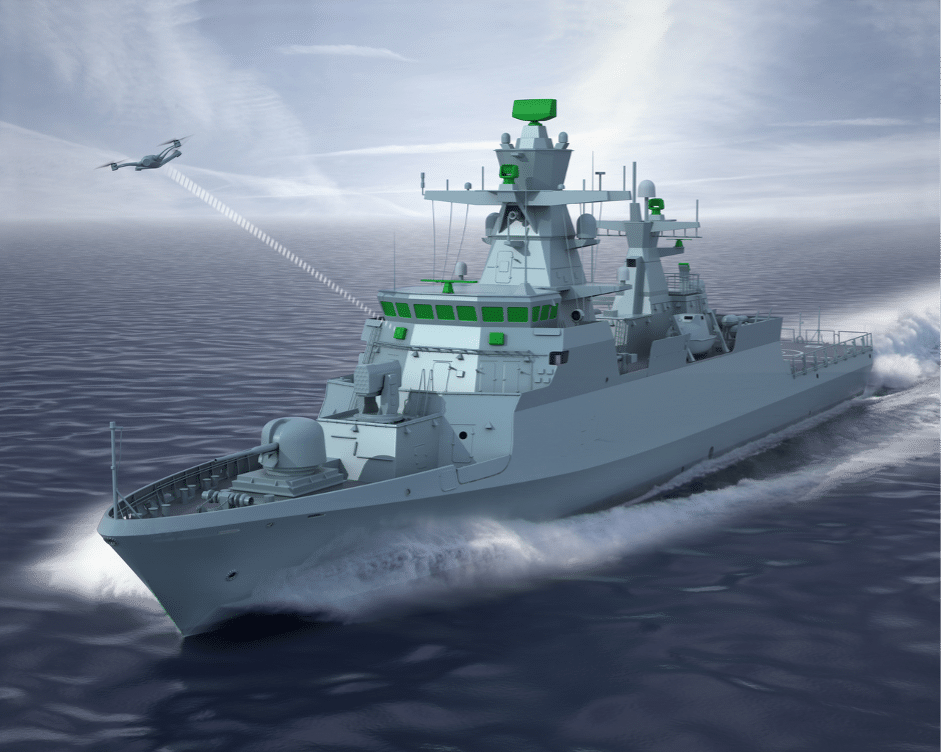
SPEXER 2000 3D is purpose-built to close that gap. Using AESA technology, it detects and classifies small, slow, fast and low-profile targets at short range, from commercial drones and unmanned surface vessels to sea-skimming missiles. It provides the early warning and effector guidance that CUAS and SHORAD missions depend on, whether protecting a warship at sea, a harbour, or critical coastal infrastructure. Compact, military-qualified and requiring no topmast installation, it can be integrated or retrofitted with minimal disruption.
A portfolio supported from the UK, for the UK
What sets HENSOLDT apart is not just the breadth of this portfolio, but the fact that it is supported end-to-end by HENSOLDT UK. From design and integration to training and through-life support, these capabilities are sustained by a British team, contributing directly to the UK’s sovereign defence industrial base and delivering measurable social value.
Visit HENSOLDT at Combined Naval Event 2026, Stand A29.