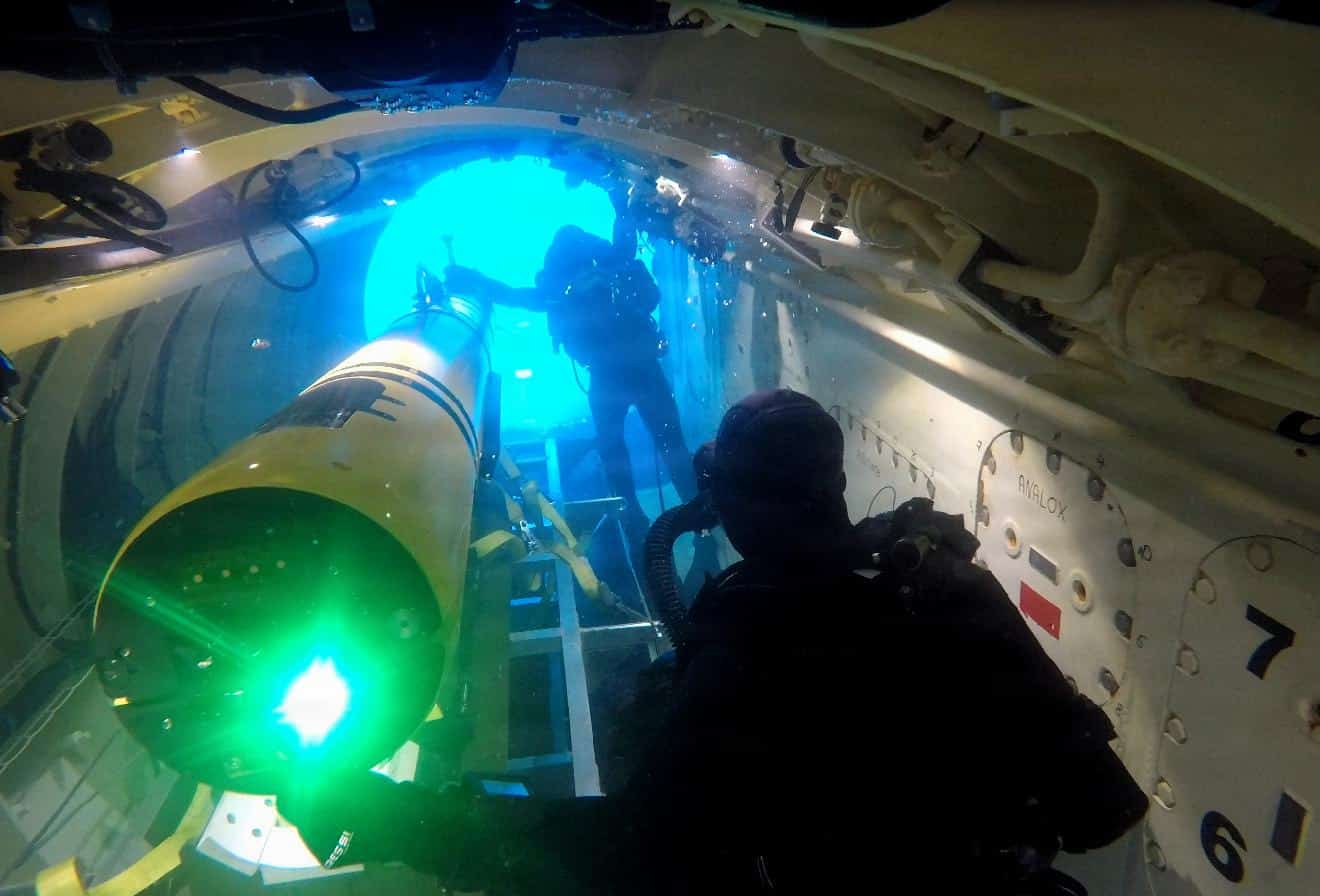
The U.S. Navy’s Pacific-based submarine force is exploring a number of new mission sets for uncrewed undersea vehicles (UUVs) as they rapidly proliferate across the fleet, including new mission sets involving carrier-basing and underway submarine replenishments for contested environments.
The interest comes after large-scale fleet experimentation with uncrewed capabilities at Exercise Rim of the Pacific (RIMPAC) that formally ended earlier this month. RIMPAC featured over 35 experiments with uncrewed systems and emerging technologies, according to USNI News.
“The operational environment in the Pacific continues to evolve with the rapid development of technological advancements in the undersea domain,” Rear Admiral Chris Cavanaugh, commander, Submarine Force, U.S. Pacific Fleet, said in a media statement. “The Pacific Submarine Force is heavily investing in unmanned capabilities to augment our manned submarines and preserve our undersea advantage across the full spectrum of submarine operations.”
Cavanaugh and Rear Admiral Marcos Jasso, commander, Carrier Strike Group (CSG) 9 met after the end of RIMPAC’s at-sea phase to discuss the implementation of UUVs in the fleet. The meeting was “focused on the strategic alignment of subsurface and surface fleet operations,” according to the release.
Both discussed the value of the U.S. Navy’s attack submarine fleet as enablers for carrier operations, and discussed the role of UUVs in carrier operations where the uncrewed systems could serve as extensions of the strike group. When integrated, UUVs could extend strike group organic reconnaissance, strike, minesweeping, and anti-submarine warfare capabilities. They could be deployed by helicopters or by the carrier itself, and could extend as far as defending against torpedoes.

The two also discussed the possibility of using UUVs for underway submarine replenishment from carriers to submarines — a current challenge in the U.S. Navy especially in contested or denied environments. Naval News has previously covered industry proposals to field new submarine tenders for such a role, but it is unlikely those tenders would be capable of replenishing a submarine in contested environments.
“[T]he leaders explored the logistical advantages of unmanned systems, specifically focusing on utilizing UUVs to transfer critical parts and components between submarines and aircraft carriers,” the release said. “By leveraging these intra-group/intra-ship transfers, submarines would be able to deploy and retrieve unmanned platforms while remaining entirely submerged, ensuring stealth, operational security, and the rapid flow of critical assets without requiring the submarine to surface or return to port.”
Replenishing submarines underway, even with just critical spare parts and materials, could dramatically extend the time a submarine can remain operational during conflict.
When paired with the U.S. Navy’s ‘Revolver’ force-multiplying launcher currently in development for its Virginia-class attack submarine fleet, a submarine could stay in combat for far longer than previously capable. Naval News was first to report on the emerging capability, which aims to multi-pack torpedoes into current 21-inch tubes by leveraging smaller diameter weapons like the Mark 58 Compact Rapid Attack Weapon currently being developed by RTX. The company gave Naval News new details on the CRAW and its relationship to the Revolver program in an exclusive interview in April.
UUV operations across the U.S. Navy are rapidly expanding around the world as the service gets acclimated with systems that are now reaching maturity. Several next-generation systems focused around scalable production and affordability are in development, geared towards new and emerging contractors that have focused heavily on developing solutions for massed uncrewed systems. Global fielding, testing, and evaluation will continue in coming years.