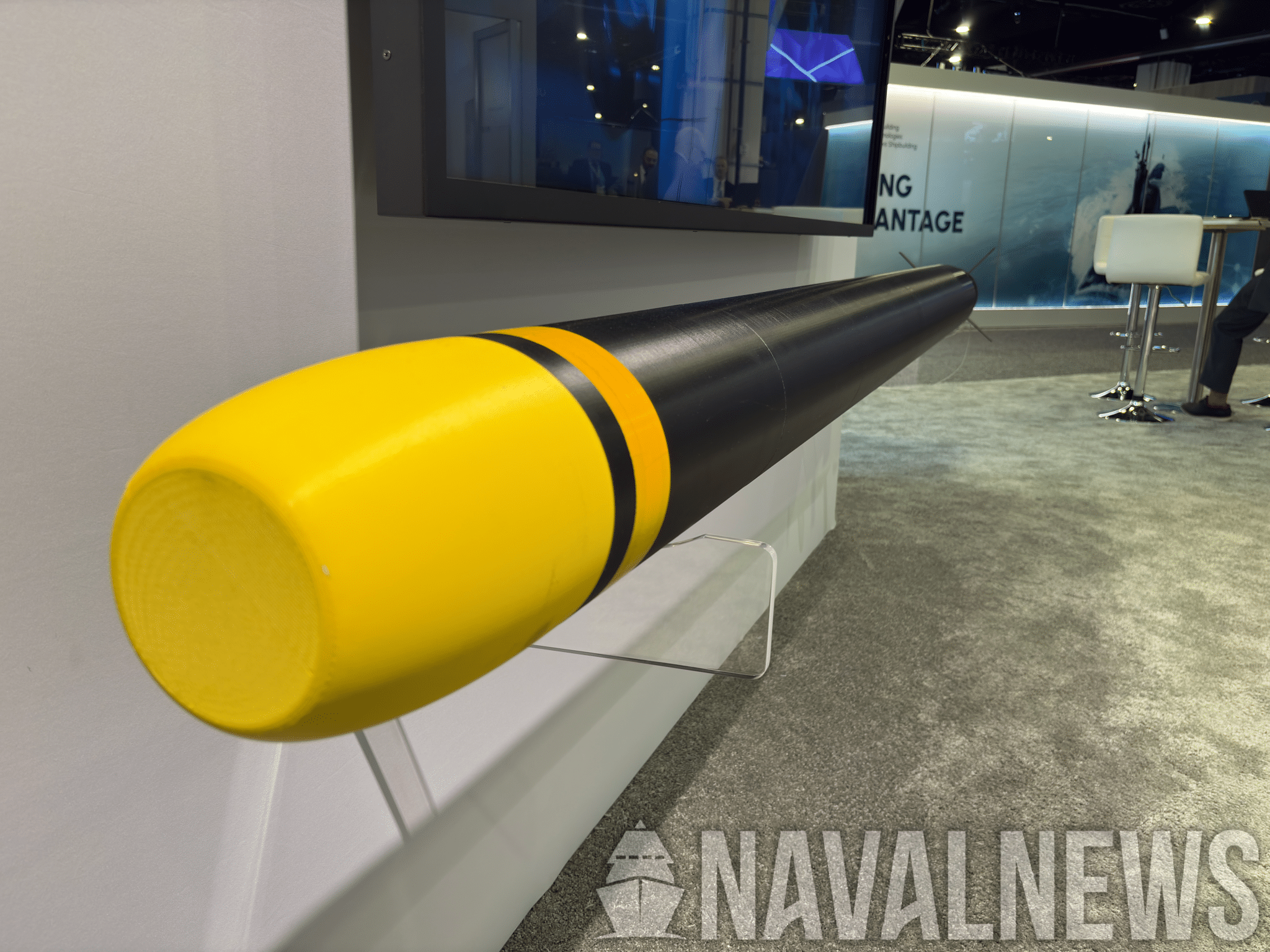
NATIONAL HARBOR, MD — Development of the U.S. Navy’s next-generation submarine weapon is well underway as the fleet turns to a new suite of highly capable, modern attack weapons designed to counter emerging threats in the Indo-Pacific.
Raytheon’s Bill Guarini, Director of Requirements for the Naval Systems and Sustainment Business, sat down with Naval News during the Sea Air Space 2026 Symposium to provide an exclusive update on one of the fleet’s newest submarine-launched torpedo systems, the Mark 58 Compact Rapid Attack Weapon (CRAW).
“The CRAW is a program we’re very proud of here, and so is the Navy,” Guarini told Naval News. “Penn State did a really good job developing the initial development units—Increment 1 of the [CRAW] program—and now Raytheon has won the contract to deliver and test Increment 2.”
Raytheon’s primary responsibility in the handoff from Penn State is establishing the baseline for producibility, manufacturability, and military hardening for operational use, which is ongoing as of this year. As that continues, the Navy is restructuring the program and changing some capabilities and requirements—which Guarini confirmed would not impact Raytheon’s current CRAW Increment 2 effort.
“By the end of this year we’re going to do some in-water testing at a Navy range,” Guarini said. “It really focuses on the forebody of the system… …the processing, the control and the arrays. The key components on whether the Mark 58 CRAW can find its target.”
Some of the Navy’s biggest changes to CRAW, according to Guarini, are in the torpedo afterbody and propulsion system, which recently expanded to electric propulsion—as well as stored chemical propulsion, which Guarini likened to a rocket engine —after an industry day in April.
Various CRAW sub-programs, like the Revolver Innovative Naval Prototype project, are under simultaneous development in the fleet, but Raytheon is not under contract for those efforts. Revolver seeks to multi-pack dozens of CRAW torpedoes into Virginia-class 21-inch torpedo tubes. Naval News was first to cover the project in 2025.
“The Navy has separate efforts to fund a torpedo launch variant, and that will certainly enable the submarine community to increase their number of stowed effectors.”
Bill Guarini, Director of Requirements for the Naval Systems and Sustainment Business at Raytheon
Despite that effort, Raytheon’s contract is geared towards delivering an anti-submarine warfare and hard-kill anti-torpedo variant launched from Virginia-class external countermeasure launchers (ECL). “The ECL launcher, that’s what we’re under contract for,” Guarini told Naval News.

Separate efforts are underway to proliferate CRAW across the U.S. Navy, beyond submarines. Naval News previously reported on Ultra Maritime’s proposal to develop a CRAW launcher for the surface fleet to support a new hard-kill anti-torpedo capability being fielded across the U.S. Navy’s major surface combatants in coming years.
“We will support the Navy as they go forward with [those programs],” Guarini said. “Beyond that, we hear a lot of excitement from other communities as well—something with this form factor, with this capability, is viable for air-launch as well as surface-launch torpedo defense. But those are not funded yet.”
With any effort, Guarini emphasized that Raytheon is prepared to support any eventuality for CRAW, remaining agnostic as the company builds out the Increment 2 capability dedicated to the anti-submarine and torpedo defense mission. “As the Navy funds different launchers and mechanisms, we will certainly shared our date with whoever the Navy selects,” Guarini confirmed.
“Raytheon is absolutely well-positioned. We are on schedule with our development, integration, and test [schedules], and the program office is very satisfied with our progress.”
Bill Guarini, Director of Requirements for the Naval Systems and Sustainment Business at Raytheon
CRAW has a future across the Navy’s aviation, surface, and submarine fleet, with projected uses across all domains of maritime systems as the service funds new programs of record as CRAW matures. “This is the furthest along that any company has been,” Guarini said.