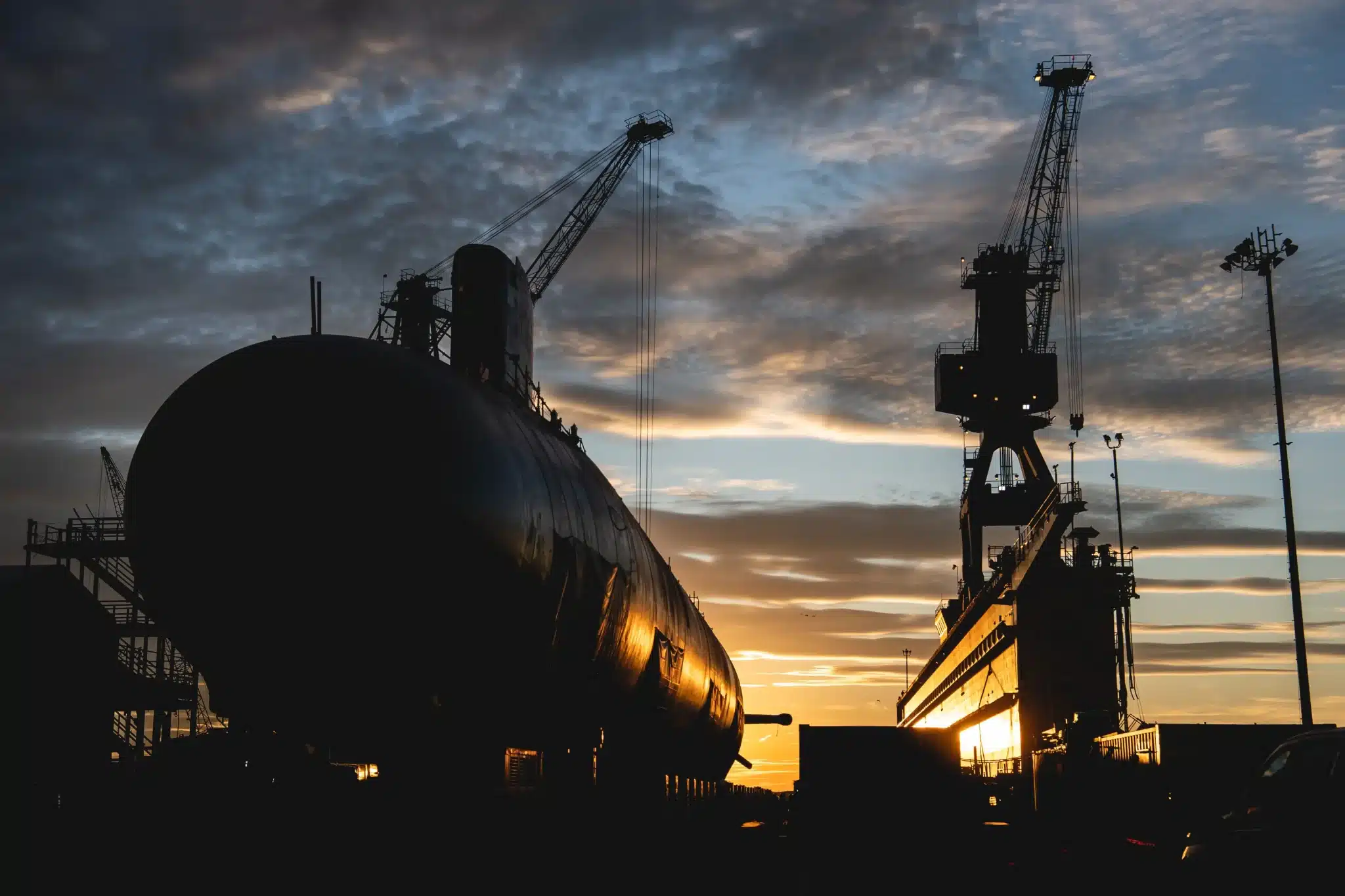
The U.S. Navy published a Sources Sought Notice concerning SSN(X) late in the morning on October 9th, seeking information from industry on manufacturing capabilities for the submarine meant to succeed the vaunted Virginia-class fast attack boats.
The notice represents one of the initial steps of getting a program off of the drawing board and into the manufacturing cycle, preceding the likely service entry date of the new class of submarines by over a decade. The primary purpose of such a notice aims to give the U.S. Navy feedback from industry partners, in this case about which “interested and capable” U.S. shipyards can meet the needs for production and support of SSN(X).
As stipulated in the notice, interested prime shipyards must be capable of completing the advanced manufacturing steps present in the process of producing a submarine, which includes the capabilities for “executing complex manufacturing, complete hull fabrication, modular outfitting, precision systems integration, reactor compartment installation, and post-delivery testing.” The Navy also seeks information on yard availability, workforce skill and availability, and the presence of key elements such as advanced machine tooling, floating dry docks, and a crane system capable of lifting entire submarine compartments into place.
As such, these criteria narrow down the possible manufacturers considerably, leaving practically only two candidates in the shape of General Dynamics Electric Boat with their main yard in Groton, Connecticut, and Huntington Ingalls’ Newport News Shipbuilding with their facilities at Newport News, Virginia. Both of these yards have extensive experience building advanced Nuclear submarines, and both currently produce Virginia-class SSNs, although General Dynamics Electric Boat remains the primary contractor.
SSN(X) and the Future Sub Force

SSN(X) represents a highly critical program that’s still largely in its beginnings, even as funding suffered a roughly $121 million dollar reduction (to ~$315 million) in the presidential budget request for FY 2027. Despite this funding decrease, SSN(X) design work remains ongoing, with a critical transition to efforts dedicated to hammering out the design requirements and then the development of an eventual acquisition strategy expected next year.
SSN(X)’s potential improvements possibly include a higher transit speed reducing the time it takes to arrive on station, integration with multiple Unmanned Underwater Vehicles (UUV), new propulsion technology, and a new slate of weapons and sensors (with full coverage by Naval News here). SSN(X)’s production date remains scheduled for sometime in ~2034 and a service entry date targeted in the early to mid 2040s.
Until SSN(X)
Until then, the U.S. submarine force will continue to receive Virginia-class submarines, likely totaling over 60 Virginias of various blocks in service once the class stops construction sometime in the 2040s. Blocks V, VI, and VII constitute the remaining submarines of the class due for construction, with work already underway on the first Block VI. Block V and VI will utilize the Virginia Payload Module, an additional compartment that allows carriage of an additional 28 Tomahawk sized munitions or 12 Conventional Prompt Strike missiles.
Block VII’s design features remain murky, but U.S. budget documentation alludes to the Block VII boats being used as a pseudo-transitional group to receive, refine, and improve some of the technologies destined for SSN(X). Both submarine types might receive the same sonar upgrades currently being developed. These sonar upgrades may take the form of a new Bow Conformal Array with better active transmission capability as well as an improved Wide Aperture Array or a new Low Frequency Hull Array.