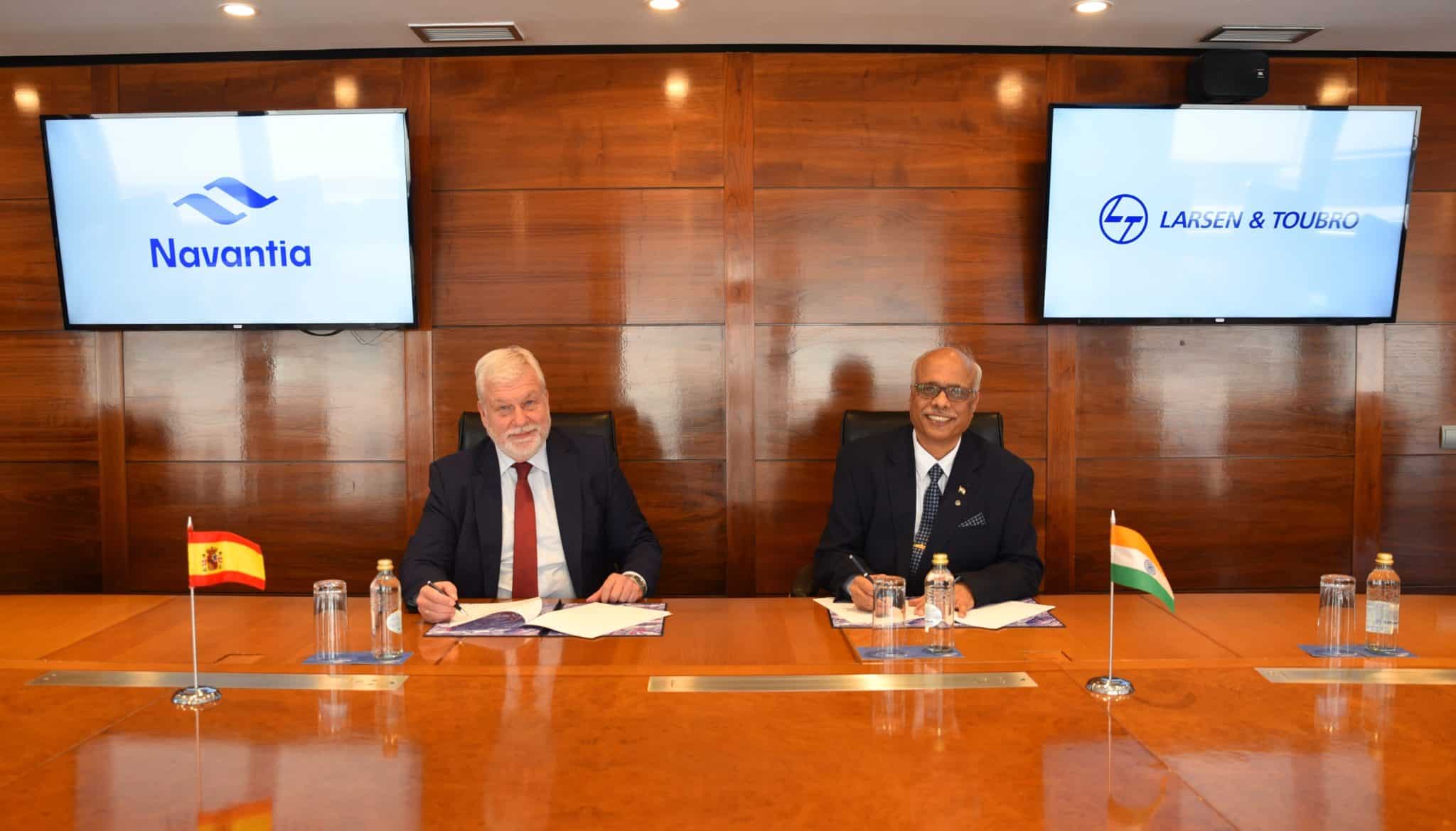
Navantia and L&T (Larsen and Toubro) have reached a strategic agreement to collaborate on the upcoming program for four amphibious assault ships for the Indian Navy (known as the LPD program in India).
Navantia press release
The alliance, formalized in Madrid with the signing of a memorandum of understanding (MoU), establishes a framework for long-term collaboration between the two companies.
The collaboration will combine L&T‘s engineering excellence with Navantia’s experience in the design and construction of surface ships and submarines, and will contribute to the development of local capabilities for the construction of large ships, while strengthening the proposal by drawing on Navantia’s extensive experience.
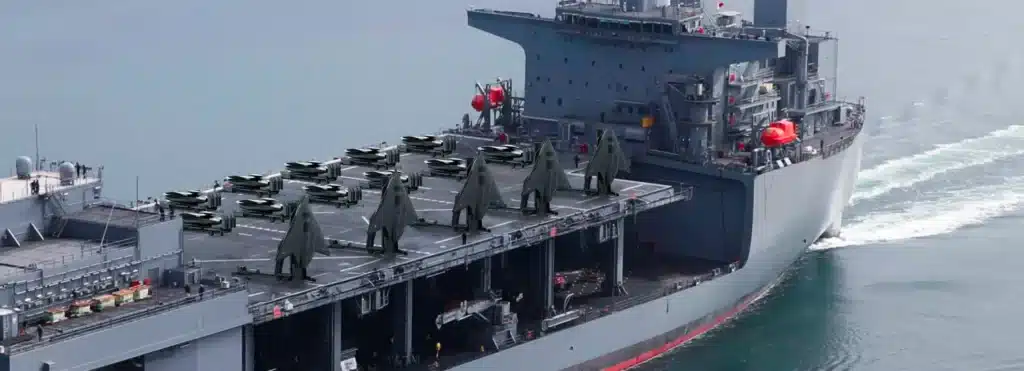
Navantia has extensive experience in LHD vessels, such as the Juan Carlos I for the Spanish Navy and the Canberra and Adelaide for the Royal Australian Navy. These proven designs will serve as the basis for the LPD program, which envisions the acquisition of four platforms to support India’s amphibious operations, humanitarian assistance and disaster relief missions, as well as other naval operations.
Regarding the agreement, Arun Ramchandani, Senior Vice President and Head of Precision Engineering & Systems at L&T, stated: “This collaboration brings together L&T’s extensive shipbuilding capabilities and the expertise of Navantia, one of the world’s leading designers and builders of military vessels, to support the Indian Navy’s highly complex LPD program. We are confident that this partnership will contribute to strengthening India’s maritime capabilities and advancing the country’s autonomy in constructing such complex and essential platforms.”
Gonzalo Mateo-Guerrero, Director of Operations and Business at Navantia, stated: “We are proud to strengthen our alliance with L&T. Navantia’s experience in the design and development of strategic naval platforms, combined with L&T’s engineering excellence and track record in shipbuilding, will allow us to develop the best technical solutions for the Indian Navy. Navantia also remains committed to providing long-term support to L&T, the Indian Navy, and all other stakeholders throughout the LPD lifecycle.”
– End –
Naval News comments
The Indian Navy’s requirement for LPDs is long known, with a Request for Information (RFI) released in 2021. The RFI had called for four 200 meter long vessels with electric propulsion and the capacity to embark 900 troops. The RFI also required the LPDs to have a through deck capable of accommodating helicopters of various types, making the ship an LHD rather than an LPD. The ship was also required to be heavily armed, with 16 anti-ship missiles and 32 VLSRSAM missiles.
Landing Platform Docks are envisaged to embark, transport and land elements of a force for expeditionary operations using specialised surface craft and integral helicopters. It will act as a mother ship for unmanned capability and to support the operation of futuristic unmanned vehicles, platforms and equipment. The length of the LPD would be about 220m +/-5% and displacement of 29000T +/- 10%. The ships will be equipped with Multi -Function Radars, Air Surveillance Radars, associated weapons/ equipment, Combat Management System, Integrated Full Electric Propulsion, Landing Craft Mechanised (LCMs) and Landing Craft Vehicle Personnel (LCVPs), Unmanned Vehicles viz., Remotely Operated Vessels, Unmanned Aerial Vehicles, Gliders.
The Indian Navy’s amphibious capability has declined notably in recent years due to decommissioning of old LSTs. The sole ex-US Navy LPD INS Jalashwa is the flagship amphibious vessel. Just four LSTs remain in service: 3 Shardul class vessels commissioned in the late 2000s and INS Gharial of the Magar class, which was commissioned in 1997. These are supported by eight Mk IV LCUs commissioned in the late 2010s and several smaller vessels. INS Jalashwa has notably been used for trials of India’s Gaganyaan human space flight mission by ISRO.