Shield AI announced that the U.S. Navy has executed a $150 million modification to its existing Other Transaction (OT) agreement with the company to advance X-BAT, an AI-piloted, vertical takeoff and landing (VTOL) fighter aircraft.
Shield AI press release
The Navy executed the $150 million modification with funding from the Office of the Under Secretary of War for Acquisition and Sustainment through its Defense Exportability Features program. Shield AI will invest $150 million of its own capital in X-BAT alongside the government funding.
In August, the Department of the Navy’s Portfolio Acquisition Executive (Aviation) Rapid Capability Cell [PAE(A) RCC], in partnership with the Defense Innovation Unit (DIU), announced a separate $50 million funding action for X-BAT under the Runway Independent Maritime Expeditionary Strike (RIMES) effort. This action was a separate prior modification to the existing OT agreement referenced here. Shield AI independently committed $50 million of private capital alongside that effort. The two actions, together with Shield AI’s investments, bring announced public and private commitments to X-BAT to $400 million.
Across the broader X-BAT program, a team of 500 engineers at Shield AI and key suppliers, including GE Aerospace, is building flight-test aircraft. The team has completed engine light-off and thrust-vectoring nozzle integration and validated weapons bay aerodynamics in low- and high-speed wind-tunnel testing. Shield AI’s Hivemind software serves as X-BAT’s AI pilot, enabling operations in GPS-denied and communications-constrained conditions.
“We are testing early and often while working on the aircraft, mission systems, ship suitability and production in parallel,” said Armor Harris, senior vice president of aircraft at Shield AI. “That approach helps us identify and resolve issues earlier, reduce development risk and move more quickly toward flight testing.”
X-BAT is scheduled to begin flight testing later this year and is a component of DIU’s RIMES Project, a multifaceted effort across industry intended to provide Combatant Commanders with long range strike assets capable of taking off and landing vertically from ships, islands and austere sites, extending strategic reach of surface and expeditionary assets without dependence on fixed runways. The low-observable, multirole aircraft is designed to take off and land vertically from ships, islands and austere sites, extending long-range airpower without dependence on fixed runways.
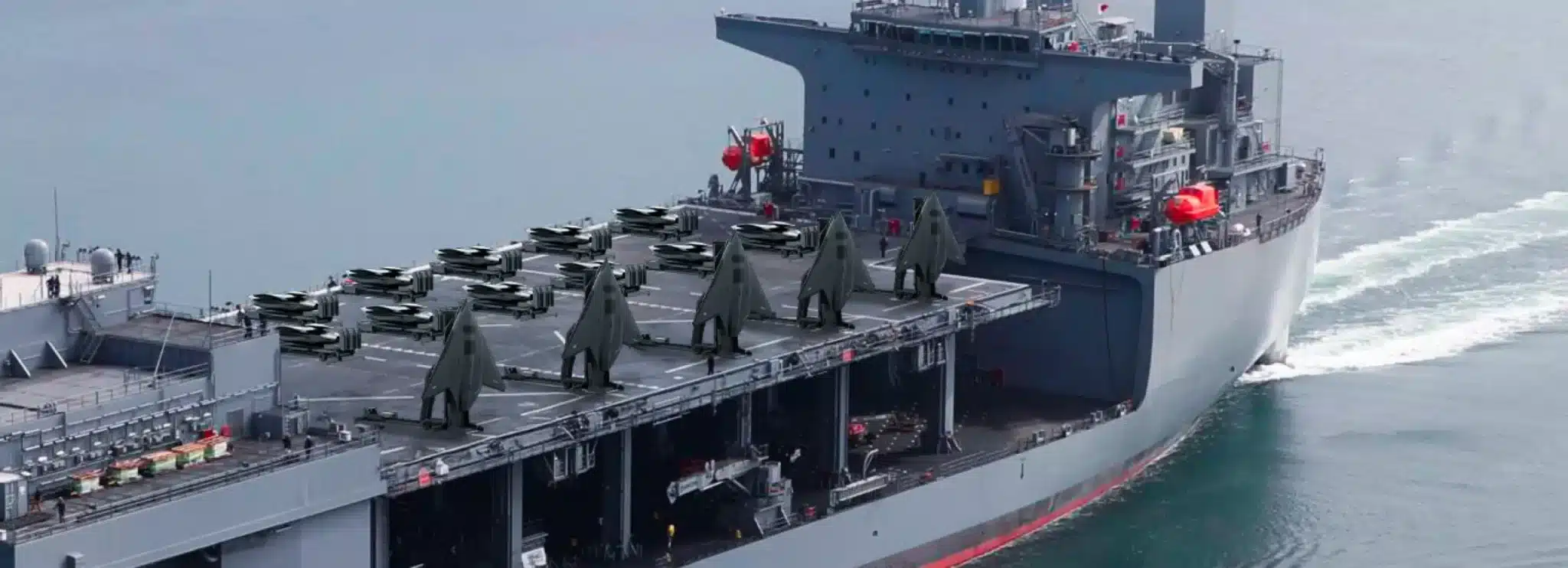
“X-BAT is being built to enhance the lethality, survivability and combat power of U.S. Naval Aviation,” said J.J. “Yank” Cummings, Shield AI’s head of mission solutions for the U.S. Navy, a TOPGUN graduate and former commanding officer of the aircraft carrier USS Gerald R. Ford. “Its runway-independent design and small deck footprint can increase sortie generation and extend long-range air combat power from CVNs, LHAs, LHDs and ESBs. Just as important, we are designing it for safe, high-tempo manned-unmanned flight deck operations and integration with the missions and capabilities of the carrier air wing, so X-BAT can add combat power without compromising existing operations.”
– End –