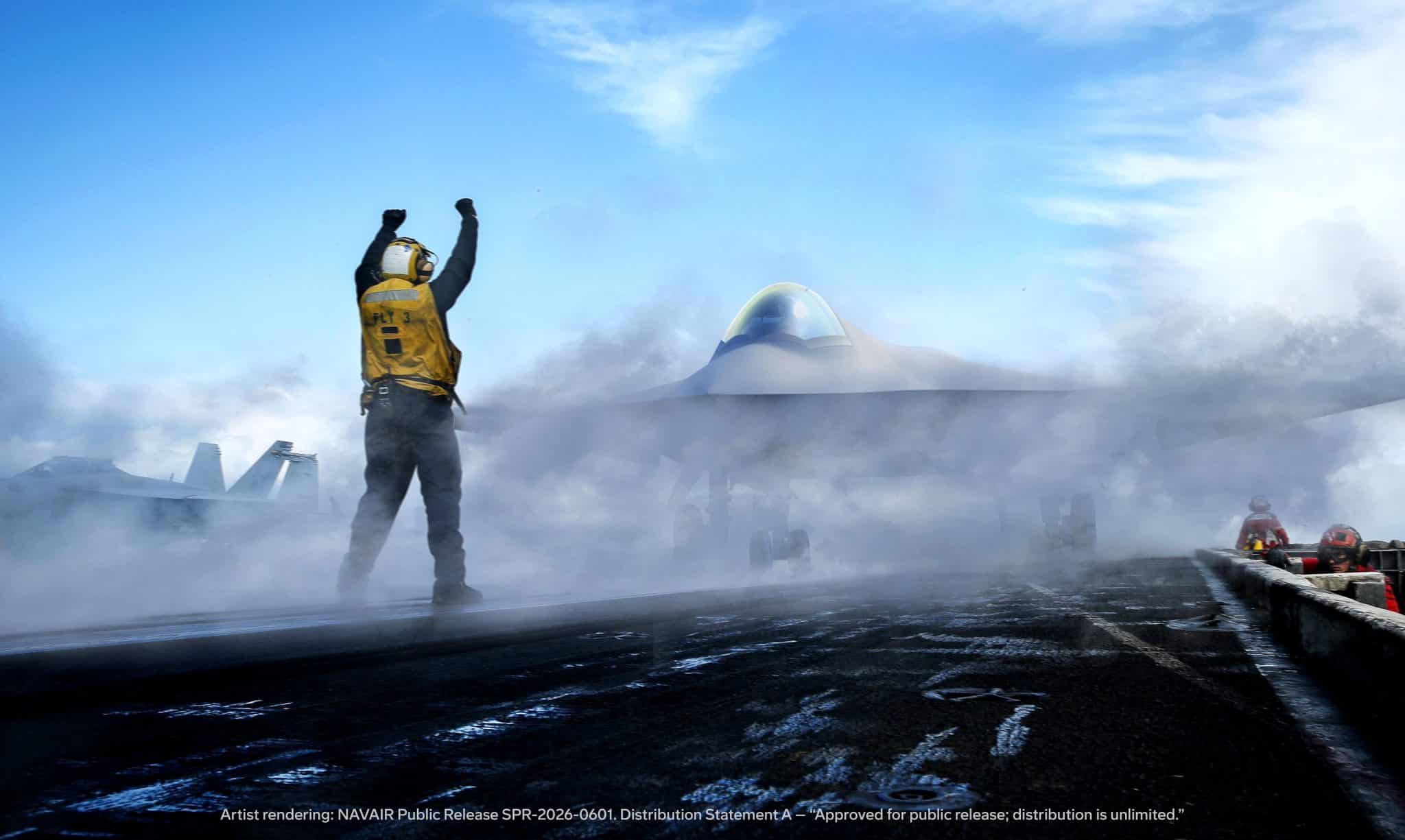
The U.S. Navy announced its selection of Boeing to build the next-generation Navy fighter late on September 29th, with the reveal arriving after an over 18-month-long pause in news about the program and its progress.
The initial contract for continued work on F/A-XX totals $20 billion dollars, likely covering several initial airframes as well as any associated costs with manufacturing and remaining development. Boeing’s St. Louis facility will be the main component in F/A-XX production as work on the massive 1.1 million square feet expansion begins to draw to a close, making this the largest fighter manufacturing facility currently present in the United States.
Additionally, the award is particularly notable as Boeing has now scored both Next Generation Fighter programs, as Boeing won the Air Force’s Next Generation Air Dominance program (now referred to as F-47) in March of 2025. Speculation over the U.S.’s industrial capacity took place between the awarding of F-47 and F/A-XX, as both Northrop and Boeing already handled 6th generation programs (B-21 for Northrop and F-47 for Boeing). Subsequently, Boeing’s several billion dollar expansion in it’s own development and manufacturing capabilities for fighter aircraft likely proved critical to it’s success.
“Delivering two advanced fighters in parallel was always our plan, and we invested accordingly. We are ready and able to build multiple concurrent future combat aircraft franchise programs.”
– Steve Parker, President and Chief Executive Officer, Boeing Defense, Space & Security.
Whilst timelines remain uncertain, if F/A-XX follows in F-47’s footsteps of only three years between the contract being awarded and first flight, F/A-XX could fly as soon as the end of the decade provided a similar pace is followed and there are no delays. Lauded as a critical program, the Navy would hope to see F/A-XX in service as fast as possible as the current F/A-18E/F Super Hornets continue to rack up flight hours.
F/A-XX and The Future Carrier Air Wing

The U.S. Navy publicly sought a standalone next generation multi-role fighter in 2012 when the program’s request for information surfaced online. Since then, much of the Navy’s efforts since beyond manufacturer concept work were either kept secret or trickled through to the public through limited releases or broader conceptual statements.
During the 2025 budget cycle, the program almost received only $76 million dollars that was initially requested by the current administration, representing such a low sum that it likely would have halted development and manufacturing efforts. This came on the heels of a months long silence after no promised announcement over the contract arrived. However, Congress halted these efforts, restoring funding along with a previous injection of nearly $1 billion dollars.
F/A-XX aims to bring a better integrated and more advanced aircraft to America’s flattops, carrying a new radar, potentially next-generation propulsion, an aircraft designed for manned/unmanned teaming, greater payload and fuel capacity, and greater sensor fusion. F/A-XX will also come with more of an emphasis on multi-role capability than F-47’s emphasis on sheer air dominance, aiming to augment the F-35Cs in service and to replace the ageing F/A-18E/Fs.
Now, F/A-XX finds itself as the centerpiece in the future carrier air wing as aircraft in all roles begin to be replaced, upgraded, or augmented as the Navy seeks to future-proof the role of carriers on the battlefield. This includes efforts to field unmanned and autonomous fighter/strike aircraft (which Naval News previously reported on), retirement of the C-2 Greyhounds, phasing out E-2Cs for upgraded E-2D Advanced Hawkeyes, and now the preparation for the vaunted Super Hornets to begin to leave service, likely sometime in the late 2030s.