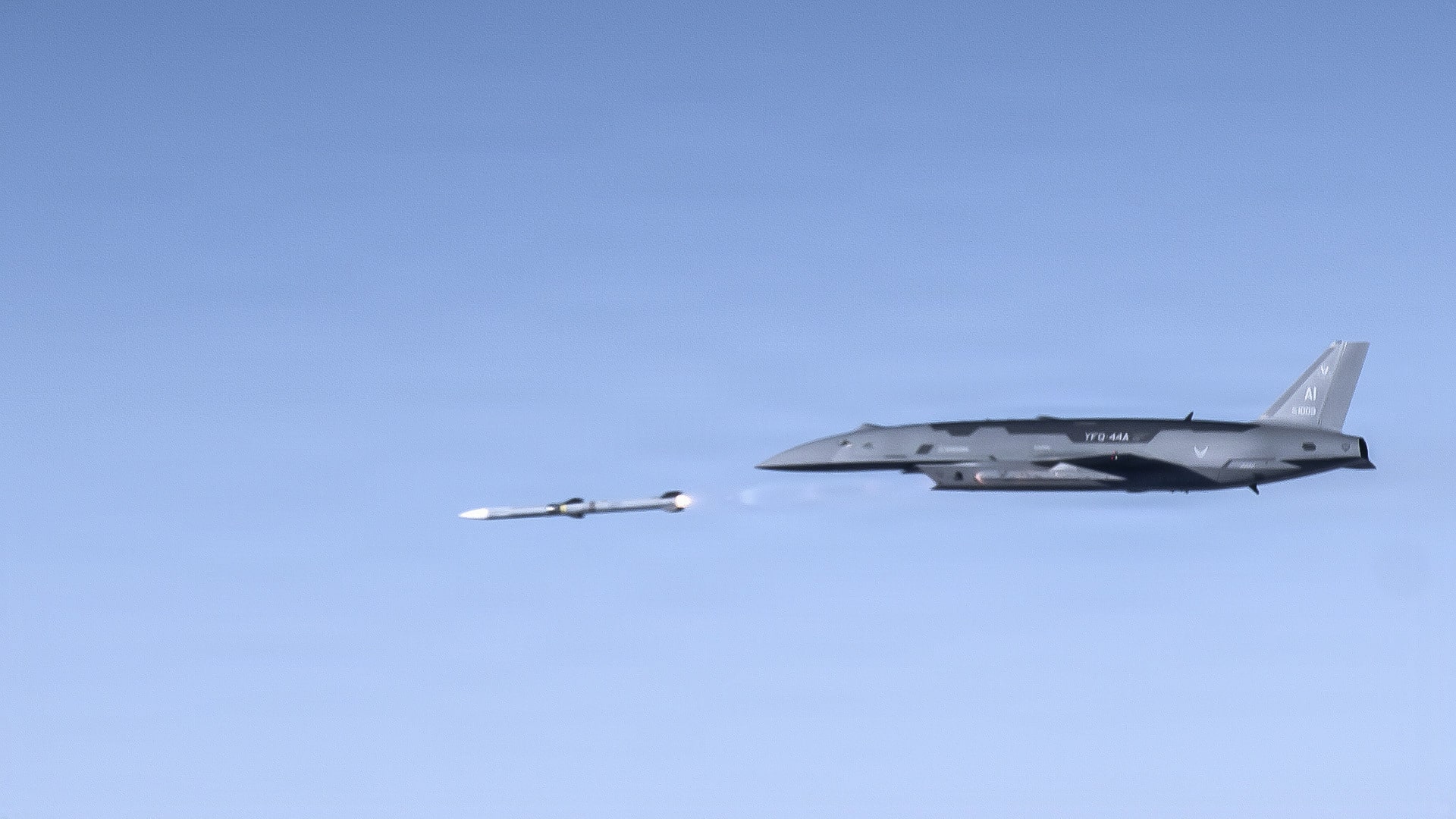
The US Navy officially issued an RFI for carrier-based Collaborative Combat Aircraft (CCA) to boost air wing mass alongside F/A-18E/F and F-35C fighters.
The U.S. Navy confirmed their intentions to source a Collaborative Combat Aircraft to fly from America’s flattops via a Request For Information (RFI) published late on August 31st. The U.S. Navy’s introduction of a CCA type platform aims to plug the gap in carrier air wings by fielding a fighter that will provide more mass and that can be utilized in more risk heavy environments.
The U.S. Navy confirmed its intention to source a Collaborative Combat Aircraft (CCA) to fly from America’s flattops via a Request for Information (RFI) published on August 31. The introduction of a carrier-capable CCA platform aims to plug capacity gaps in carrier air wings (CVWs) by fielding an uncrewed fighter that adds mass and operates effectively in high-risk environments.
To fill this need, the Navy’s Future Advanced Capability Program Office (PMA-228) under NAVAIR laid out critical design requirements. The RFI stipulates that the autonomous fighter must carry up to four 2,500-pound class munitions, integrate into existing Navy command-and-control architectures, and seamlessly cooperate with manned and unmanned assets. Additionally, the Navy is open to designs lacking internal weapons bays, indicating a willingness to trade a degree of stealth for lower production costs.
The Navy is seeking an expedited development schedule. To support rapid fleet integration, the CCA must utilize the existing Joint Precision Approach and Landing System (JPALS) and allow “non-marinized” commercial off-the-shelf components, provided vendors offer a clear path to sea-proofing. Structural requirements limit the CCA to roughly the footprint of an F/A-18E/F Super Hornet, with operational capability required in conditions up to Sea State 5, using standard shipboard tooling and logistics systems.
The CCA fleet will operate alongside the F/A-18E/F Super Hornet and the 5th-generation F-35C Lightning II, primarily taking on frontline missions deemed too dangerous or long-range for manned fighters. Over time, the selected platform will also integrate with future carrier fighters as the affordable end of a high-low operational mix.
The Future Carrier Air Wing

Alongside the Navy’s organic CCA program, the broader CVW structure continues to evolve. As highlighted in recent Naval News video reporting from Sea Air Space featuring Boeing’s MQ-25 program leadership [02:35], scale models of the MQ-25 Stingray—originally designed primarily as an aerial tanker—have demonstrated armed configurations carrying Long Range Anti-Ship Missiles (LRASM), underscoring a broader shift toward expanding carrier strike reach through uncrewed capabilities.
This unmanned expansion coincides with major transitions across the rest of the air wing. The venerable C-2A Greyhound completed its 60-year service life with its final flight in late July, officially passing the Carrier Onboard Delivery (COD) mission to the CMV-22B Osprey. Meanwhile, legislative proposals in the National Defense Authorization Act (NDAA) look to secure multi-year procurement authority for up to 12 additional E-2D Advanced Hawkeyes as the new Block II variant prepares to enter service and the remaining E-2C fleet reaches retirement.
However, continued silence surrounding the Navy’s 6th-generation fighter program, F/A-XX, has raised concerns over the timeline for replacing manned fighters. With many Super Hornets entering their second decade of heavy operational use and F-35C procurement rates remaining modest, delays in the next-generation fighter program could create future readiness and capability gaps across carrier strike groups.
Naval CCA: A Growing Transatlantic Trend
The U.S. Navy is not alone in seeking carrier-borne collaborative combat capabilities; major European navies are actively pursuing similar trajectories to augment their carrier air wings. In June 2026, the French defense procurement agency (DGA) issued a Request for Information for a future collaborative combat UAV system with an explicit carrier-capable focus, aiming to field loyal wingmen that can operate alongside the Rafale M F5 and integrate onto the future PANG aircraft carrier. Across the Channel, the Royal Navy is advancing its Maritime Aviation Transformation (MATX) strategy under Project Vanquish, progressing toward fixed-wing Autonomous Collaborative Platform (ACP) flight demonstrations from a Queen Elizabeth-class carrier to pave the way for a hybrid air wing by 2040.