The French defense procurement agency (DGA) has issued a Request for Information (RFI) regarding a future “Collaborative Combat UAV System” or CCA system. Published on June 4, 2026, the document marks an official market-exploration phase to define the operational, technical, and industrial landscape for France’s next generation of loyal wingmen and manned-unmanned teaming (MUM-T) platforms.
While the RFI covers multi-domain airborne collaborative combat, the details released by the French Ministry of Armed Forces point to a highly strategic naval dimension. Naval News notes that the requirements outlined in the document are directly tied to the future capabilities of the French Navy (Marine Nationale), particularly regarding carrier-borne aviation and sea-based power projection.
Carrier-Capable Requirements
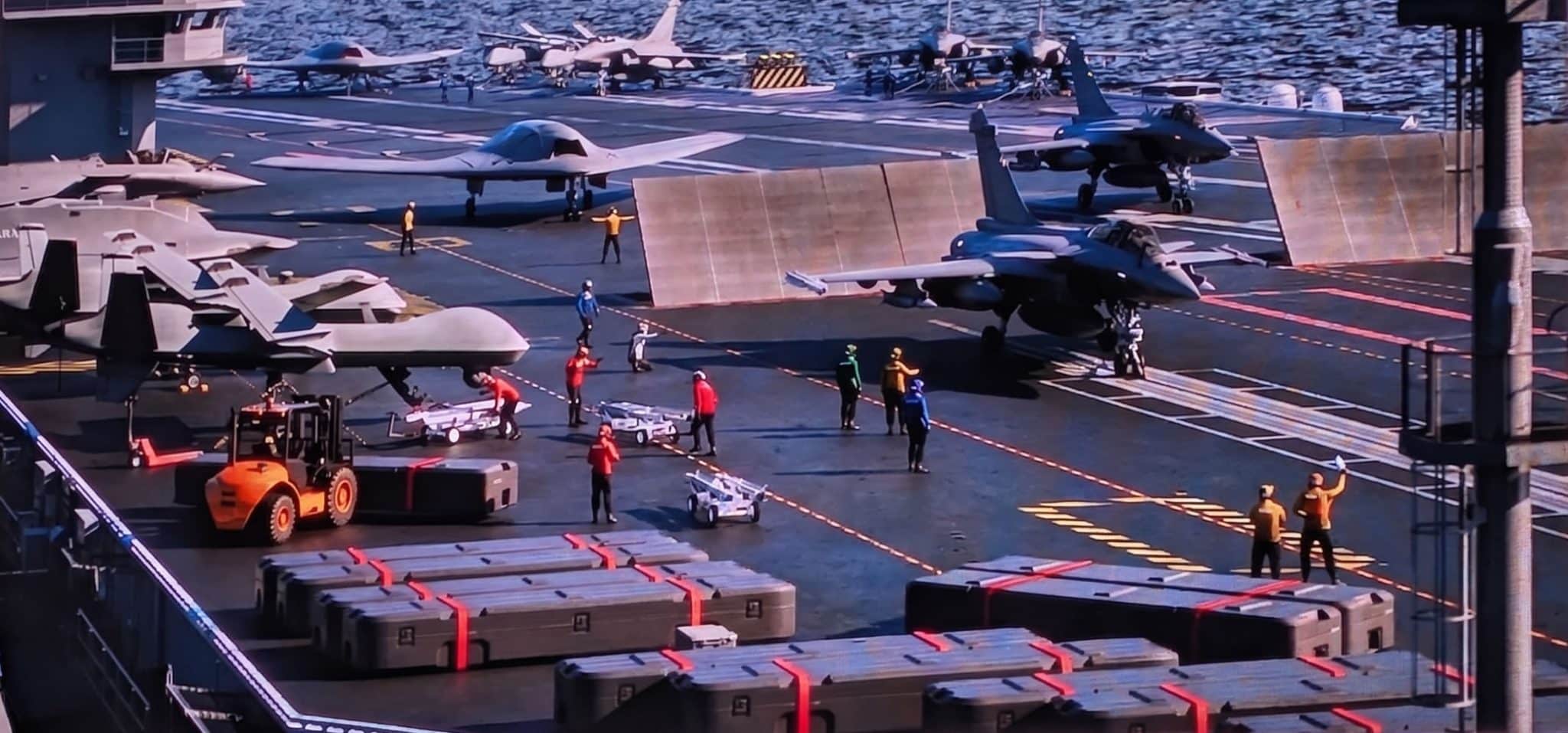
A critical indicator of the naval scope is found within the RFI’s technical questionnaire under the platform characteristics sections. The DGA explicitly asks industry to provide details on “maximum takeoff weight” involving catapulting, as well as “maximum landing weight” specifically accommodating “landing on an aircraft carrier, if applicable.”
This language strongly suggests that the DGA is actively eyeing an unmanned collaborative combat platform capable of integrating into a future carrier air wing. The timeline aligns seamlessly with ongoing developments for France’s Next-Generation Aircraft Carrier (PANG) program, with the France Libre slated to replace the Charles de Gaulle in 2038, as well as potential intermediary carrier-borne drone experimentation.

Operational Architecture: MUM-T at Sea
The operational need detailed in the RFI focuses heavily on advanced flight and mission autonomy systems, alongside command-and-control (C2) agility. Contractors must demonstrate how these UAVs can be controlled from both a ground control station and directly from a “manned aircraft.”
For the French Navy, this indicates a clear path toward MUM-T architectures at sea. Future aircraft carrier-launched collaborative drones are expected to act as force multipliers for the Rafale M in the “F5” standard (and eventually a Next-Generation Fighter which was previously being developed in cooperation with Germany and Spain under the SCAF program), taking on high-risk roles such as penetrating anti-access/area-denial (A2/AD) bubbles, suppression of enemy air defenses (SEAD), and advanced intelligence, surveillance, and reconnaissance (ISR) ahead of the strike group.
The RFI also emphasizes complex payload capabilities, querying industry on electro-optical, infrared, radar, and electronic warfare sensors, alongside dedicated armament payload integration—capabilities critical to securing contested maritime airspaces and conducting anti-surface operations.
Industrial Framework
The DGA has laid out a strict timeline and industrial framework for the RFI. Interested defense contractors and consortia have until August 21, 2026, to submit their comprehensive technical and industrial responses. They are permitted to respond to all or part of the expressed need, encouraging smaller defense SMEs to participate alongside major primes.
The RFI is not strictly limited to French industry. While the program’s ultimate goal is to protect and strengthen France’s sovereign defense industrial and technological base (BITD), the RFI itself is open to broader international participation. A giveaway for this is the DGA released an official “Request for Information – Courtesy translation” alongside the French version of the document. This is done when the procurement agency wants to capture market data from foreign and international defense contractors, rather than just domestic suppliers.