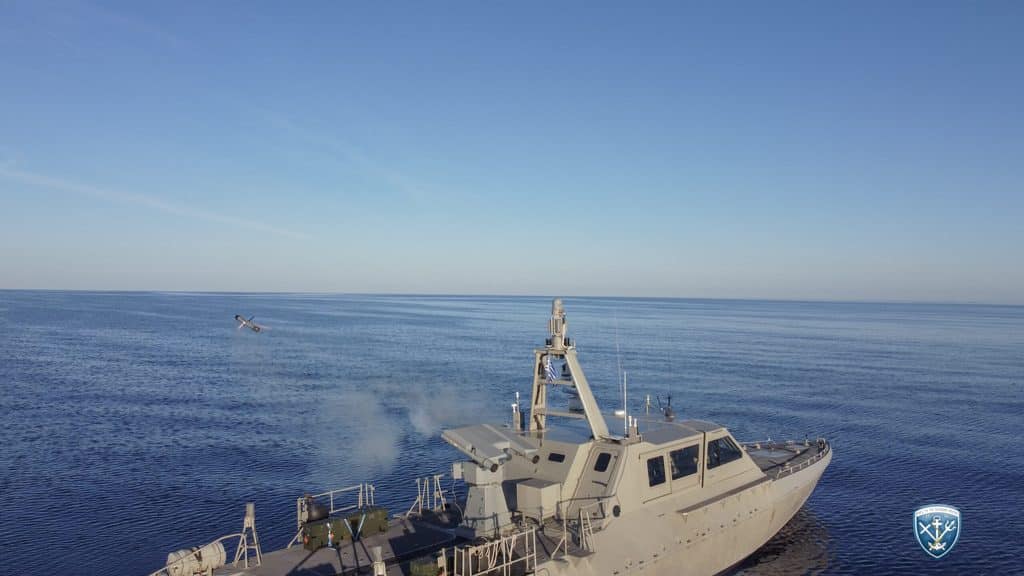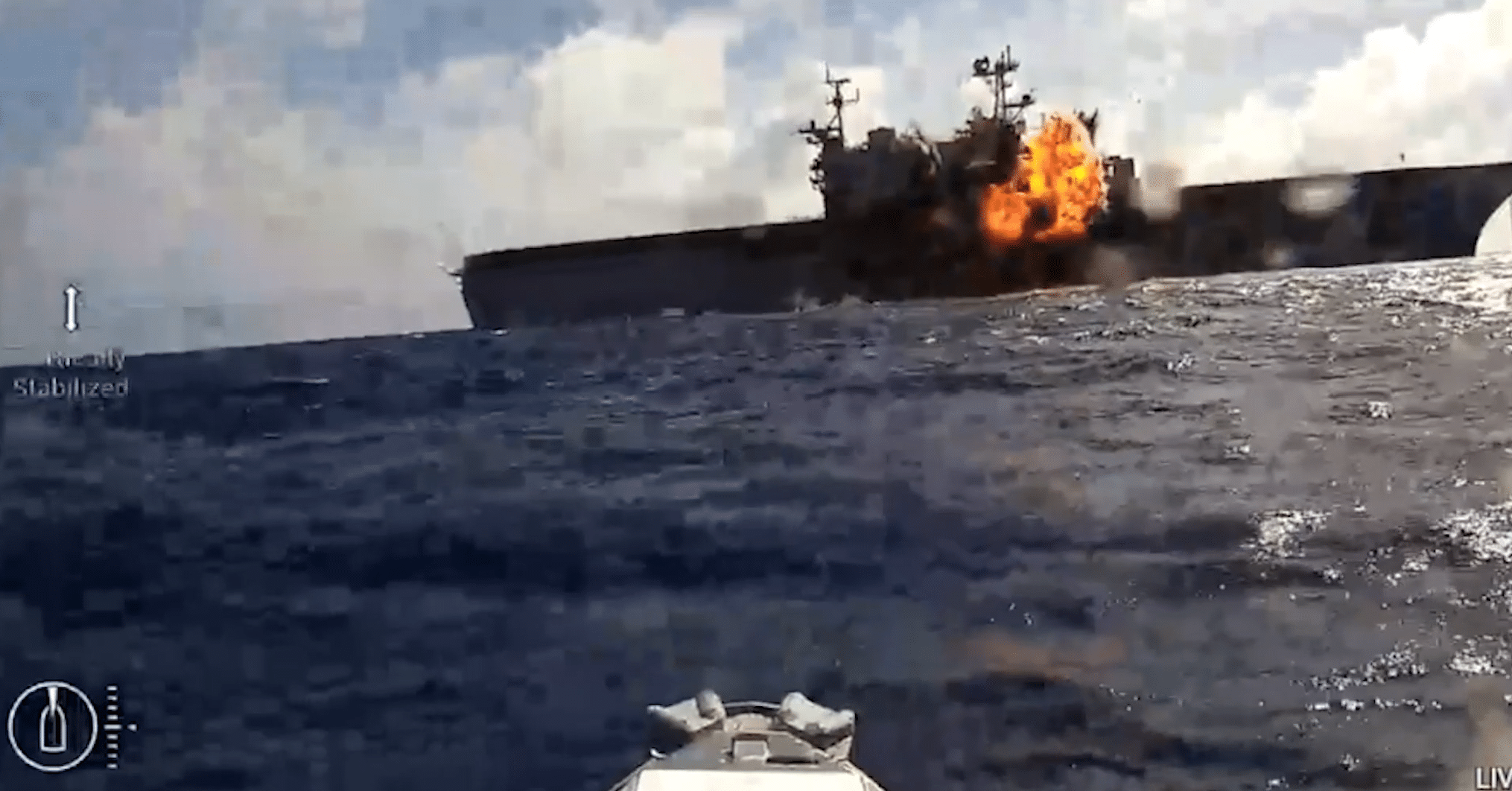
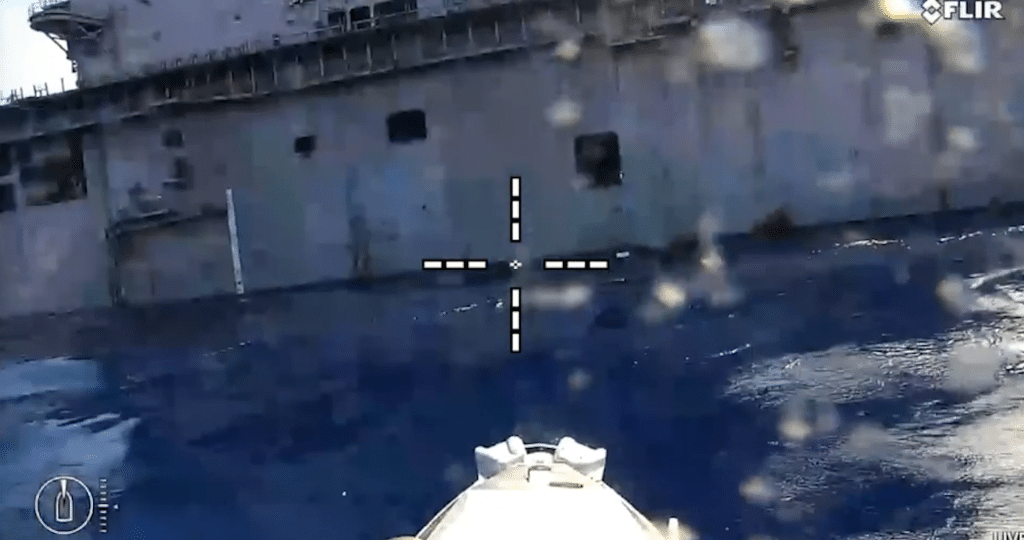
Sailing past the impact holes left by Harpoon, Spike, and LRASM missiles, two U.S. Navy one-way attack surface drones closed in on a decommissioned amphibious assault ship before detonating at the ship’s waterline.
This story has been updated to provide additional information on the sea drones deployed during the RIMPAC SINKEX.
U.S. Navy-piloted Global Autonomous Reconnaissance Craft (GARC) uncrewed surface attack drones from Unmanned Surface Vessel Division (USVDIV) 32 helped sink the former USS Peleliu (LHA-5) off the coast of Hawaii last Friday, pushing forward the service’s intentions of fielding a fleet of autonomous attack drones in the air, on the surface, and underwater. The live-fire demonstration occurred during the bi-annual, multinational Rim of the Pacific (RIMPAC) exercise hosted in and around Hawaii.
The U.S. Navy’s use of Ukraine-style one-way attack surface drones comes after months of industry and service efforts to accelerate the fielding of drones to the fleet, culminating in several drone systems moving into development and testing for the fleet. GARC USVs, which traditionally serve as reconnaissance drones, were the type deployed to hit the Peleliu during the exercise.
Exercise Rim of the Pacific (RIMPAC) is now an Operational Test (OT) event, giving the U.S. Navy an opportunity to demonstrate advanced capabilities to allies in the region while showing them off to adversaries across the Pacific. In 2024, the service unveiled its AIM-174B ultra long-range air-to-air missile at the exercise.
During that exercise the USS Carl Vinson (CVN 70) participated in War at Sea scenarios with its embarked Air Wing of the Future — an air wing configuration demonstrated to international allies for the first time.
This year, the service has partnered with Saildrone to test a counter-UAS uncrewed vessel capable of long-endurance missions across the Pacific. The service is also testing integration between U.S. Army and U.S. Marine Corps air wings on the USS Essex (LHD 2), with elements of the 25th Combat Aviation Brigade embarked on the ship for maritime anti-ship and reconnaissance missions.
The one-way attack drone’s deployment is perhaps most significant during the multinational exercise, giving international partners and adversaries a close look at U.S. Navy capabilities as the service leverages experience from Ukraine’s attacks on Russian Navy forces in the Black Sea.
Combined Task Force 66, a Europe-based U.S. Navy unit focused on maritime domain awareness, counter-unmanned system operations, and asymmetric warfighting, has closely followed Ukraine’s battlefield experiences as it works to enhance Ukraine’s lethality while improving the Pentagon’s own unmanned initiatives.
The RIMPAC SINKEX marks a crucial milestone in realizing the U.S. Navy’s own capabilities.
Video showing a U.S. Navy one-way attack USV detonates at the waterline of Ex-USS Peleliu during the RIMPAC SINKEX event on July 17. (U.S. Navy video):
Kamikaze drones in practice
Industry partners have quickly latched onto several USV concepts being pursued by the U.S. Navy and the U.S. Marine Corps. The latter has already tested similar kamikaze drones to the ones used on Ex-USS Peleliu during exercises in the Philippines that simulated an archipelagic defense strategy. Drones used for counter-UAS and anti-air missions have also begun development, both on smaller displacement boats and larger displacement ships that will supplement current fleet capabilities with added magazine depth.
Naval News has previously covered the growing presence of uncrewed surface combatants like GARC, many of which made appearances at Sea Air Space 2026. The service has already fielded several USVs, with operational employments in the Pacific and Middle East — including the rescue of two downed crewmembers of a U.S. Army AH-64 Apache over the Strait of Hormuz with a Saronic Corsair USV during combat operations. Corsairs were later used in one-way attack missions against a laid-up Iranian submarine.
Drone use will continue to expand across all services as the Pentagon pushes its Drone Dominance initiatives, which all aim to push drones into the hands of deployed personnel with less red tape and bureaucracy.
“The future of lethal autonomy is unmanned warfare – robotic autonomous systems with AI-driven targeting – which could reshape naval conflicts,” a U.S. Navy asymmetric warfare official said in 2025. “[Ukraine’s] use of [robotic autonomous systems] marks an evolution in maritime warfare, proving that low cost, asymmetric tactics can challenge larger naval forces”