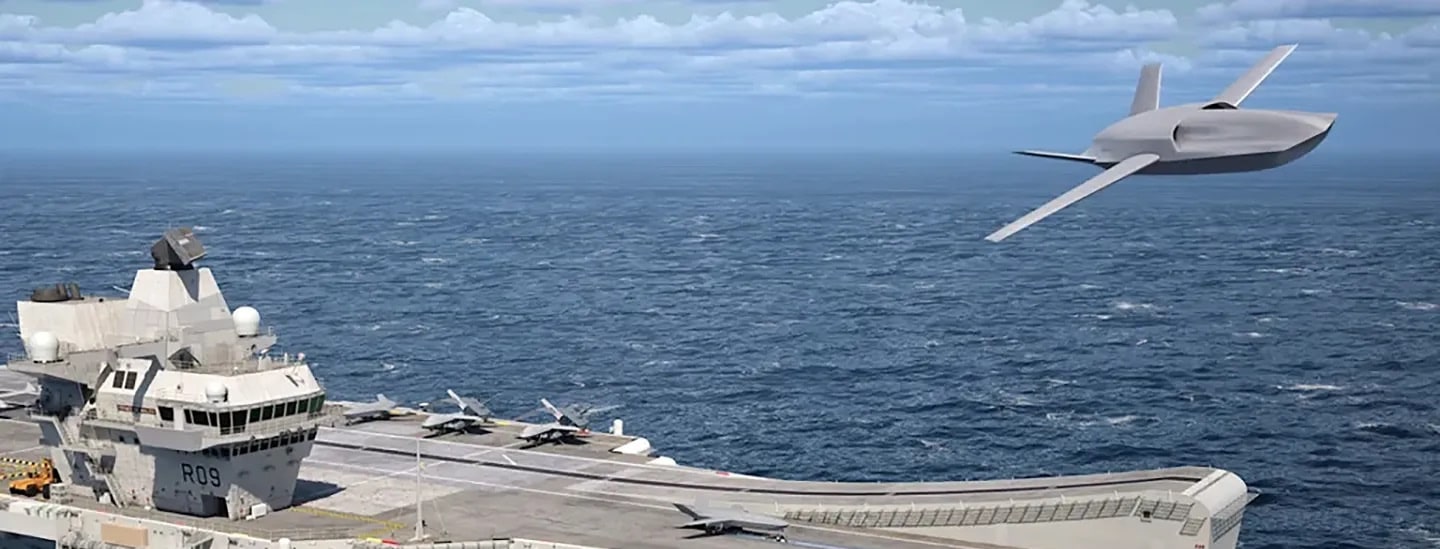
The UK Royal Navy (RN) is progressing plans to undertake flight trials of a jet-powered Autonomous Collaborative Platform (ACP) from a Queen Elizabeth-class (QEC) aircraft carrier by the end of next year.
Speaking at the Defence Leaders CNE 2026 conference in Farnborough on 20 May, Commodore Steve Bolton, Deputy Director Aviation Programmes and Futures, said Project Vanquish was a joint endeavour with the Royal Air Force (RAF) to demonstrate a fixed-wing short take off and landing ACP to inform development of the RN’s Hybrid Air Wing concept. The Hybrid Air Wing, which envisages the transition to a largely uncrewed Fleet Air Arm by 2040, is being delivered under the Maritime Aviation Transformation (MATX) programme.
Project Vanquish was first announced in September 2025 by Chief of Naval Staff and First Sea Lord General Sir Gwyn Jenkins. A request for information released in October last year outlined the intention to deliver a technical demonstration at sea of an attritable (Tier 2) ACP able to embark and operate autonomously from a QEC aircraft carrier without catapults or arrested recovery systems.
Addressing the CNE 2026 audience, Commodore Bolton said the “demonstration will provide the evidence to understand the practicality of fielding collaborative combat aircraft, or CCAs, as they are commonly known.
“This will be a joint enterprise with the [RAF] to augment our fleet of F-35Bs. We’re currently looking at working through several credible options from industry, and are looking forward to fielding a trial in the next 12 to 18 months.”
Project Vanquish requirements promulgated to industry framed the need for a jet-powered, high subsonic ACP, with a credible payload and endurance, to compliment the F-35B Lightning as part of QEC and its carrier air wing. “There must be an exploitation pathway to the delivery of a wide range of maritime mission sets in support of UK Carrier Strike in due course (ISR/strike/air-air refuelling),” said the RFI, adding: “Successful completion of a technical demonstration will inform future capability development and procurement options.”
Commodore Bolton told CNE 2026 that the increasing adoption of autonomous air systems would place a premium on precise navigation and timing systems that work over the sea and support long-range warfare, and resilient networks to coordinate targeting. “The Royal Navy’s Maritime Fighting Web seeks to address the need for more capable and resilient communications applied across the Hybrid Navy design, providing the route to credible mission autonomy and widespread adoption of ACPs to build a Hybrid Air Wing,” he said, adding: “The current programme framework for the development of vertical and short take-off and landing ACPs is known as Pantheon, conceived by the Royal Navy is an umbrella program that applies an effects-based approach to the development and procurement of a suite of different ACPs for ISR, strike, and logistics lift.”
According to Cdre Bolton, this approach will promote commonality in the digital architecture across individual equipment projects, including common control systems in place of bespoke ground stations and communications links for individual air systems. “We anticipate the need for commonality of digital standards to integrate maritime uncrewed and crewed systems into the Maritime Fighting Web, and to provide the degree of interoperability, including with allies and partners, that we currently take for granted with crewed aircraft.”
“The digital architecture that we will develop through Pantheon will ensure that all elements of the Hybrid Air Wing offer resilient capability in a congested environment to field a crewed/uncrewed kill chain that offers the commander increased choice and lethality.”
The Vanquish requirement for short take off and landing reflects the fact that the QEC ships are not configured with assisted launch and recovery equipment [ALRE]. A study programme known as Project Ark Royal had been established to look at the potential retrofit of ‘cats and traps’ into the QEC design; another effort, Project Vixen, was focused on a high performance, fixed-wing ACP that could contribute to persistent ISR and strike.
However, both Ark Royal and Vixen have now been shelved. Replying to a parliamentary question in February this year, minister for defence readiness and industry Luke Pollard said that Project Vanquish had instead been established within MATX to “generate evidence to inform the development of uncrewed fixed wing aircraft for operation from Royal Navy aircraft carriers without requiring the installation of [ALRE], subject to Defence Investment Plan decisions.”