Naval News visits Helsinki Shipyard to examine how the “Finland model” is driving icebreaker production, and questions if this strategy could solve the U.S. Navy’s surface combatant crisis.
The ”Finland model” has been quoted as the one to be used by the U.S. Navy to solve the issue of a smaller and more affordable surface combatant than the fleet’s Arleigh Burke-class destroyers.
The U.S. Navy has so far been unable to produce a replacement for the now-retired Oliver Hazard Perry-class frigates which entered service back in 1977, the latest failed programme being the Constellation-class FREMM-derivative cut short after two vessels. Naval News contributor Robin Häggblom had the opportunity to get a look at the work done at Helsinki Shipyard where coast guard icebreakers are being built under the Finland model.
Revitalizing Helsinki Shipyard Under the ICE Pact
The historical shipyard, now part of the UK-based Inocea Group, has been building ships in central Helsinki since 1865. Under different owners throughout its history, the yard has found a niche in building ice-reinforced vessels, both for the polar cruise industry, but also in the form of icebreakers. The latest chapter of the yard started with Canadian shipbuilder Davie acquiring it following the Russian full-scale invasion of Ukraine, and has seen it elevated to a key role in the trilateral US-Canadian-Finnish ICE Pact. The agreement outlines closer cooperation in the field of icebreaker design and production, as well as technology transfers.
In practice this sees two consortiums build icebreakers for the US Coast Guard Arctic Security Cutter programme (ASC), with both building the first vessels in Finland to speed up delivery while at the same time investing in US industry to be able to build the rest of the series there. At the same time, the construction of the larger Polar Max icebreaker for the Canadian Coast Guard is also underway in Helsinki.
Inocea’s Distributed Build Approach
Inocea’s approach to the ASC is to build the first two vessels in Finland, followed by three more in Texas at Davie Defense’s facilities which currently are seeing significant investment. In the Finnish end, it is not just the Helsinki Shipyard that is employed, but also the facilities of Sata Shipbuilding in Pori on the west coast where hull construction of both vessels has started. Compared to the Helsinki Shipyard, Sata has better facilities for building large hull and superstructure blocks up to 500 tons in weight, which are then assembled in the main 280 m long drydock in Helsinki. For the Polar Max, the hull is being built in Helsinki where it currently occupies the drydock, before it is to be shipped to Canada where the superstructure will be added at Davie’s shipyard in Quebec.
The Heavyweight: Polar Max
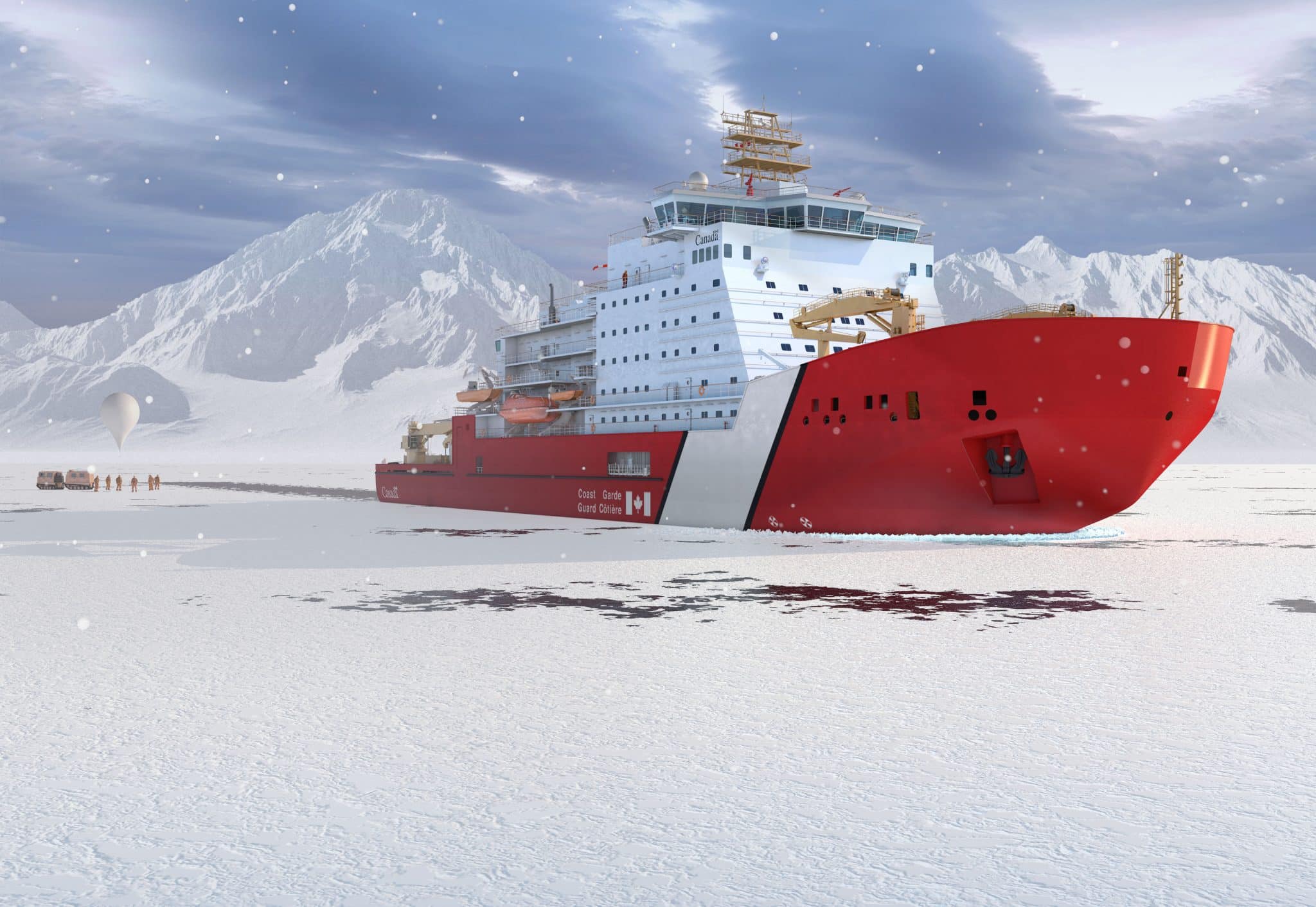
When it enters service, the 22,800-tonne Polar Max will claim the title of the world’s heaviest non-nuclear-powered icebreaker. It reflects a growing trend of icebreakers serving as true multirole platforms. Designed for year-round Arctic operations, the ship can break up to 2.5 meters of ice and boasts a 90-day endurance. Alongside its icebreaking capabilities, the vessel features substantial cargo space and heavy-lift cranes for resupply missions. It can accommodate up to 250 personnel, allowing ample room for researchers and mission specialists alongside the core crew.

The Agile Platform: Arctic Security Cutter
The Arctic Security Cutters are smaller, measuring 100 meters in length with a normal operating displacement of 9,000 tons. Like the Polar Max, they feature a 90-day endurance, though with a smaller 124-person capacity. While the Canadian vessel is built to Polar Class 2 standards for year-round operation in moderate multi-year ice, the ASC requires Polar Class 3 (PC3) certification. PC3 denotes capability for year-round operation in second-year ice with multi-year inclusions. Even at PC3, this represents top-tier Arctic capability, outpacing several other operational and planned icebreaker classes.
The Future of the Finland Model
In addition to the three vessels currently being built, the Finnish part of Inocea also has the new Finnish civilian 96-meter long icebreaker Aino under contract for delivery in 2029, as well as another undisclosed project in the pipeline. While shipyard representatives note that running this kind of heavy industry in the middle of the capital is “Quite an adventure” and that the company face some issues with finding enough skilled workers, they are at the same time confident in the somewhat unique close cooperation between Finnish shipyards, academia, design bureaus, and system suppliers. The value placed on this is visible in the 200 million euro investment made into the yard during the upcoming years. Together with a comprehensive in-house design capability, the ecosystem has sped up the building process, allowing for an average time of delivery from contract of 30 months for their ice-capable vessels, compared to a global average approaching 60 months. This is backed up not only by the latest Finnish icebreaker Polaris delivered within 32 months of contract, but also by hull construction beginning within three months of contract for the Polar Max and four months for the ASC.
While the programme currently is on track, it is important to remember that the first ICE Pact vessels are still a few years out and none of the vessels to be built in the US have yet to start production. As such, the final outcome is still open, but even more unclear is whether the promising-looking “Finland Model” may easily be adopted for the more complex and politically more sensitive world of naval surface combatants. With much of the benefits of the model stemming from trusting the expertise of the foreign shipyards and system suppliers, the experience from the Constellation-class raises questions about whether the U.S. Navy really is ready to accept a foreign design into its ranks.