Saab has released details of a new construct it has developed – and demonstrated – for protecting maritime borders, including particular sites and assets and/or broader at-sea areas: Ocean Barrier.
The Swedish defence and security company’s Ocean Barrier concept is a multi-layered, underwater-based construct but with multi-domain impact, providing sensing capability and capacity to detect threats below, on, and (in some circumstances) above the surface.
“With Ocean Barrier, we provide customers with a scalable, future-ready solution that delivers continuous awareness, enabling faster decisions and more effective protection of critical assets and maritime areas,” Åsa Schöllin, Business Unit Underwater Systems head in Saab’s Business Area Naval, said in a company statement.
Ocean Barrier’s three underwater sensor layers – named ‘Detect’, ‘Prevent’, and ‘Protect’ (and what Saab also referred to as ‘defensive perimeters’) – build capacity together to counter incursions through maritime chokepoints, around offshore installations including critical undersea infrastructure (CUI), and into naval bases, ports, and harbours, plus other access and infrastructure points. The layers can operate individually, in pairs, or as a collective whole; consequently, Ocean Barrier is as suited to protecting a single point as it is to securing a wider area, Saab said.
Saab described Ocean Barrier as a fully integrated, scalable, underwater surveillance network, built on a modular architecture, generating persistent maritime domain awareness, and protecting critical infrastructure, coastal areas, and territorial waters. The company added that underwater surveillance is essential to securing such assets and seas, given the increasing significance of – and threats to – maritime infrastructure.
The naval requirement, Saab explained, is to provide reliable underwater surveillance capacity drawing on different systems networked together, to create a more complete operational picture and co-ordinated threat response. The system-agnostic, adaptable Ocean Barrier meets this requirement, it added, by integrating sensors, data, and operators into a single, connected system, thus enabling those operators to detect, track, and analyse underwater activity across large maritime areas.
“By converting sensor information into real-time situational awareness, [Ocean Barrier] helps its operators understand what is happening below the surface, and respond to potential threats with confidence,” the Saab statement said.
Layered approach
The ‘Detect’, ‘Prevent’, and ‘Protect’ layers each serve a specific purpose, namely, early warning, tracking, and close-range protection respectively, Fredrik Danell – from the company’s Sales and Marketing team in the Underwater Systems business unit – told a media briefing.
Danell detailed the roles and capabilities of the three layers.
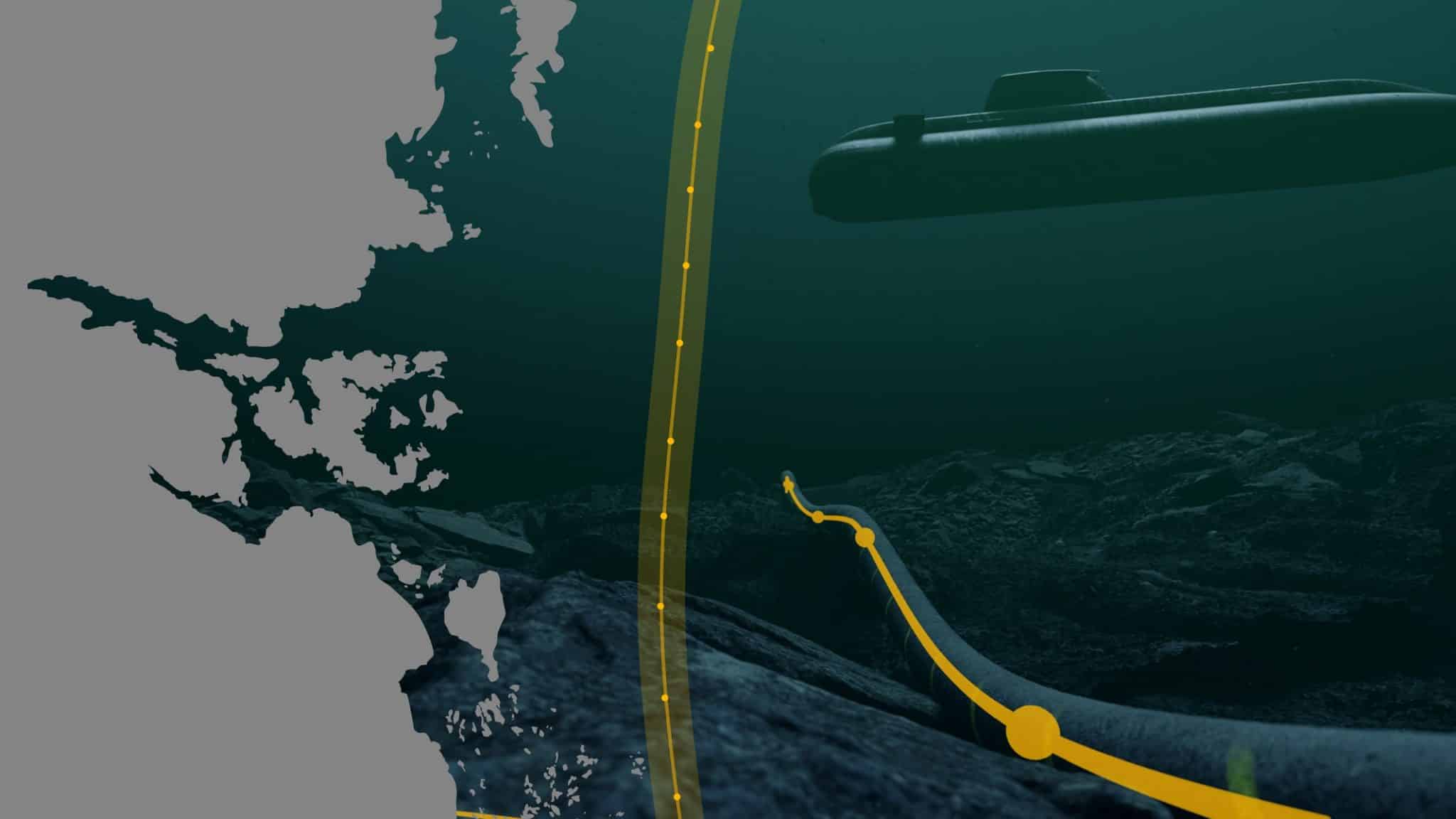
‘Detect’, the outer perimeter, “is designed for the larger coastal areas and open sea environments, acting like an underwater ‘tripwire’ to give an early heads-up about an approaching activity,” he explained. It uses a very long line passive array carrying a large number of hydroacoustic sensors. As the first point of potential contact, its target coverage is quite large: “The dimensioning target type is submarines, uncrewed underwater vehicles (UUVs), and diver delivery vehicles,” Danell said.
‘Prevent’, the next layer, “is tailored for archipelagos, coastal channels, bays, fjords, or other near-shore environments,” Danell continued. “Here, Ocean Barrier not only detects contacts, it also continuously tracks their movements.” This passive acoustic layer consists of fibre-optic sensors mounted on tripods, with these ‘pods’ and their sensors providing the possibility to obtain a classification – plus bearing, track, and speed data – on an underwater object. “The dimensioning targets are the same as for the ‘Detect’ line, but you get more accuracy in the positioning and tracking,” Danell added.
‘Protect’, located at the coastline, offers close-range security for naval bases, ports and harbours, or other coastal installations. This layer uses active sonar, Danell said. Active sonar signals will have shorter range, but a wider area – like a large harbour – could be covered by installing several sensors. “Dimensioning targets [are] smaller,” he added. “You get more visibility with this [layer] so you can detect single divers.”
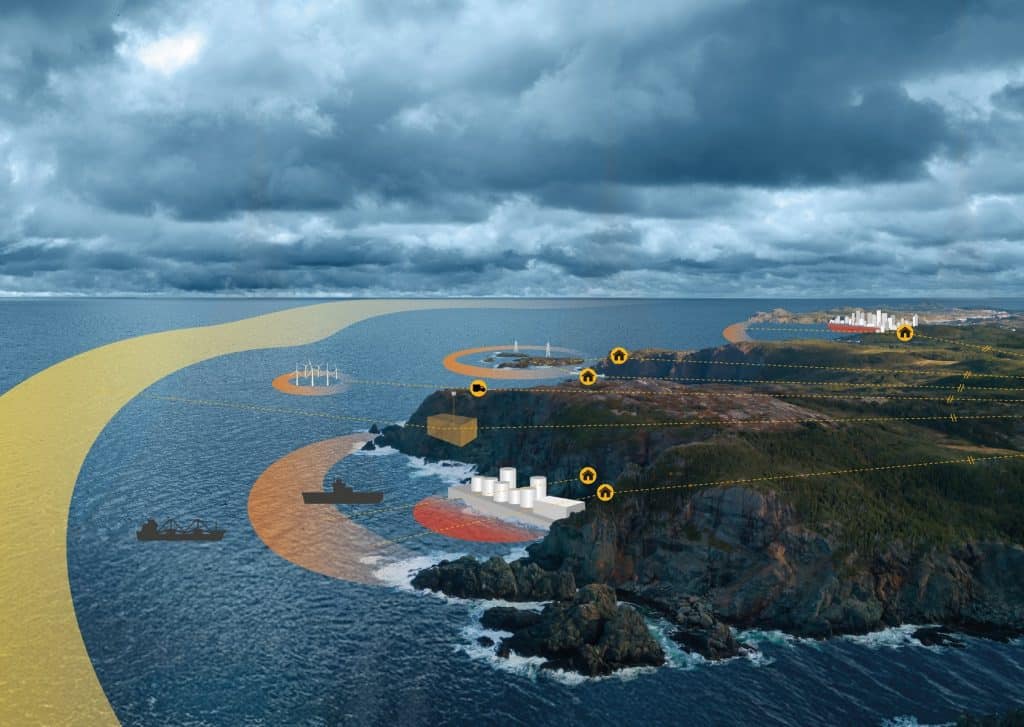
The sensor network is physically plugged into a nearby shore installation, located for example at a naval base or maritime operations centre, a coastguard or other maritime agency facility, or a port or harbour. Any surface sensors can also be connected up to the shore installation.
Data is then passed from the shore installation to a surveillance facility. “[This] is the command centre of Ocean Barrier,” said Danell. “It fuses the data from the various sensors into one real-time view, enabling operators to detect, track, and evaluate maritime activities and make a quick decision.”
Following a contact being made at any of the layers, the operators can draw on other data feeds – like radar or AIS – to see if a surface vessel of any description is present or not at that contact location. If not, and a sub-surface contact is confirmed, an alarm is triggered.
OPEX demo
Saab has already tested – and demonstrated – the system and its capabilities in a NATO operational experimentation (OPEX) context, namely the ‘REPMUS 2026’ exercise.
At the alliance/Portuguese Navy co-hosted event, held at Tróia, southern Portugal in September, Saab established a two-layer construct – ‘Prevent’ and ‘Protect’ – as an underwater surveillance barrier for the naval facility there. Several different UUVs were deployed to test the barrier.
Containerised shore installation and surveillance centre facilities were also set up.
In addition, another key development was demonstrated. NATO Standardisation Agreement (STANAG) 4817 – the STANAG designed to develop a common architecture underpinning multi-domain maritime uncrewed system command and control (C2) – has been established as the ‘entry level’ requirement for ‘REPMUS’ participation. Consequently, Ocean Barrier was made 4817-compliant.
At ‘REPMUS’, Saab achieved its aim of testing the system and its 4817 compliance. “[We] successfully demonstrated the ability to integrate data from different sensor systems, and autonomously send tracked object data up to the central [C2] system used by exercise command, all while following the requested NATO standards for data transfer,” Danell said.
While continuing to develop the capability and its construct further through other OPEX activities via a roadmap of steps to take – steps which include enhancing system automation across all layers – Danell said the next development priority is, for 2027, to prepare to productise Ocean Barrier.
Naval News Comment
Saab’s development reflects wider NATO navies’ efforts to build national and multinational underwater surveillance networks to deter and defend across the Euro-Atlantic theatre against what is seen as a significant, and growing, underwater threat.
The development and demonstration of Ocean Barrier contributes to this deterrence and defence output by communicating credible capability to detect such threats.
Ocean Barrier having a modular, sensor-agnostic architecture also permits connection and integration with other national and multinational underwater surveillance networks, thus helping to build more layers of NATO underwater surveillance, deterrence, and defence capability.