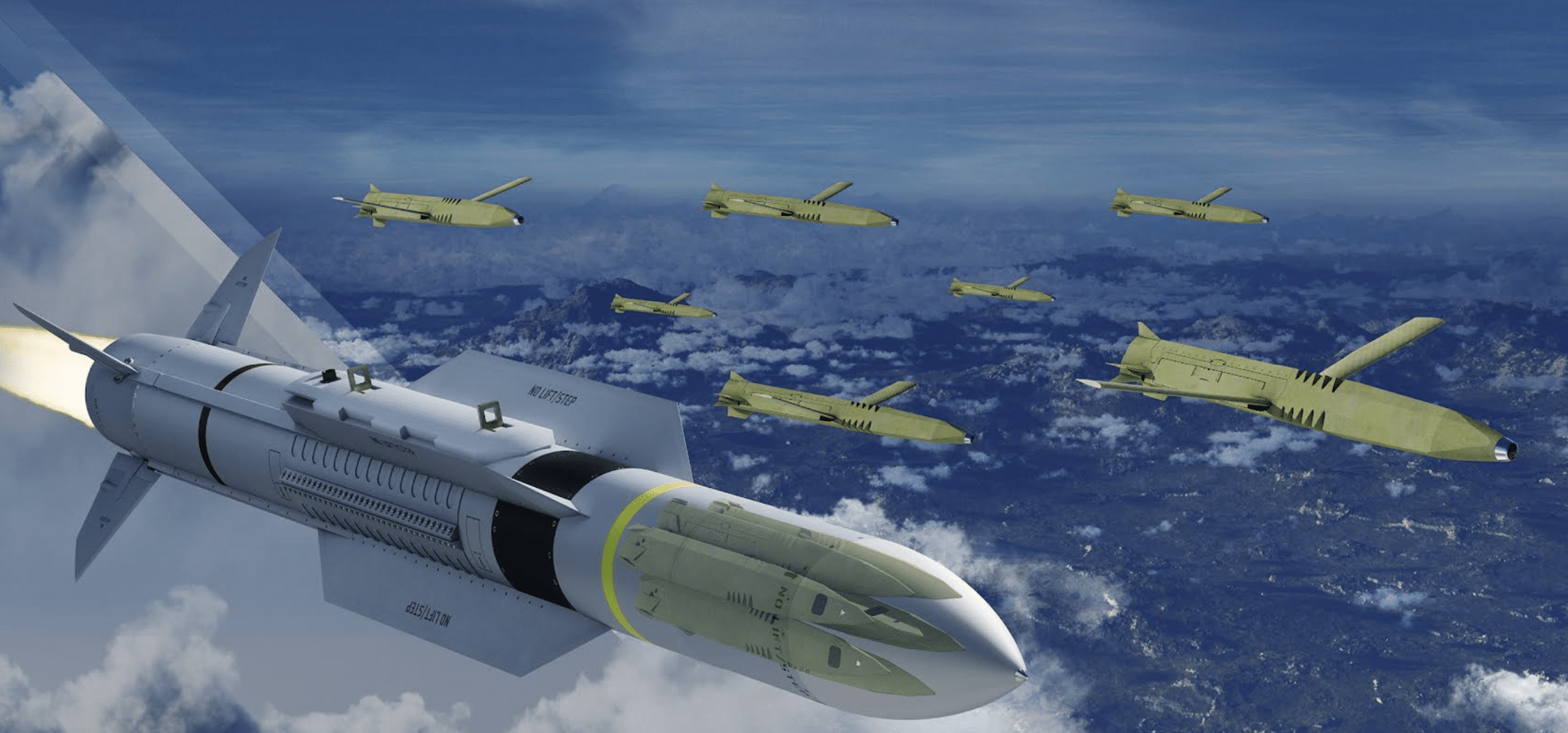
General Atomics hinted at another potential submunition deployment method for its Vektrex maneuvering projectiles from an air-launched missile.
A graphic from General Atomics’ booth at Euronaval 2026 shows a F/A-18E/F Super Hornet launching a missile loaded with seven Vektrex projectiles. The American defense firm did not comment on the missile type.
However, the conceptual graphic appears to represent the U.S. Navy’s AIM-174B Gunslinger, an air-launched variant of the Standard Missile 6. If mounted from this missile, a carrier-based Super Hornet fighter has the potential to carry up to 28 gliding projectiles each capable of striking a separate target independently.
It is unclear how far Vektrex can reach from this air-launched missile submunition concept. Furthermore, the mission potential for the gliding projectiles may increase potential missions for Vektrex from a high-altitude deployment.
From LRMP to Vektrex

Debuted at Sea Air Space 2023, Naval News has covered the development of Vektrex since its inception as the Long-Range Maneuvering Projectile. Developed to address challenges faced by the U.S. Army, the U.S. Marine Corps and Navy have taken interest in the munition. Vektrex’s development used General Atomics concepts, designs and technologies initially created via the firm’s railgun, drone and hypersonic programs.
While Vektrex’s scale is currently configured for the ground branch’s 155mm guns, its design has the potential be adjusted for the Navy’s 127mm cannons and submunition deployment from larger missiles. The latter of these include concepts on the Precision Strike Missile and Guided Multiple Launch Rocket System. In the past, General Atomics highlighted intelligence and electronic warfare packages for the projectile. Internally developed sensors also enable the munition to track and target moving vehicles and ships.
With the return of the potential of conventional conflict with peer adversaries, Washington is tapping numerous defense firms to increase the lethality and capacity of its forces. The Pentagon wants massed quantities of low-cost munitions to penetrate dense enemy air defenses, permit more strikes against more targets and enable the penetration of higher-end missiles.