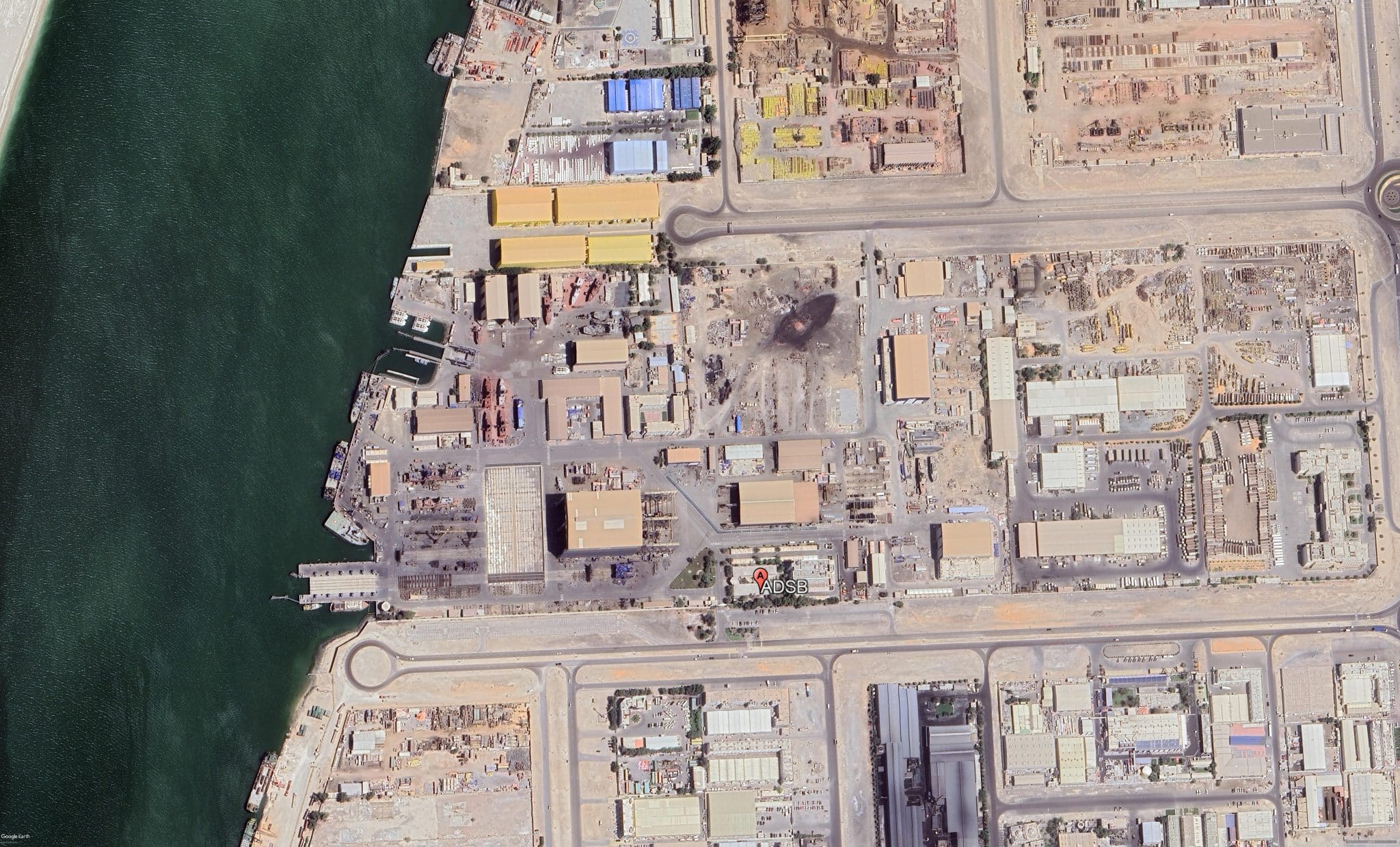
Today, Abu Dhabi Ship Building (ADSB) has three major shipbuilding contracts from three different nations. These projects are keeping the workforce almost fully occupied but, with future expansion in mind, ADSB is already planning a new shipyard that will permit construction of more and larger vessels.
ADSB’s obvious core function is shipbuilding, which is its major revenue earner. Maktoom Ali Al Shehhi, Chief Operating Officer, said his company serves not only the UAE: “We’re open to discuss with any client, with any military.” He added that, “In terms of size, we’re able to build from six-metre composite boats up to 80-metre corvettes.”
During a media tour sponsored by the Edge Group in mid-November 2026, Naval News witnessed just how busy and full the ADSB shipyard actually is. ADSB is a public joint-stock company in which Edge has a 49.96% stake.
Falaj 3
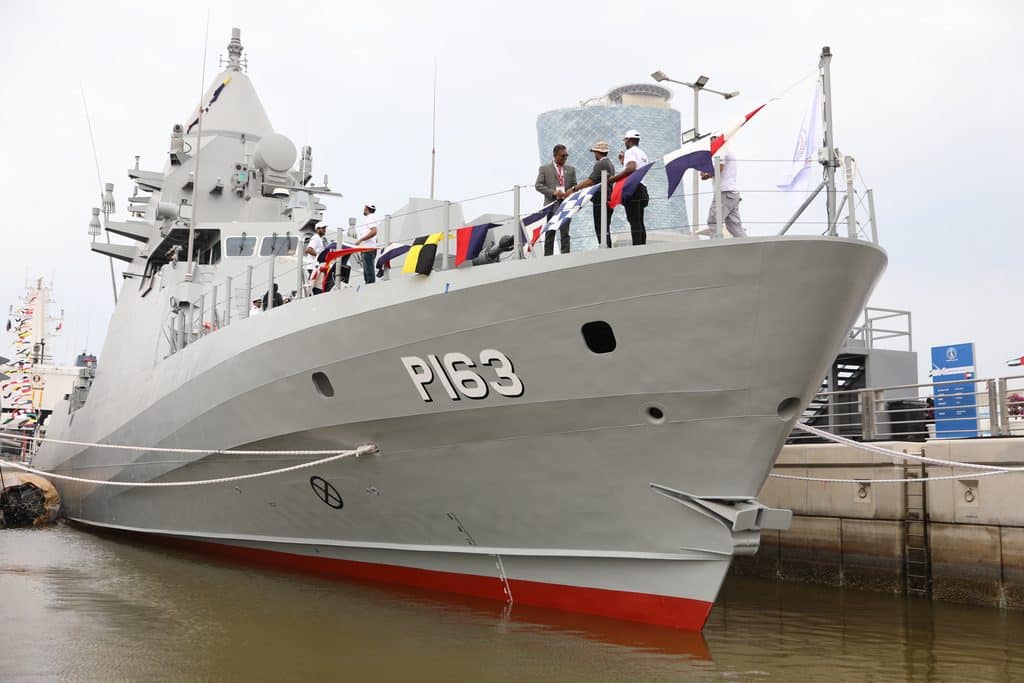
The first shipbuilding programme is four 62.7m Falaj 3 offshore patrol vessels (OPV), known as the Altaf class, for the UAE Navy. This AED3.5 billion (US$950 million) contract was signed in May 2021, with these OPV-sized missile boats designed by ST Engineering of Singapore.
Asked why ST Engineering was chosen as the design authority, Al Shehhi explained: “The final decision to go with ST Engineering was based on customer requirements as well as ADSB’s proposal, because we foresaw that, to fulfil the operational requirements of the customer, then that would be the best design that suits them.”
“So there have been multiple factors: timeline, lead time, delivery.” He said the relationship with ST Engineering is “great”. “We have a very close relationship with them and, if it was not to that level of maturity and transparency and understanding, we would not have given them three platforms to build for the [Kuwaiti] Al Dorra programme.” More on that shortly.
Regarding the Falaj 3, the COO shared: “Honestly speaking, it’s a unique design. It’s very hard to have 63 metres with this much speed, with this much complexity, as well as the combat system capability.” He said its capability is more typical of corvettes or frigates. “For the intellectual property [IP] rights, there has been a very detailed discussion. Still the IP rights remain with ST Engineering, but I think Edge and ADSB have reached a very mature stage to have the IP rights of the design, which could be finalised within this year, I believe.” This could involve IP rights being transferred, co-shared or being applied to specific regions.
The first of these Falaj 3 OPVs had a “soft” commissioning at NAVDEX in February 2025, before returning to ADSB for further work. It is now almost ready to return to the UAE Navy, ADSB said. Meanwhile, the second-of-class ship launched earlier this year will begin platform trials before year’s end, ahead of scheduled delivery in Q2 of 2027. Steel has already been cut on the third Falaj 3 vessel, with the keel-laying ceremony occurring on 12 November 2026. Work on the fourth and final vessel will commence before the end of 2026, with all work currently meeting agreed timelines.
Angolan angle
A second major ship construction project for the Abu Dhabi-based shipyard is a €1.2 billion contract signed in 2023 for three BR71 MK II Combattante corvettes for the Angolan Navy. The 70.3m-long design originates from CMN, and ADSB is receiving transfer of technology from the French shipbuilder. CMN constructed the first BR71 MK II in Cherbourg, with ADSB responsible for only the second example.
Al Shehhi said this first-of-class, the future NRA Ekuikui II, which was launched on 4 March 2026, should be handed over to the customer by December 2026. Meanwhile, the Abu Dhabi shipyard launched the second example, Nimi-ya-Lukeni, on 29 October 2026 and it is slated for handover next year.
This Angolan programme is also delivering five 12m and six 16m high-speed interceptor boats manufactured by ADSB, as well as six Edge/Anavia HT-100 rotary-winged unmanned aerial vehicles. The COO said all these craft and aircraft have been delivered and are already in Angolan Navy service.
Kuwait in the queue
ADSB’s largest ever shipbuilding contract was for eight Al Dorra-class OPVs/missile boats for the Kuwait Naval Force, this AED9 billion (US$2.45 billion) contract having been signed last year. Al Shehhi said, “The deliverables related to this contract is to build eight missile boats, plus providing ammunition and internal service support for five years.” These vessels are identical to the Falaj 3 class for the UAE Navy. Furthermore, ST Engineering is building three of the eight hulls in Singapore – the third to fifth examples – before they are transported to Abu Dhabi for fit-out and systems integration.
Asked why hulls are being built in Singapore, ADSB said it accelerates production and spreads the workload. “There are multiple reasons and multiple priorities. In ADSB we’ve been busier than ever, and then to make sure that you comply with all the requirements – timelines, having to manage more than four clients at the same time – and to keep those timelines, ADSB decided that sometimes it’s more commercially attractive” to split the workload in order to make sure everything is delivered on time.
Furthermore, it frees up space at ADSB for additional projects, otherwise it denies or impacts ADSB’s ability to accept new contracts. “So shifting vessel three, vessel four and vessel five will give us some timeline that we’re able to participate and get additional business.” By that stage, the Angolan project will be completed, and the Falaj 3 project will be in its final stage, allowing ADSB to absorb new business. Indeed, a spokesman confirmed it currently has a number of active bids with national and international customers.
The first Kuwaiti ship was launched in February 2026; sea trials start in late November, followed by integration of its Leonardo combat system and live firing. It should eventually be delivered in June 2027. The second vessel is now in the assembly hall, due to be launched in February 2027 and completed in June 2028. Steel cutting and keel laying for the first Singaporean-built vessel occurred in late October 2026, and it is slated for completion in June 2029. ST Engineering has already cut steel on the fourth and fifth vessels too.
The first three ships will be delivered in one-year intervals, but remaining vessels will be completed every six months through till mid-2032. A few minor changes have been introduced on Kuwaiti vessels compared to the UAE’s Falaj 3, but the objective is to have a similar standard across the combined fleet. ADSB is managing around 15 major OEMs for this ship construction project.
Other opportunities

Elsewhere, ADSB received a subcontract directly from PT PAL, the Indonesian state-owned shipbuilder that is constructing a 163m-long landing platform dock (LPD) for the UAE Navy. This requires ADSB to produce two 12m high-speed interceptor boats, two rigid-hulled interceptors, and 23m and 32m landing craft for the LPD. ADSB will begin constructing these in Q1 of 2027, and it should take around 15-17 months to fulfil the contract. The Indonesian-built, 13,170-tonne LPD is slated to be delivered to the UAE Navy before the end of 2027.
Asked about other export opportunities, the COO mentioned the Middle East, Africa, Asia and South America, as well as a specific European nation that he could not name. He claimed “there is a lot of discussion around and across the world” for ADSB.
Incidentally, two years ago ADSB consciously decided to start developing its own designs instead of relying on IP belonging to others. This began with a 16m composite boat and then 12m fast boats. This ambition ultimately led to the FA-400 fast patrol boat design, the first of which was built without a client in mind. That platform garnered success, however, and Al Shehhi said today it has been commissioned into the UAE Navy. It was recently seen fitted with Aselsan’s Gökdeniz close-in defence system and two launchers for 70mm Logir guided rockets.
The 44.22m-long Rabdan FA-400 design can be reduced to 35m in length, or extended to 50m based on customer requirements. “I believe it’s a key player now with the majority of ongoing bids,” Al Shehhi said. “We’re ready to discuss our baseline as a design that can be customised based on client requirements. For ADSB’s future, I believe, we need to not limit ourselves, we need to continue this approach. At the international level, we’re able to participate in any tender around the world.”
As well as the FA-400, ADSB has small boats up to 24m in length, composite boats and landing craft in its catalogue. “Comparing ADSB ten years before, I can guarantee you that ADSB used to have zero designs. Today, we have a very healthy portfolio. We can present to clients multiple designs,” enthused Al Shehhi.

MRO gains ground
Another core function in ADSB’s business is maintenance, repair and overhaul (MRO), with its main client being the UAE Ministry of Defence, including both the Navy and Coast Guard.
In late 2024, ADSB signed an almost AED500 million (US$136 million) strategic contract via its parent company Edge for its largest ever international MRO programme. This is seeing the shipbuilder reconstruct, repair, develop and upgrade a whole fleet of 21 vessels for the Kuwait Coast Guard. “This contract gave us the possibility to claim that ADSB is not limited only to the UAE market; we’re able to reach whatever clients are around the world,” Al Shehhi pointed out.
By the end of November 2026, ADSB expected to complete delivery of the first of two batches of these patrol boats back to the Kuwait Coast Guard. The entire project will last four years, and it involves stripping ships down to their steel hulls and completely refurbishing them with new propulsion and internal and external systems.
New shipyard
The ADSB shipyard occupies an area of 300,000m² in the Mussafah Industrial Zone in Abu Dhabi. However, a chief limitation of its current location is the shallow depth of the channel adjacent to the shipyard, which means 80m vessels are the largest that can be constructed there and are able to navigate the channel.
Furthermore, ADSB has almost run out of space for all the UAE, Angolan and Kuwaiti vessels that it is constructing. ADSB said the lack of space “is a nice problem to have,” but it has driven demand for a newer and bigger shipyard facility.
When asked about plans for the new shipyard, Khaled Al Zaabi, President Platforms and Systems at Edge, told Naval News, “We already have approved plans of where to move, so we’re going into a new shipyard in the next five to seven years. We have to, because that whole Mussafah area, in any case, is no longer going to be an industrial area. So we’re already moving into a new facility.”
This new shipyard will be capable of dry-docking ships 400-500m long. This is to give ADSB the ability to perform MRO on larger vessels such as commercial tankers, as it envisages itself as a major regional MRO centre. Naturally, it will also allow ADSB to build larger naval vessels than it currently can.
The new site for the shipyard has been selected, but ADSB was unable to divulge where it is, “Because we’re still finalizing, crossing the t’s, dotting the i’s. We might have two sites,” Al Zaabi noted. “I think the point of ADSB and Edge is that we’re also thinking that we’re not just restricted geographically. Just like AD Ports is international and has ports all around the world, ADSB is also going to have a footprint all over the world.” The new site will obviously have access to deeper waters than the current one.
The shipbuilder said it is “very serious” about autonomy, and it has the advantage that it can lean heavily on the wider Edge Group for such capabilities. For example, ADSB built a 17-metre vessel that it handed over to the local Technology Innovation Institute (TII) to add an autonomy stack. This was ADSB’s first foray into the uncrewed sector, and it is marketed as the 170 Detector unmanned surface vessel (USV).
However, Edge and ADSB have far grander plans for USVs. Al Zaabi said they plan to be a “disruptor” in the naval shipbuilding sector. As part of this, Naval News is privy to information about a major project for large, scalable USVs. However, details have been embargoed until IDEX/NAVDEX starts in January 2027.