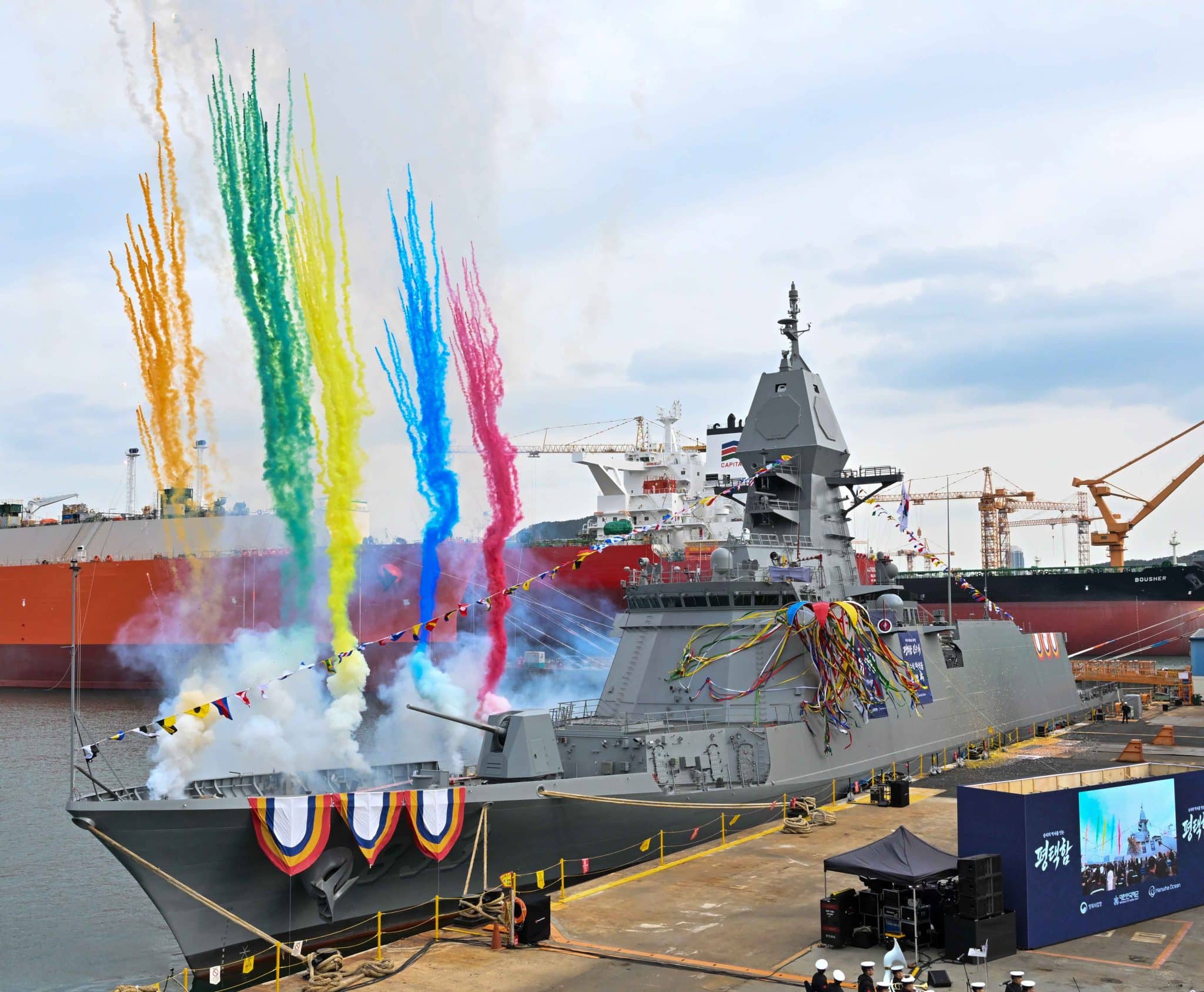
Hanwha Ocean launched South Korea’s fifth FFX Batch-III frigate, ROKS Pyeongtaek (FFG-833), featuring upgraded electronic warfare and cybersecurity systems.
ROK Navy and Defense Acquisition Program Administration(DAPA) joint press release translated by Naval News
The Republic of Korea Navy and the Defense Acquisition Program Administration (DAPA) held a launch ceremony for ROKS Pyeongtaek (FFG-833) at Hanwha Ocean’s Okpo shipyard in Geoje on the afternoon of November 18. It is the fifth frigate in the Ulsan-class Batch III program, also known as FFX Batch-III.
The Batch III frigates will replace the Navy’s aging frigates (FF) and patrol combat corvettes (PCC). Chungnam was the lead ship, followed by Gyeongbuk, Jeonnam and Jeju. Each successive batch introduces improvements to the same basic ship design.
In keeping with its practice of naming frigates after Korean cities and provinces, the Navy named the fifth ship after the city of Pyeongtaek, home to its Second Fleet Command.
This is the second ROK Navy ship to bear the name. In 1996 the ROK Navy acquired a salvage and rescue ship from the U.S. Navy and commissioned it as Pyeongtaek (ATS-27). It served for about 20 years before its decommissioning in December 2016. The new frigate revives the name in honor of its predecessor.
Hanwha Ocean signed the construction contract for the Korean-designed frigate in November 2023. Construction began with a steel-cutting ceremony in 2025, when the yard cut the first plate for the hull. At the keel-laying ceremony in 2026, workers set the first hull block on the building ways.
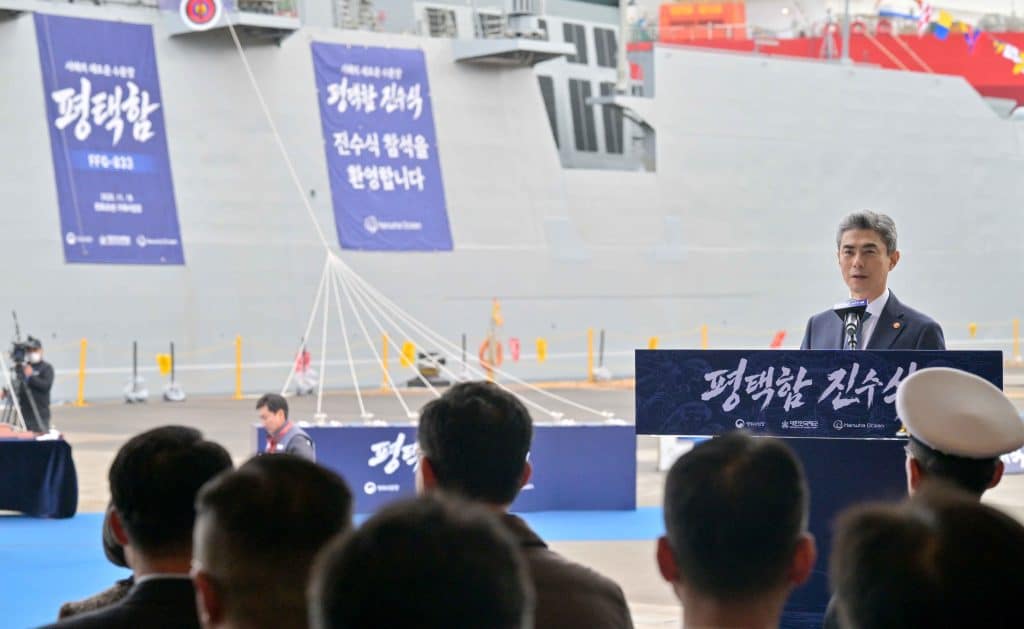
Minister of National Defense Kang Shin-chul was the guest of honor. About 150 representatives of the Navy, DAPA and the shipbuilder attended, including Chief of Naval Operations Adm. Kim Kyung-ryul, Chung Jae-joon, head of DAPA’s Current Capabilities Program Agency, and Hanwha Ocean CEO Hee Cheul Kim.
The ceremony opened with honors to the nation. A report on the program’s progress and the formal announcement of the ship’s name were followed by commemorative remarks, awards for contributions to the program and a congratulatory address. The proceedings closed with the launch and a traditional ceremony to wish the ship safe passage.
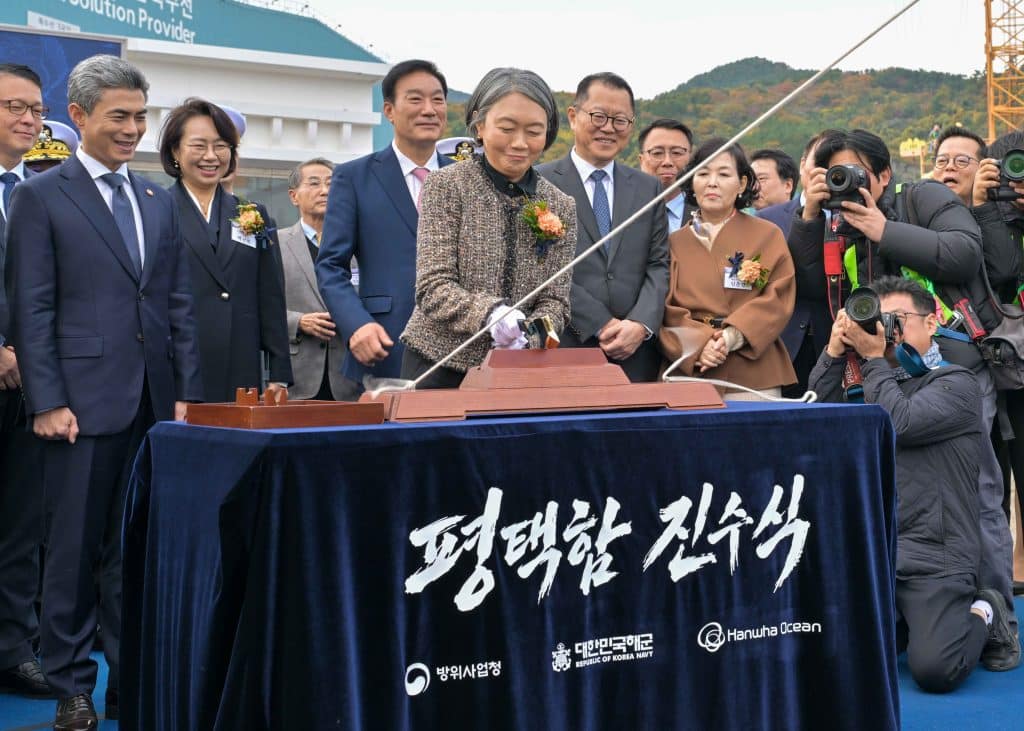
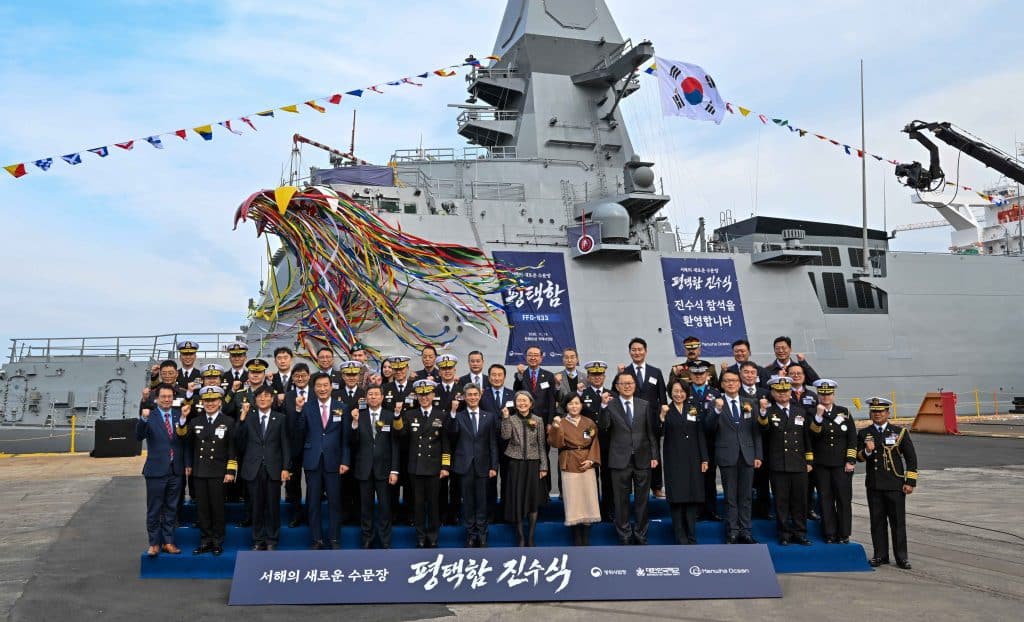
In keeping with naval tradition, Lee Hye-kyung, the defense minister’s wife, cut the launch line. Like the cutting of a newborn’s umbilical cord, the act symbolizes giving life to the new ship. Dignitaries then used scissors to cut ribbons in five colors, releasing champagne bottles that broke against the hull to wish the ship a safe passage.
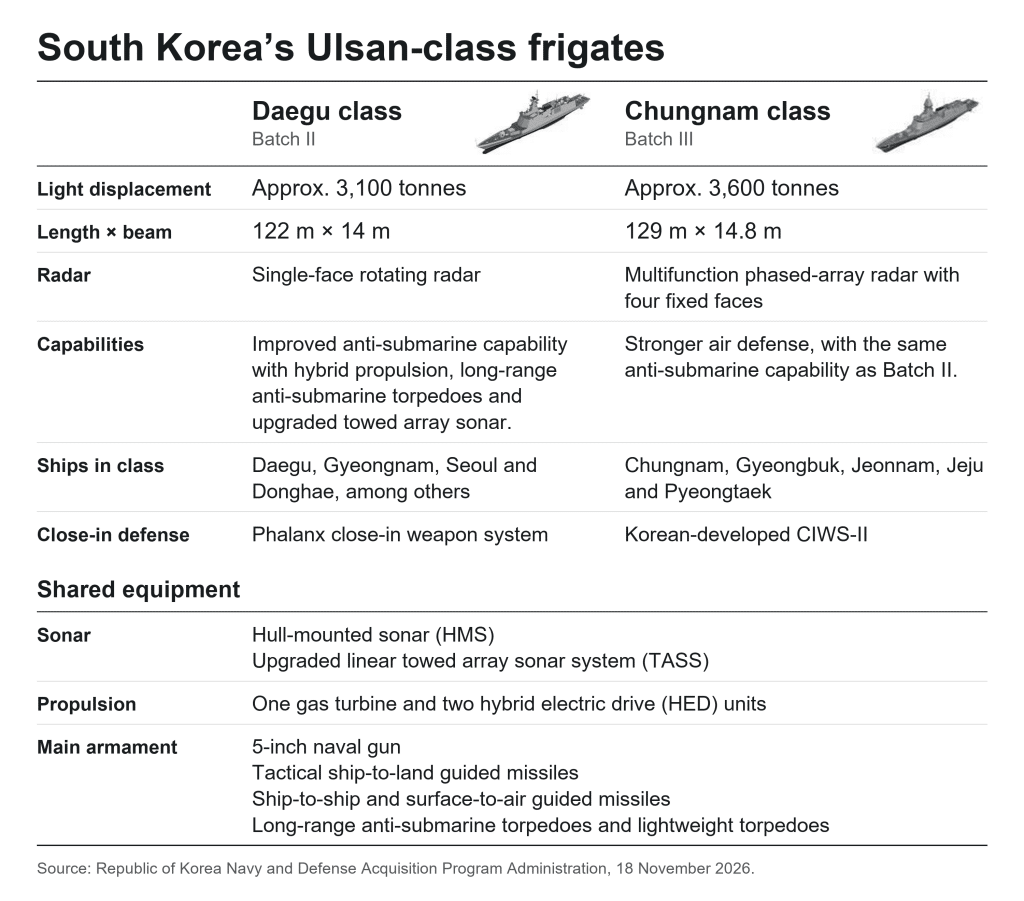
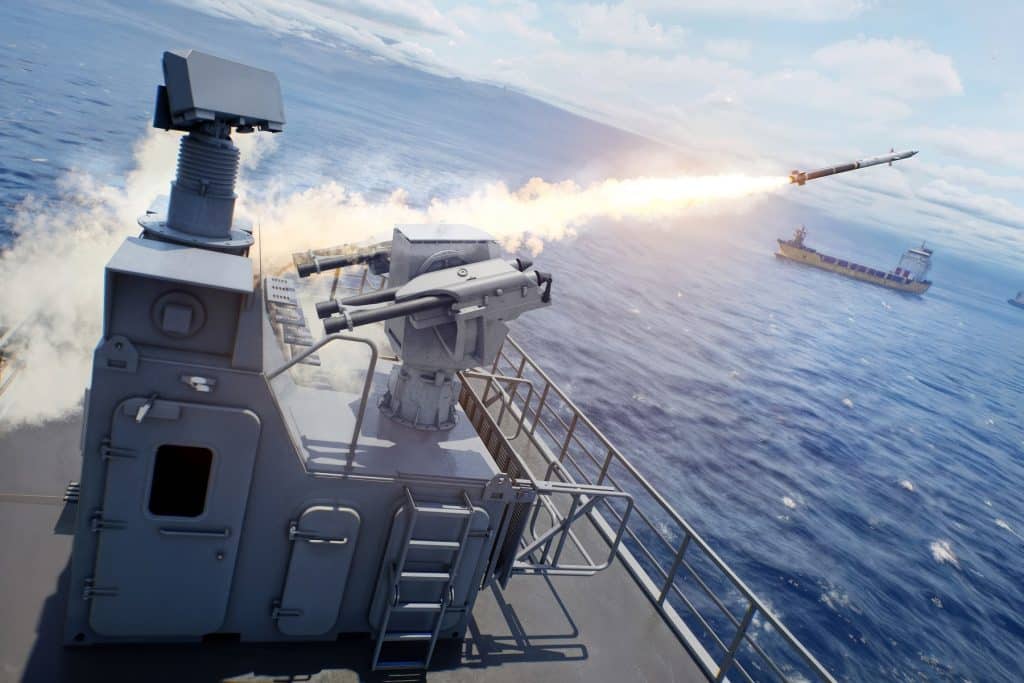
The Navy’s fifth 3,600-tonne frigate measures 129 meters in length, 14.8 meters in beam and 38.9 meters in height. Its main weapons and launch systems include a 5-inch naval gun, the Korean Vertical Launching System (KVLS), anti-ship missile interceptors, ship-to-ship missiles, tactical ship-to-land missiles and long-range anti-submarine torpedoes.
The frigate brings together the capabilities of South Korea’s defense industry. Its combat management system, the ship’s “brain,” is Korean-made, as are its principal sensors and weapons.
ROKS Pyeongtaek (FFG-833) carries a domestically developed multifunction phased-array radar (MFR) with four fixed faces. Like an Aegis radar, it can detect and track air and surface targets in all directions and support engagements against multiple air targets simultaneously.
The frigate’s Integrated Sensor Mast (ISM) has a stealth design and houses both the four fixed radar arrays and an infrared search and track system.
The ship’s hybrid propulsion system keeps underwater radiated noise to a minimum. A domestically developed hull-mounted sonar (HMS) and towed array sonar system (TASS) give the frigate a strong anti-submarine warfare capability.
ROKS Pyeongtaek is a state-of-the-art frigate that brings together advanced technologies developed here in Korea. It demonstrates the strength of our defense science and technology and our ability to build warships. With this proven technology, we expect the frigate to make a significant contribution to future defense exports.
Chung Jae-joon, Head of DAPA’s Current Capabilities Program Agency
ROKS Pyeongtaek will play a key role in defending the West Sea [Yellow Sea] and will carry out its assigned missions to the highest standard. As an elite navy charged with protecting our people, we will always stand by them. We will draw on the advanced technologies of the future to build an even stronger navy.
Rear Adm. Lee Gu-seong, head of the Planning and Management Staff at ROK Navy Headquarters
Following sea trials, Pyeongtaek is scheduled for delivery to the Navy in December 2027. The ship will then complete its operational work-up before deploying.
Naval News Comments
As ROKS Pyeongtaek marked the first surface combatant launch under the Hanwha Ocean name, the sixth and final Batch-III frigate was already taking shape alongside it at Okpo. The yard’s previous surface combatant launch had been the Daegu-class frigate ROKS Pohang in September 2021, when the shipbuilder was still Daewoo Shipbuilding & Marine Engineering. Work at Geoje now extends into FFX Batch IV, for which Hanwha holds the contract to build the first two ships.
Speaking to reporters at Okpo, Senior Vice President Chae Kyung-min, Head of Naval Ship Domestic Marketing Department, highlighted two changes from the lead ship, ROKS Chungnam. ROKS Pyeongtaek carries upgraded electronic warfare equipment and adds an onboard cybersecurity monitoring system. The latter reflects a broader ROK Navy effort to monitor cyber threats at sea. As early as 2022, Navy Headquarters was pursuing a pilot project to monitor shipboard systems remotely for signs of cyber threats. At the Naval Intelligent Informatization Policy Development Seminar in June 2026, researchers also discussed how to detect malware in encrypted maritime communications.
Pyeongtaek was the first frigate the yard had launched in five years. Chae said the yard cut several months off construction by assembling the hull in larger sections known as “mega-blocks”, before moving them into position for final assembly. Chae also put domestic content for frigates of this type at 90 percent or more, with most Korean suppliers based in Busan and nearby South Gyeongsang Province, including Geoje itself. For a navy weighing delivery times, Hanwha can point to a supplier base already at work on follow-on ships.