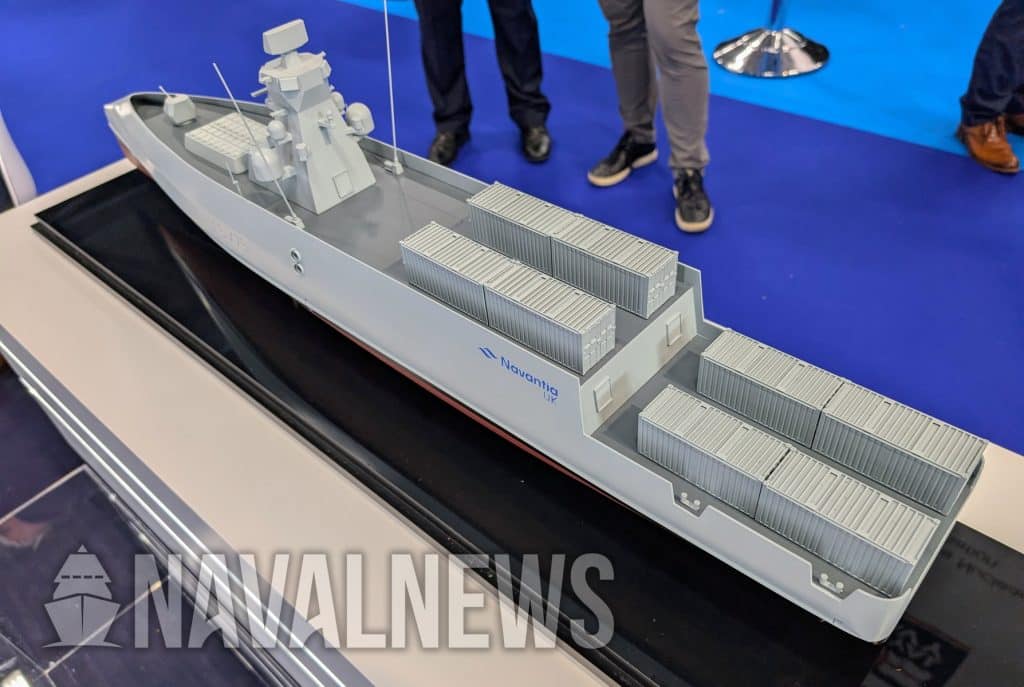
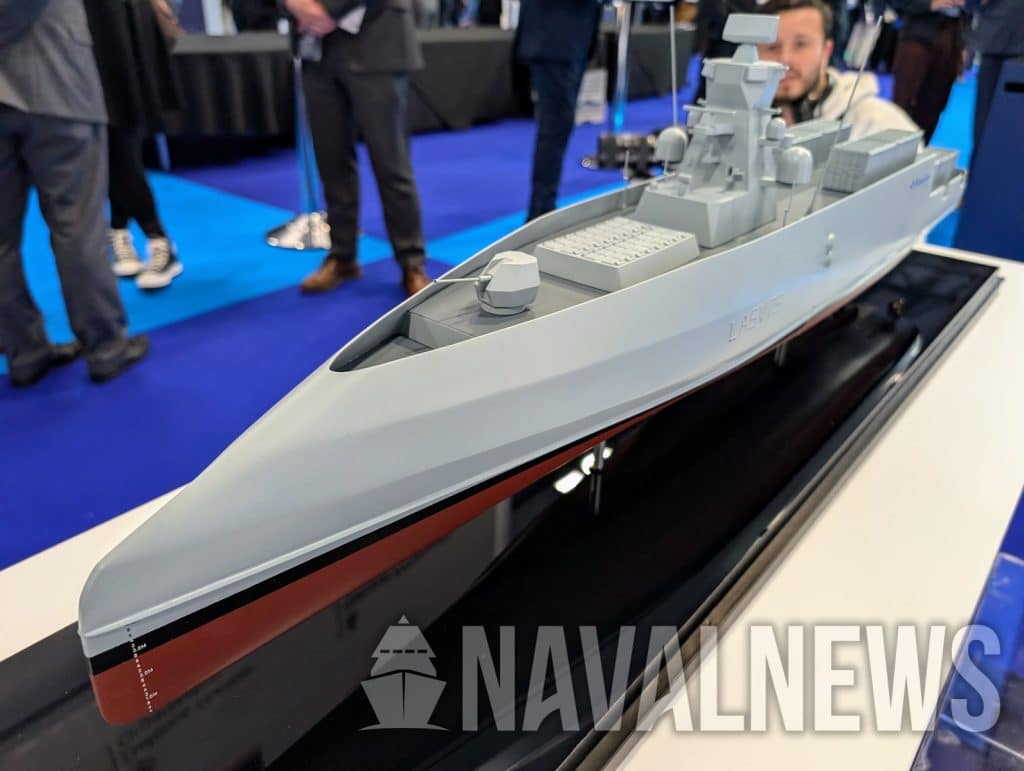
Navantia UK publicly unveiled a scale model of its new LASV75 large autonomous surface vessel concept during the Navy Leaders Combined Naval Event (CNE), held in Farnborough from 19-21 May.
Story by Kate Tringham, interview by Xavier Vavasseur
The concept design, dubbed LASV75, is intended to support the UK Royal Navy’s (RN’s) emerging ‘hybrid navy’ construct of crewed, uncrewed and autonomous platforms, the shipbuilder said.
Based on a modular 75 meters-long hull and displacing more than 1,000 tonnes, the LASV75 is designed to carry out a range of missions either independently or in support of a task group, including surveillance, escort, electronic warfare and strike-related operations depending on payload configuration.
Speaking to Naval News at CNE 2026, Simon Jones, product development director at Navantia UK, said the LASV75 was developed by the company’s Bristol-based design team as part of a broader effort to address future RN and allied operational requirements.
“This is our vision for what we think the hybrid navy will need in the future to have a credible and persistent capability,” he said. “To have true persistent capability in the North Atlantic, for example, in harsh cold weather conditions, we believe something of this scale is necessary.”
Conceived from the outset as an uncrewed platform, the concept dispenses with traditional crew accommodation and associated support systems in order to maximise payload flexibility and endurance.
The scale model on display at CNE featured a configurable payload deck supporting containerised mission systems, interchangeable sensor fits, and a modular mast arrangement.
Navantia UK is exploring both ‘NavyPOD’-style payload modules and NATO-standard interfaces to facilitate interoperability with partner navies.
“We’re thinking about standard interfaces aligned to NATO standards to make these as interoperable and interchangeable as possible,” Jones said.
Navantia UK is collaborating with autonomy and mission-system partners across industry to mature the design concept. Manufacturing and scalability have been key considerations during the design phase, and the company is exploring how to design the vessel in such a way that it can be built quickly and efficiently at low cost, and then rapidly scaled.
According to Jones, construction of LASV75 USVs would initially be undertaken at the company’s Appledore facility in Devon, which is a smaller shipyard that can accommodate vessels up to 120 m in length.
Navantia UK’s larger Belfast facility remains focussed on delivering the GBP1.6 billion Fleet Solid Support (FSS) programme, which continues to make progress. First steel for the first-of-class was cut at Appledore in December 2025, while an 85 m barge was launched from Methil in early May to transport blocks and components between Appledore and Belfast.
The autonomous vessel concept was unveiled against the backdrop of Navantia UK’s wider industrial expansion following the acquisition of Harland & Wolff assets in 2025 and ongoing investment across its four UK shipyards – Appledore, Arnish, Belfast and Methil. According to the company, GBP157 million is being invested in the modernisation effort, which includes the introduction of digital shipbuilding tools and advanced manufacturing infrastructure aimed at reducing naval vessel delivery timelines by up to 30 per cent.