Navantia Australia has presented two new ship designs at the Indo Pacific 2025 Maritime Exposition in Sydney. The two developments are the Alfa 4000 Light Frigate and the Smart LPD amphibious multirole landing platform dock (LPD) ship.
The new models were part a wider theme on flexible and innovative concepts by the shipbuilder last week in Sydney.
Alfa 4000 as amalgam of earlier Navantia-proposals
The Alfa 4000 is a significant redevelopment of earlier proposals the company offered for Australian and other international requirements. These two designs were the Tasman-class corvette and the Alpha 5000 Combatant. The shipbuilder two years ago at Indo Pacific 2023 proposed the Tasman-class for the then notional “Tier 2”-requirement of the Royal Australian Navy. The Tasman-class is directly related to the Alpha 3000-design the builder has sold as “Avante“-class to Saudi-Arabia.

The RAN-effort later developed into the SEA 3000 program, which saw MHI receive preferred candidate-status earlier this year with their significantly larger “Upgraded Mogami” (aka 06FFM)-design. The Alpha 5000 Combatant meanwhile was a heavier armed design more in line with serving as a direct ANZAC-class replacement. Naval News has in the context of Indopac 2023 provided a detailed description for both proposals. The Spanish shipbuilder has several years ago also presented a different configuration carrying the name “Alfa 4000”, with minor variations in armament and overall dimensions.
Moderate armament meets increased sensor capability
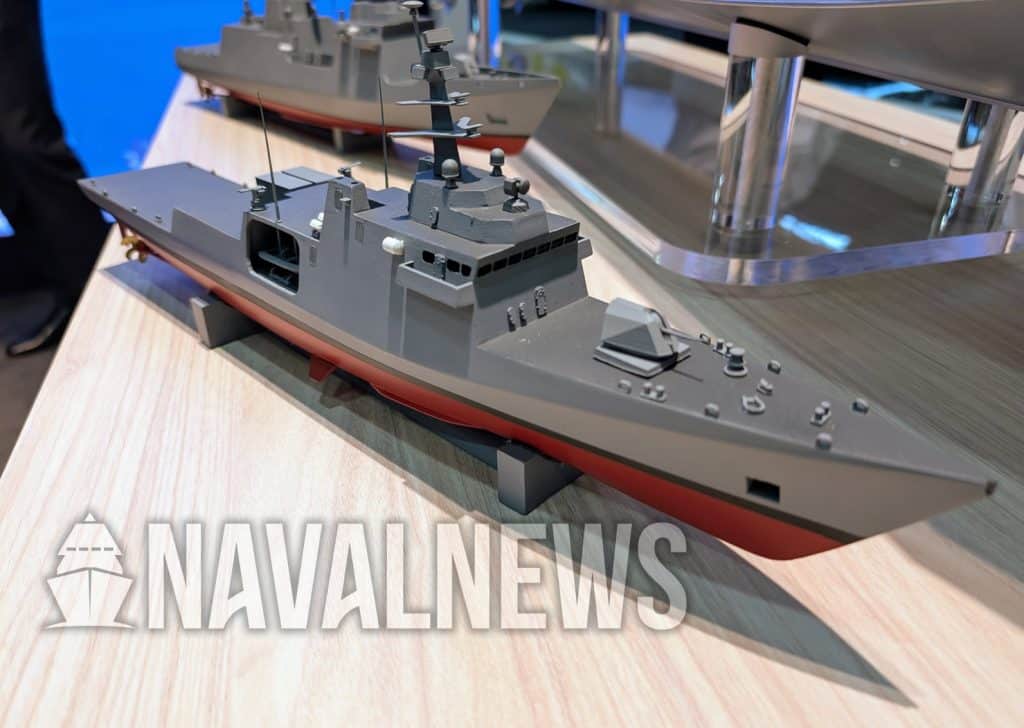
The Alfa 4000 effectively merges capabilities of these earlier designs, integrating them on a lengthened Alpha 3000-hull. As the name suggests, this frigate displaces 4.080 tons. The hull is 112.4 metres long and 15.35 metres wide. While the design therefore is approximately 15 metres longer than the Alpha 3000, the beam is identical.
Navantia terms the warship a “light frigate”, based on the somewhat moderate armament, which is identical with that of the earlier Tasman-class. Missile-capacity includes 16 cells of the Mk 41 VLS in Strike-length, and four quadruple launchers for NSM antiship missiles. Guns include the Bofors 57 mm autocannon on the bow and a smaller CIWS above the hangar, resembling the Rheinmetall 35 mm Millenium gun. The frigate also carries two triple launchers for lightweight torpedos and decoy launchers. A helicopter landing pad and hangar can accommodate a medium weight helicopter such as the MH-60 Seahawk.


Similar to the older Alpha 5000 Combatant the Alfa 4000 offers enhanced sensor capability via a six face AESA on the integrated mast above the bridge. Like Navantia’s earlier designs the light frigate offers a mission bay below the helicopter hangar, which can mount a CAPTAS-type towed sonar, in addition to a hull-mounted sonar.
Propulsion is an integrated electric design, based on four primary diesel engines driving two electric motors, which in turn power the two propellers. The Alfa 4000 is capable of operating in up to sea state 6, and can conduct helicopter operations up to sea state 4.

Prospects for Alfa 4000 in Sweden
While Navantia, as outlined, has considerable history in presenting new variants of export designs tailored to anticipated requirements, the Alfa 4000 has recently made one step closer to possible production. As Swedish media reported on November 4, the Swedish government has downselected Navantia’s Alfa 4000 frigate together with competing designs from French Naval Group and British builder Babcock, possibly in cooperation with Swedish Kockums. In discussion with Naval News officials from Navantia Australia particularly emphasised the builder’s ability to rapidly deliver the new warships. Sweden has a requirement for four new frigates.
The Smart LPD “Dual Role” vessel
Additionally, the Spanish shipbyard has also presented a completely new proposal for an amphibious multirole vessel. In discussion with Naval News Navantia-representative Luke Baxter, mechanical engineer at Navantia’s Innovation Group, characterises the Smart LPD as a “dual role”-design. In addition to providing classic amphibious landing capabilities, Smart LPD also serves as a command and control-vessel for a variety of drones, including UAV, USV and UUV-platforms.

Galicia-Class as starting point of development
The baseline hull for Smart LPD is the Galicia-class amphibious dock vessel currently in service with the Spanish Navy. Navantia has extended the Galicia-hull and completely re-designed the superstructure. The result is a 20,000 ton-vessel at an overall length of 200 metres and a beam of 30 metres. The extended hull notably provides space for a full electric propulsion. Diesel generators power electric motors, similar to the Alfa 4000 outlined above. Installed power and azimuth thrusters allow for a top speed of 23 knots. In conjunction with the bow thrusters the configuration also allows significant manoeuvrability.
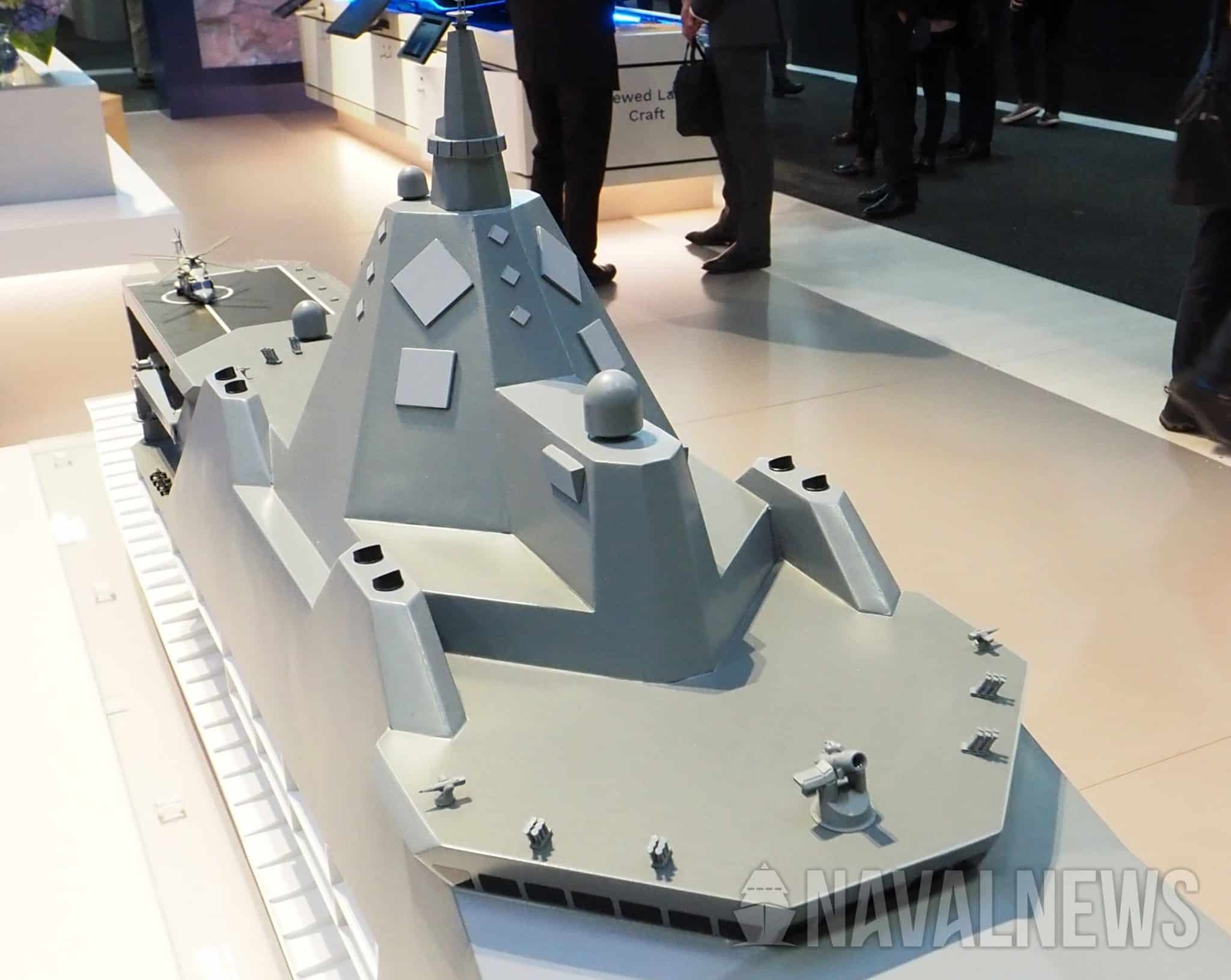
LPD-traits include a floodable welldock accommodating two LST-type landing boats behind a vehicle bay for trucks or armored vehicles. A sizeable flightdeck includes two landing spots for helicopters and a single hangar.
Air-, sea- and undersea-drone platform
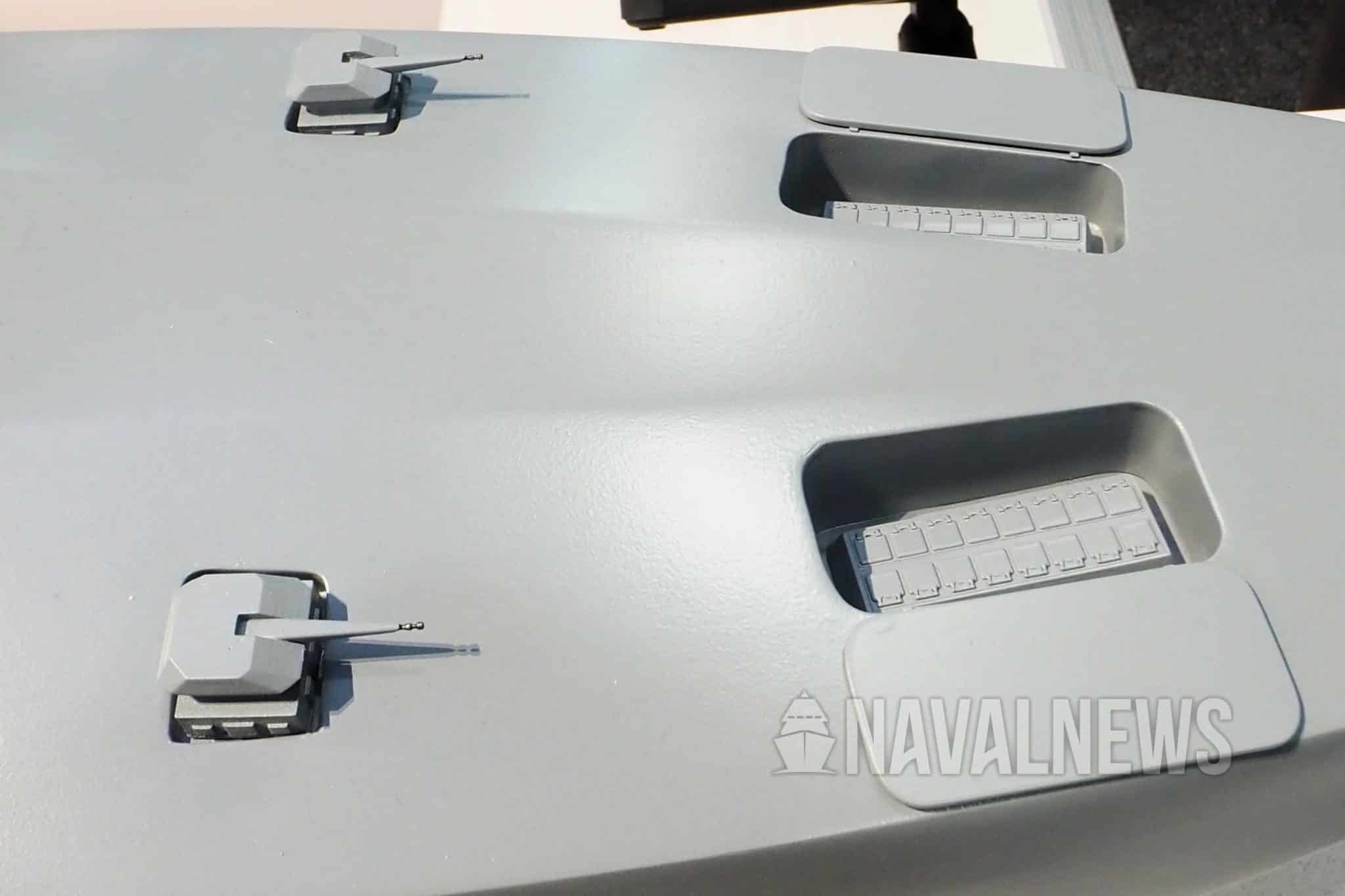
Unlike traditional landing ships the Smart LPD includes relatively heavy armament. A Mk 41-style VLS offers 32 cells in two banks on the bow. These missile cells also enable the launch of large numbers of compatible drones for “swarming” operations. Several medium calibre guns, again resembling the Rheinmetall Millenium-turret, provide 360 degree coverage. Notably the Smart LPD carries two laser-based energy weapons on the bridge and astern on the hangar. Defensive armament also includes decoy launchers and remote-controlled heavy machine guns.
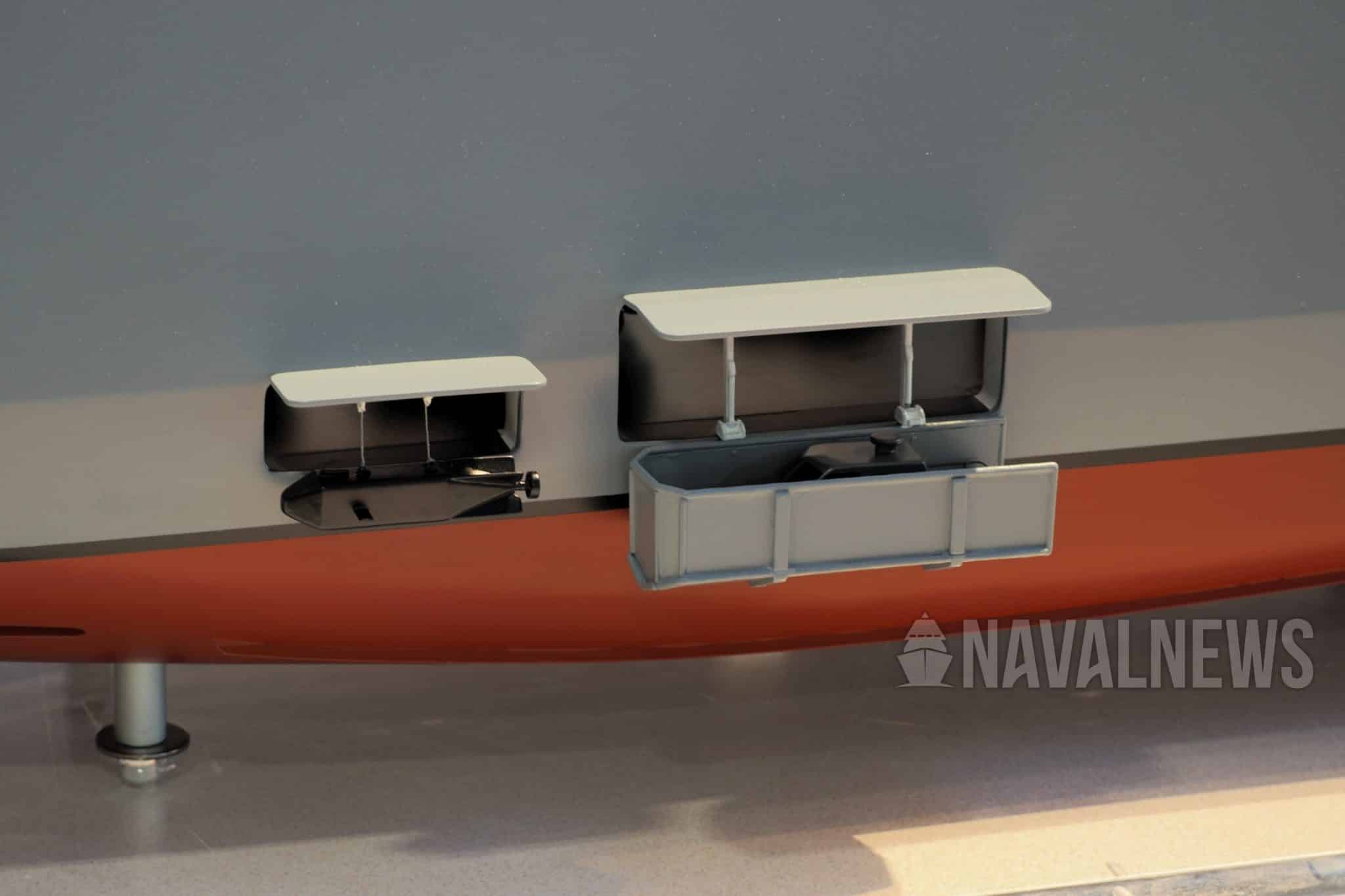
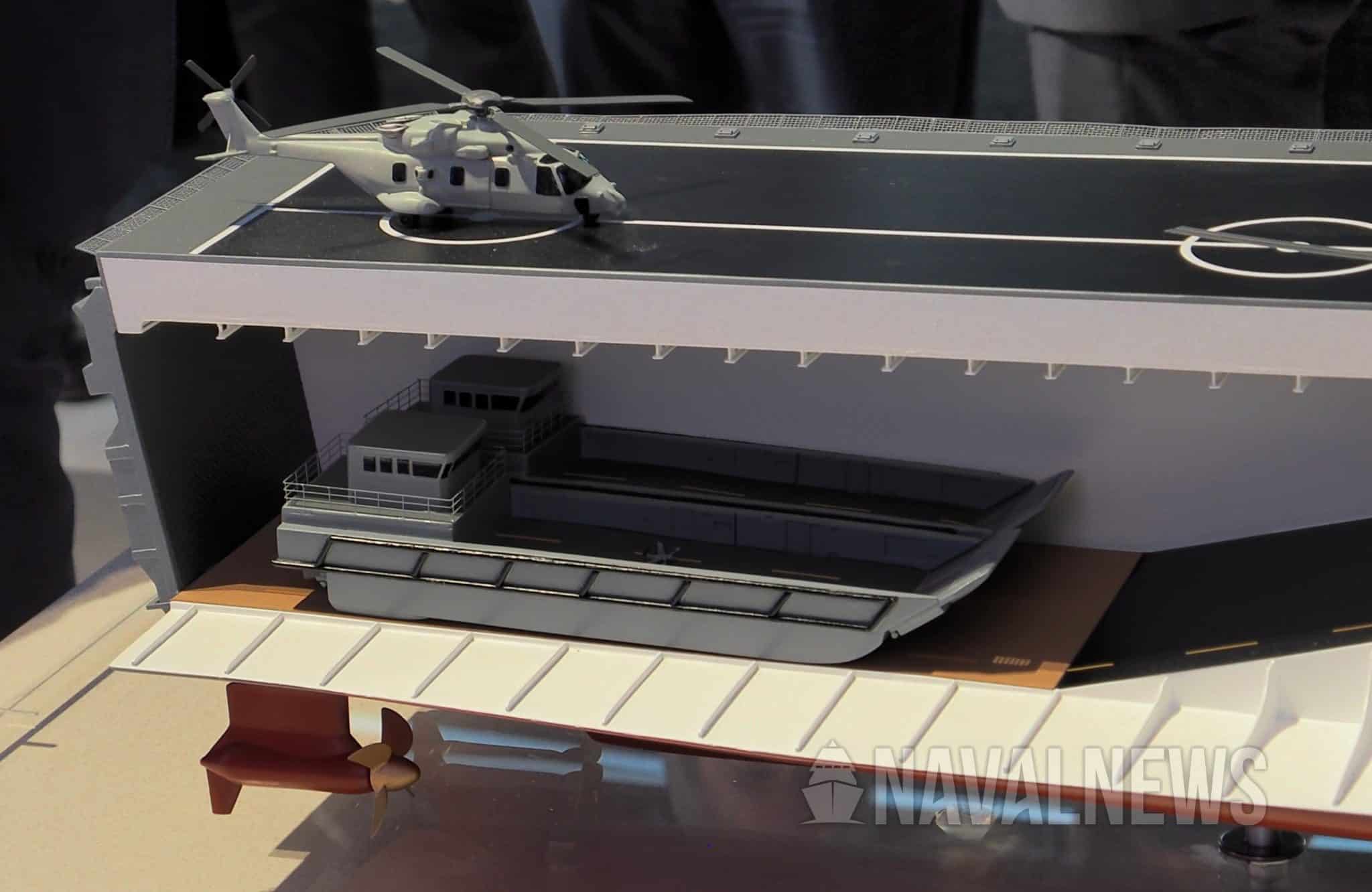
Navantia envisions the Smart LPD as drone command and control mothership. The model at Indo Pacific 2025 includes a number of vehicles to emphasise this point. Several small fixed wing drones can operate from the flightdeck via portable catapult launchers. More notably the ship provides dedicated launch bays for USV and UUV port and starboard at waterline level.
Command and control-facilities include dedicated spaces for the drone operators onboard. The Smart LPD also integrates a sizeable main mast carrying eight large panels for a relevant AESA combination. Smaller apertures and communication gear complete the electronic configuration.
The ship has a core crew of 170 personnel and can accommodate a maximum of 560 sailors and ground troops.
Navantia emphasises that the design is conceptual and not aimed at a particular national requirement. The effort acknowledges increased global demand for flexible multirole capability at sea, with a particular consideration for operation of uncrewed systems.

An amphibious hull is desirable, as vessels like the Smart LPD allow for considerable space and weight reserves. Additionally, the integrated electric propulsion-setup combined with the significant fuel reserves of large amphibious vessels also provides deeper power reserves both for command and control, or notionally recharging uncrewed electric drones onboard.
Therefore, while Smart LPD remains more of a vision for future requirements, an appearance of more refined variants which Navantia tailors to particular national designs appears at least plausible for future defence trade shows across the globe.
Check out ‘Naval News‘ video coverage of the Smart LPD at Indo Pacific 2025: