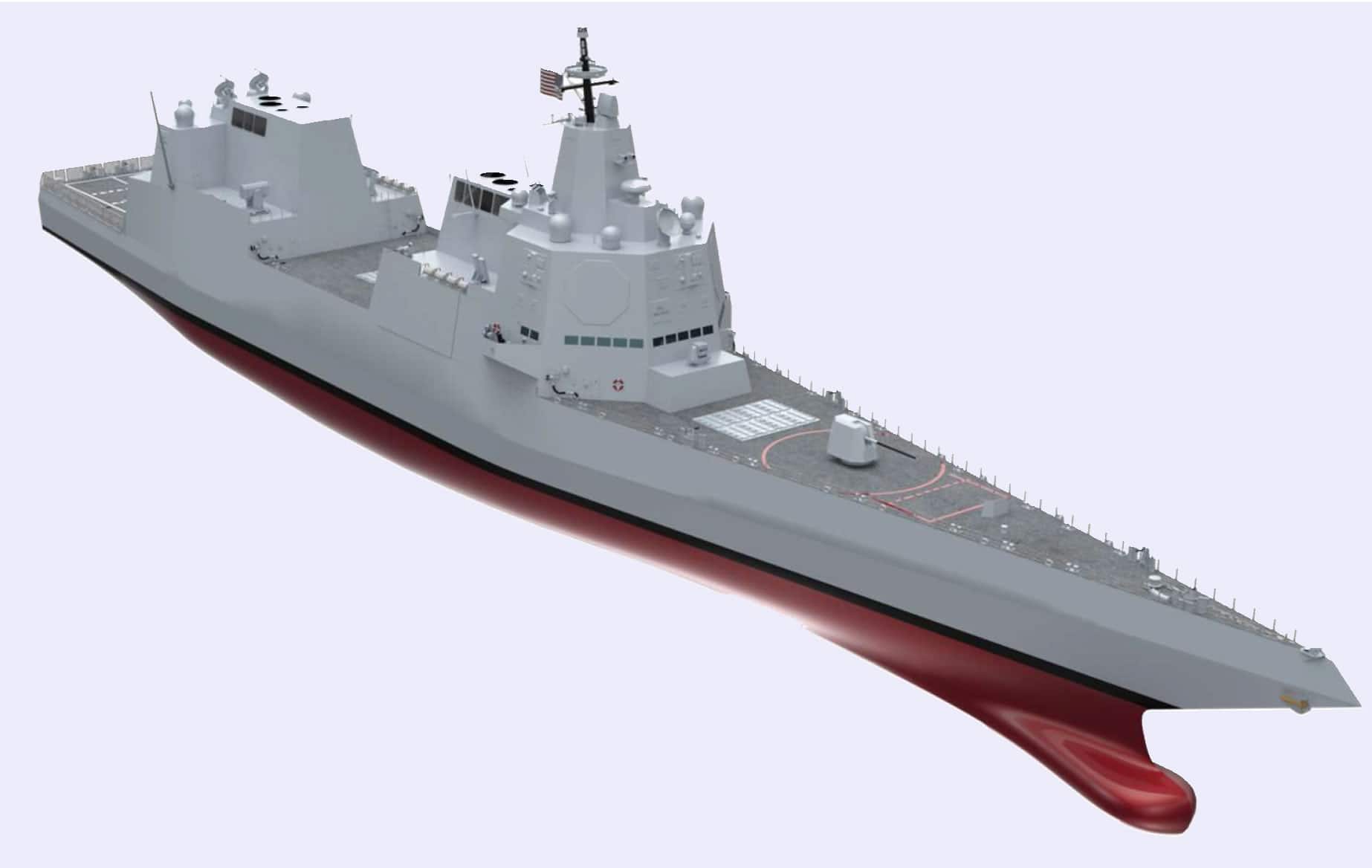
“The imperative for DDG(X) is the warfighting imperative,” Rear Admiral Fred Pyle, the USN’s Surface Warfare Director (OPNAV N96), told the Surface Navy Association (SNA) 2023 national symposium, in Arlington, Virginia, on 11 January.
“The ‘so what’ behind DDG(X) is that capability to deliver larger missile launchers so we can have a stick that meets that of the adversaries. That’s a key element,” said RADM Pyle.
“For DDG(X), I think we have a good picture on the top-level requirements. It’s going to bring us the opportunity to use larger missile launchers. It’s going to bring us the opportunity to use more higher-power lasers and long-range strike hypersonic weapons, as well as sensor growth, as we go into the future. That’s the ‘so what’ behind DDG(X) and the warfighting capability it brings.”
Rear Admiral Fred Pyle, the USN’s Director Surface Warfare/N96
“Shipbuilding is a long game,” RADM Pyle explained. “So, when we achieve the directed energy power we’re looking for, or high-power microwaves, or … lasers, we want to have a platform to land it on. That’s a key capability as well.” Here, he noted the need for the ship’s operational design requirement to accommodate larger sensors.
“The warfighting imperative for DDG(X) gives us the opportunity to get a larger missile launcher, increase our capacity of weapons, deliver long-range strike hypersonic weapons, and increase directed energy weapons that we have on board as well as growth sensors such as the [Raytheon] SPY-6 [active electronically scanned array 3-D radar], to pace the threat going into the next decade and beyond,” RADM Pyle told Naval News, in an exclusive interview on the SNA exposition show floor.
Provision to install a larger missile launcher to increase DDG(X) weapons capacity reflects the navy’s intent to grow conventional strike capability across its surface fleet, including through installation of large missile vertical launch systems (LMVLS) that can carry a broader range of weapons, and through increasing inventory and stock of key weapons systems including the Naval Strike Missile, Tomahawk land-attack missile, and Standard Missile (SM)-6.
RADM Pyle noted a second imperative – what he referred to as ‘SWPC’, namely space, weight, power, cooling. While underscoring the significant capability the in-service Arleigh Burke-class destroyer has delivered for nearly 40 years, the admiral said there is now an issue with space, weight, power, and cooling in US DDG design and capability. “The margin for those in that capability is no longer there,” he told Naval News. “We need DDG(X) to have a margin for that space, weight, power, and cooling.”

As regards the timeframe for delivering DDG(X), “We’re going to start moving out on that effort at the end of the decade/beginning of the next decade,” RADM Pyle told the SNA symposium.
The USN’s Chief of Naval Operations (CNO) Admiral Michael Gilday reiterated the importance of DDG(X) for the navy. “We need that platform,” CNO told the SNA audience, in his keynote address on 10 January. Adm Gilday noted that transition to DDG(X) will begin in the early 2030s. He highlighted, however, various programmatic and funding commitments the USN will need to balance across the timeframe. “That transition [to DDG(X)] needs to be deconflicted a bit with the investments we’re making in NGEN [a major information technology, data, and communications infrastructure programme] and the investments we will make later in the decade in SSN(X), the next generation submarine. In the middle falls DDG(X).”