NAVAIR press release
“What an incredible day for the U.S. Navy, our Australian partners, and the Airborne Electronic Attack (AEA) community. We witnessed a successful first flight with the NGJ-MB capability fully integrated onto the EA-18G Growler, validating the last four years of development and the extensive efforts of these last several months in preparation. I’m extremely proud of the entire Government and industry team.”
Capt. Michael Orr, AEA Systems (PMA-234) program manager
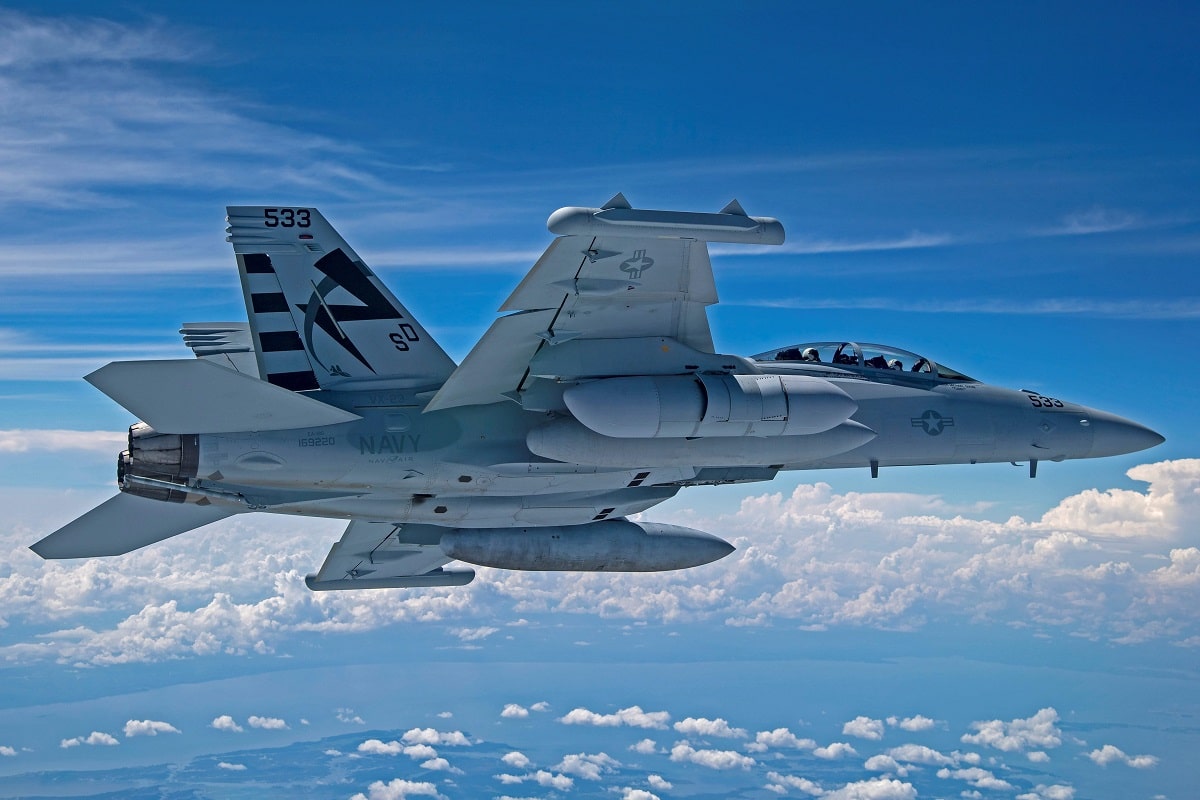
The first flight, conducted by Air Test and Evaluation Squadron (VX) 23, is a Safety of Flight (SOF) checkout that ensures the pods can be safely flown on the EA-18G aircraft for follow-on test flights.
“There was a lot of discussion on how the NGJ-MB pod would affect how the Growler handles and it was exciting to have the jet feel like any other flight,” said Lt. Jonathan Williams, VX-23 test pilot. “We have a great test team to thank for making today happen and I look forward to seeing how the Growler team brings out the full potential of the NGJ-MB pod.”
The NGJ-MB system, developed by Raytheon Intelligence and Space, is part of a larger NGJ system that will augment, and ultimately replace the legacy ALQ-99 Tactical Jamming System (TJS) currently used on the EA-18G Growler. NGJ-MB is an external jamming pod that will address advanced and emerging threats using the latest digital, software-based and Active Electronically Scanned Array technologies and will provide enhanced AEA capabilities to disrupt, deny and degrade enemy air defense and ground communication systems.
“The AEA community has been relying on the ALQ-99 TJS for decades,” said Lt. Jonathon Parry, NGJ-MB Aeromechanical Project Officer. “Gone are the days of isolated Surface-to-Air Missile systems that operate on a small frequency spectrum and do not integrate into a larger Integrated Air Defense System. Modern adversaries are developing complex emitters that use advanced techniques to defeat legacy jamming. NGJ-MB will provide new capabilities to the fleet to ensure spectrum dominance against current and future threats.”
PMA-234 is responsible for acquiring, delivering and sustaining AEA systems, providing combatant commanders with capabilities that enable mission success.