According to Taiwan’s Ministry of National Defense, the Chinese Navy Shandong Carrier Group transited the Bashi Channel on April 5th from the South China Sea to conduct her first Western Pacific Cruise Exercise. Multiple Taiwanese surface combatants, aircrafts and land-based radar systems closely monitored the group’s movement. By the evening, the Joint Staff Office (JSO) of the Japanese Ministry of Defense stated that the Carrier Group, consisting of Shandong herself along with Type 054A Guided Missile Frigate Liuzhou (FFG-573) and Type 901 Fast Combat Support Ship, Chaganhu (AOE-905) was spotted 300 km south of Hateruma Island. Japan Maritime Self-Defense Force (JMSDF) Destroyer, JS Sawagiri (DD-157) was shadowing the group.

On April 7th to 9th, while operating south of Miyako Island, the Shandong Carrier Group was joined by two additional surface combatants: Type 052D Guided Missile Destroyer, Jiaozuo (DDG-163) and type 054A Guided Missile Frigate, Xuchang (FFG-536) .
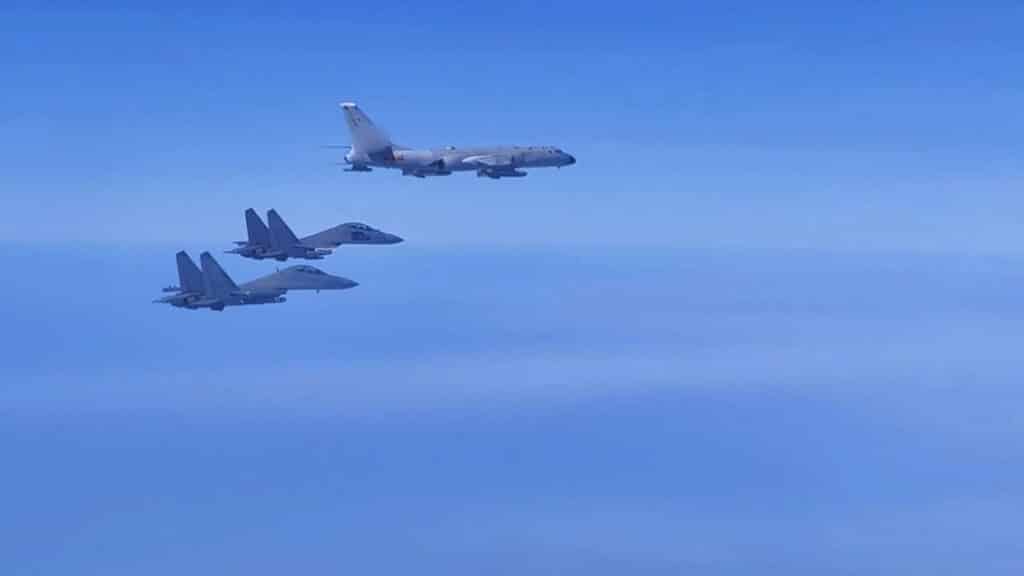
Over 140 fixed wing and rotary wing sorties were generated from the group in the span of three days, according to Japan’s JSO report. That’s including 80 J-15 Fighter sorties which forced the Japan Air Self-Defense Force (JASDF) to scramble their F-15Js stationed in Naha Air Base, Okinawa to respond as the J-15s were operating within the Southern sector of the Japanese Air Defense Identification Zone.
In comparison, the USS Nimitz (CVN-68), also operating in the Western Pacific in the same period, is capable of generating 120 sustained sorties within 12 hours a day (240 sorties in a “surge” configuration within 24 hours a day.).
According to CNN, the Chinese navy for the first time appears to have simulated strikes by aircraft carrier-based warplanes on Taiwan.

As part of the three day “Joint Sword” exercise led by the PLA Eastern Theater Command, multiple aircrafts from the Chinese Air Force (PLAAF) and Naval Air Force (PLANAF) were operating in the southwest sector of the Taiwanese Air Defense Identification Zone as well as additional surface combatants operating in the Formosa Strait. Intensive ISR and tanker flights also supported the exercise in order to conduct an “around the island” combat readiness training.
According to Chinese state media, the goal of the ”Joint Sword“ exercise is to simulate the ability to form a naval and air blockade around Taiwan to cut off the supply line to the island, with the carrier group providing the eastern coverage. China currently possesses two aircraft carriers, offering a very limited carrier strike capability from the east of Taiwan; however, with a third larger carrier, Fujian (Type 003) currently at fitting out stage and a fourth one being planned, China might able to form a more robust blockade and apply more pressure to the eastern defense of Taiwan.