In an Australian Securities Exchange filing on 15 October, the latter announced, “Civmec Limited and NVL B.V & Co KG (Naval Vessels Lürssen) of Bremen, Germany have entered into a non-binding heads of agreement detailing the framework for the transfer of ownership of Luerssen Australia Pty Ltd to Civmec Limited.”
The proposed change of ownership requires governmental consent, but the two parties have immediately begun engaging with Canberra to gain all necessary approvals.
They hope to complete the deal by 31 December 2024, with one priority being a framework for the interim period so that Sea 1180 is closely managed and the RAN benefits from the takeover agreement.
Civmec announced, “Upon completion of the potential transaction, NVL will transfer all its shareholding in Luerssen Australia Pty Ltd to Civmec Limited, including all assets, employees and licenses. This ensures the uninterrupted design and build of the Arafura-class offshore patrol vessels at the Osborne South shipyard in South Australia and the Civmec-owned facility in Henderson, Western Australia.”
Civmec Executive Chairman Jim Fitzgerald, added: “The acquisition of Luerssen Australia is a natural step for Civmec as a sovereign Australian shipbuilder with world-class shipbuilding facilities and an experienced shipbuilding workforce. Having worked on the project since 2018, we’re confident in our ability to execute the remaining work scope and ensure a smooth transition for all stakeholders.”
Luerssen Australia had subcontracted Civmec in April 2018 to provide steel for the OPV hulls and block fabrication. It completed its portion of the project in June 2024. If the takeover is approved, Civmec can reengage its shipbuilding workforce that it earlier had to redeploy.
This planned takeover comes at a time of great strife. The OPV programme, which should have been straightforward, was placed on the projects of concern list on 20 October 2023. The defence budget released in May coyly said, “The project has experienced delays in delivery of both the vessels and the associated support system, with schedule delays first emerging in 2021.”

According to the contract Luerssen Australia was awarded on 31 January 2018, the first vessel should have been handed over to the RAN in late 2021. This means the project is currently three years behind schedule.
According to the latest FY2024-25 defence budget, Sea 1180’s approved shipbuilding expenditure was A$3.705 billion (€2.29 billion), of which A$1.626 billion had been spent as of June this year. The coming FY2024-25 budget allocated an additional A$469 million for the project.
Concerning the planned sale, Tim Wagner, Luerssen Australia’s Chairman, noted, “We’re very confident in Civmec’s ability to finish the remaining works on the Sea 1180 project, and NVL will ensure they are supported by us until Civmec’s successful completion of the project. We appreciate there are many details to work through, and we look forward to engaging with all stakeholders, including the Commonwealth, Luerssen Australia employees and suppliers to ensure a smooth and successful transition.”
Sea 1180 / Arafura-class OPV: A troubled program
This OPV programme was dogged by trouble from the start, and construction has proceeded at a snail’s pace. COVID-19 had a role to play in slowing the already complicated government-mandated build of the first two OPVs in Osborne near Adelaide, and the remainder in Henderson. Canberra initially attempted to insert Austal into the project, but Luerssen stuck with Civmec.
A key problem seems to have been continually shifting RAN requirements. The navy sought these specific OPVs, awarded a contract, observed them being built, and then appeared to spurn these lightly armed vessels.
The navy could well be accused of not allowing the design to reach its full potential too. Based on Brunei’s Darussalam class, the RAN ditched the original 57mm gun and four anti-ship missiles. It also later cancelled its choice of Leonardo’s OTO Marlin 40mm gun, citing too much technical risk, and simply fitted Typhoon 25mm weapon systems salvaged from Armidale patrol boats.
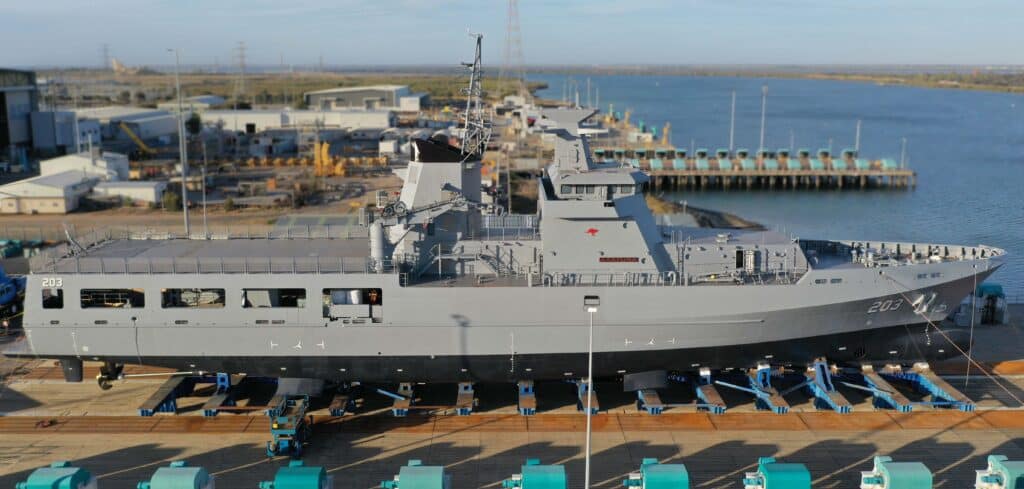
The first-of-class Arafura was launched on 16 December 2021, and only commenced contractor sea trials in August 2024. It still has not been commissioned. Meanwhile, the second vessel was launched on 22 November 2023, and the next three vessels were laid down in Henderson on 11 September 2020, 30 July 2021 and 27 September 2022 respectively. First steel for OPV 6 was cut in August 2022.
There were media reports that the vessels did not meet civilian safety standards, although it has been clarified that their flight decks can accommodate both helicopter and UAV operations. Raytheon Australia is the capability lifecycle manager for the class, as the first proof-of-concept case for Plan Galileo’s maritime sustainment model.
The latest defence budget stated: “During 2024-25, the focus will be on the transition of the first two vessels out of the acquisition programme, continuing the establishment of support arrangements to meet interim operational release milestone and reviewed support funding arrangements in line with the government’s decision to truncate the OPV fleet from 12 to six.”
The momentous, aforementioned surface fleet review, publicly released in February, slashed the OPV fleet from twelve to six. Furthermore, two further hulls proposed for mine countermeasure vessels under Project Sea 1905 Tranche 2 were also cut, leaving the whole programme looking rather forlorn.
The review recommended a fleet of 25 “minor war vessels” for constabulary tasks, including just six Arafura-class OPVs. The review took a dim view of the Arafura class: “The OPV is an inefficient use of resources for civil maritime security operations and does not possess the survivability and self-defence systems to contribute to a surface combatant mission.”
Luerssen Australia offered the Department of Defence the possibility of seamlessly shifting Arafura-class construction to more heavily armed corvettes enjoying a high degree of commonality. Instead, the RAN plumped for eleven general-purpose frigates. Australia successfully brassed off Naval Group in France after suddenly cancelling its Attack-class submarine programme in 2021, and it has achieved the same result with Germany-based Luerssen.