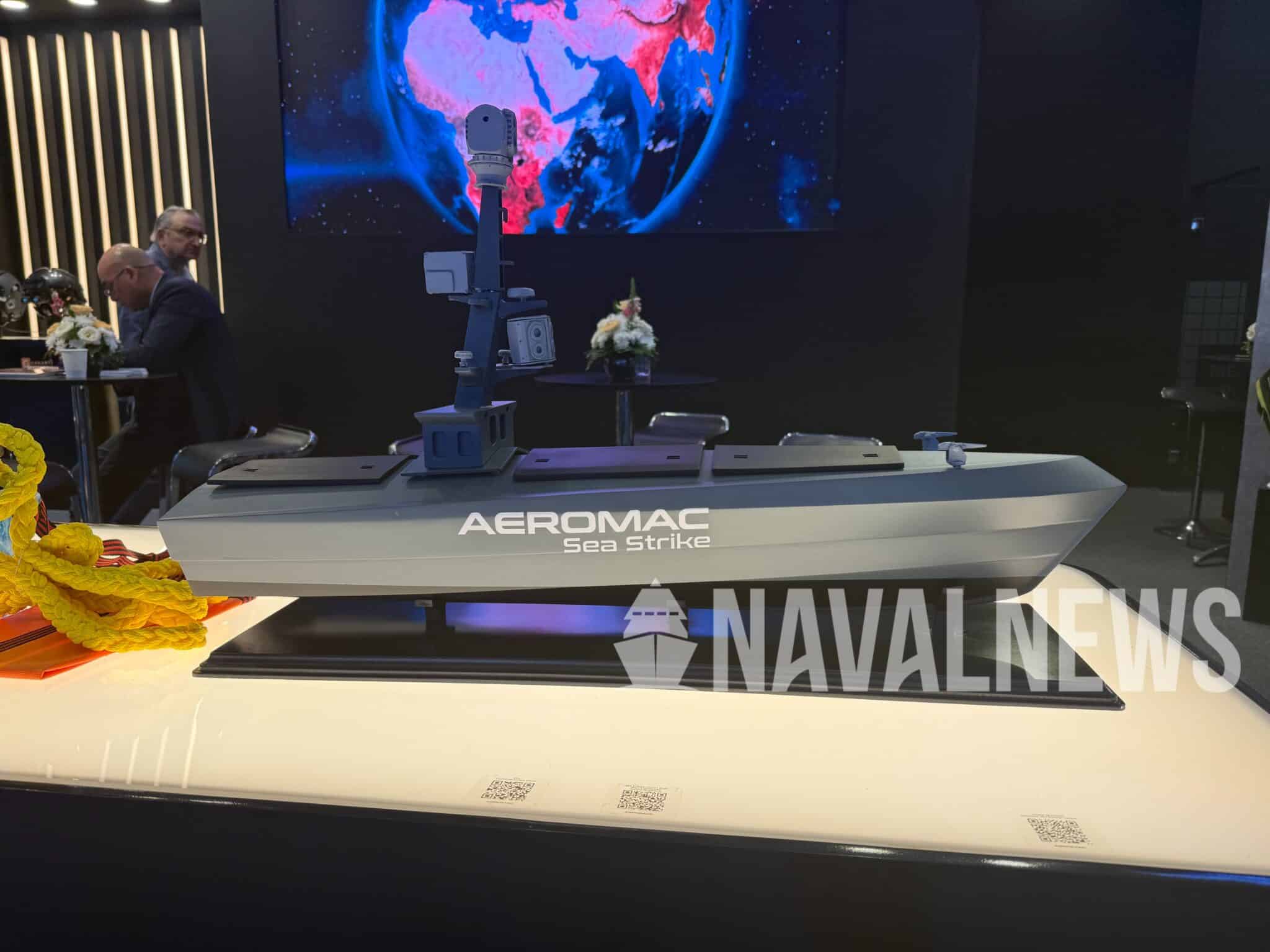
Turkish defence company Aeromac Electronic displayed its SEA STRIKE unmanned surface vehicle (USV) family and several newly developed systems for naval applications at the Indo Defence 2025 exhibition in Jakarta, Indonesia, held from 11 to 14 June.
Aeromac Electronic showcased its new addition to the Turkish defense industry’s unmanned surface vehicle (USV) portfolio at the InTurkish defence company Aeromac showcased its expanding unmanned surface vehicle (USV) portfolio at the Indo Defence 2025 exhibition in Jakarta, Indonesia. Among the systems on display was the SEA STRIKE, a multi-purpose unmanned surface platform developed for various naval missions. While the hull of the system is based on the Albatros-S kamikaze surface vehicle, its software, onboard systems, and payload integration were entirely developed by Aeromac.
SEA STRIKE refers to an entire family of USVs, ranging in length from 5.6 to 14.5 metres, each tailored for different operational needs. These vessels are equipped with Aeromac’s proprietary autonomy suite, enabling them to undertake a wide array of missions, including anti-surface warfare, anti-submarine warfare, air defence, amphibious operations, mine countermeasures, electronic warfare, patrol and surveillance, signals intelligence, expendable kamikaze roles, and target practice as unmanned surface target boats.

The autonomy system provides key operational features such as waypoint-based route planning, flexible navigation, and dynamic re-routing. A Return-to-Base (RTB) function allows for safe recovery with or without pre-programmed waypoints. The system also supports real-time obstacle and collision avoidance, geo-fencing for restricted area compliance, and is developed in accordance with the International Regulations for Preventing Collisions at Sea (COLREGs). Additionally, the autonomy framework enables coordinated swarm operations, allowing multiple vessels to operate simultaneously in tactical formations.
According to Aeromac Project Manager Mustafa Ağırbaş, the SEA STRIKE USV family integrates artificial intelligence and autonomous navigation capabilities. Key performance attributes include speeds exceeding 50 knots, modular payload capacity, reduced radar cross-section, enhanced ballistic protection, and a specially developed sea-type warhead intended for use in kamikaze missions.
“Our designs for all products are complete. The 7.2-meter kamikaze USV has already been delivered to the Turkish Navy by Aselsan.” Mr. Ağırbaş said. “The shipyard responsible for constructing the vessel is affiliated with our company. We have the capacity to complete deliveries within a defined timeline based on incoming orders.” he added.
In addition to the SEA STRIKE platforms, Aeromac also introduced several other in-house developed systems at the exhibition:
- SARPAN: An autonomous system for detecting and neutralizing drifting sea mines
- THORN and THORN/AMPHIBIOUS: Countermeasure systems designed to disable kamikaze USVs and amphibious unmanned vehicles
- Marine Unmanned Surface Target Boats: Used for naval training and live-fire testing

Aeromac is also actively involved in the development of advanced autonomy and machine learning technologies. The company’s expertise spans computer vision, sensor fusion, robotics, electronic design, embedded systems, and high-performance computing. Its focus remains on integrating artificial intelligence-based solutions to enhance the operational efficiency, reliability, and mission scope of both manned and unmanned maritime platforms.
Check out our video coverage of Thorn and Sarpan: