The current deployment of the UK Royal Navy’s (RN’s) HMS Prince of Wales carrier strike group (CSG) across the North Atlantic and into the High North is building deterrence against regional threats – but is also demonstrating the navy’s quickening transition towards a ‘hybrid’ crewed/uncrewed operational force structure.
With the deployment including extensive engagement with NATO allies, Operation ‘Firecrest’ is designed to support the generation, development, and sustainment of UK and allied warfighting capability and readiness in the region. For the RN, this is relevant in both the NATO and ‘hybrid navy’ contexts.
In its June 2025 Strategic Defence Review (SDR), the UK reiterated its ‘NATO first’ strategic posture, based around leading efforts to reinforce North Atlantic security within a wider focus on enhancing Euro-Atlantic deterrence and defence. SDR also announced plans to generate a ‘hybrid navy’, to build naval mass by integrating crewed and uncrewed platforms across the RN’s force structure and operational outputs, including through the construction of a ‘hybrid’ carrier airwing.
The June 2026 Defence Investment Plan (DIP) reiterated the ‘hybrid navy’ commitment, including as a framework within which RN technology and capability developments would move forward. It detailed plans to develop carrier-launched, ‘jet-powered’ uncrewed aerial vehicles (UAVs) to work alongside the navy’s carrier-borne F-35B Lightning II joint strike fighter aircraft, with the CSG’s escort platforms also set to deploy increasingly autonomous rotorcraft.
SDR and the DIP set the strategic vision and programmatic framework for delivering the ‘hybrid navy’. The Prince of Wales CSG is already deploying it on operations.
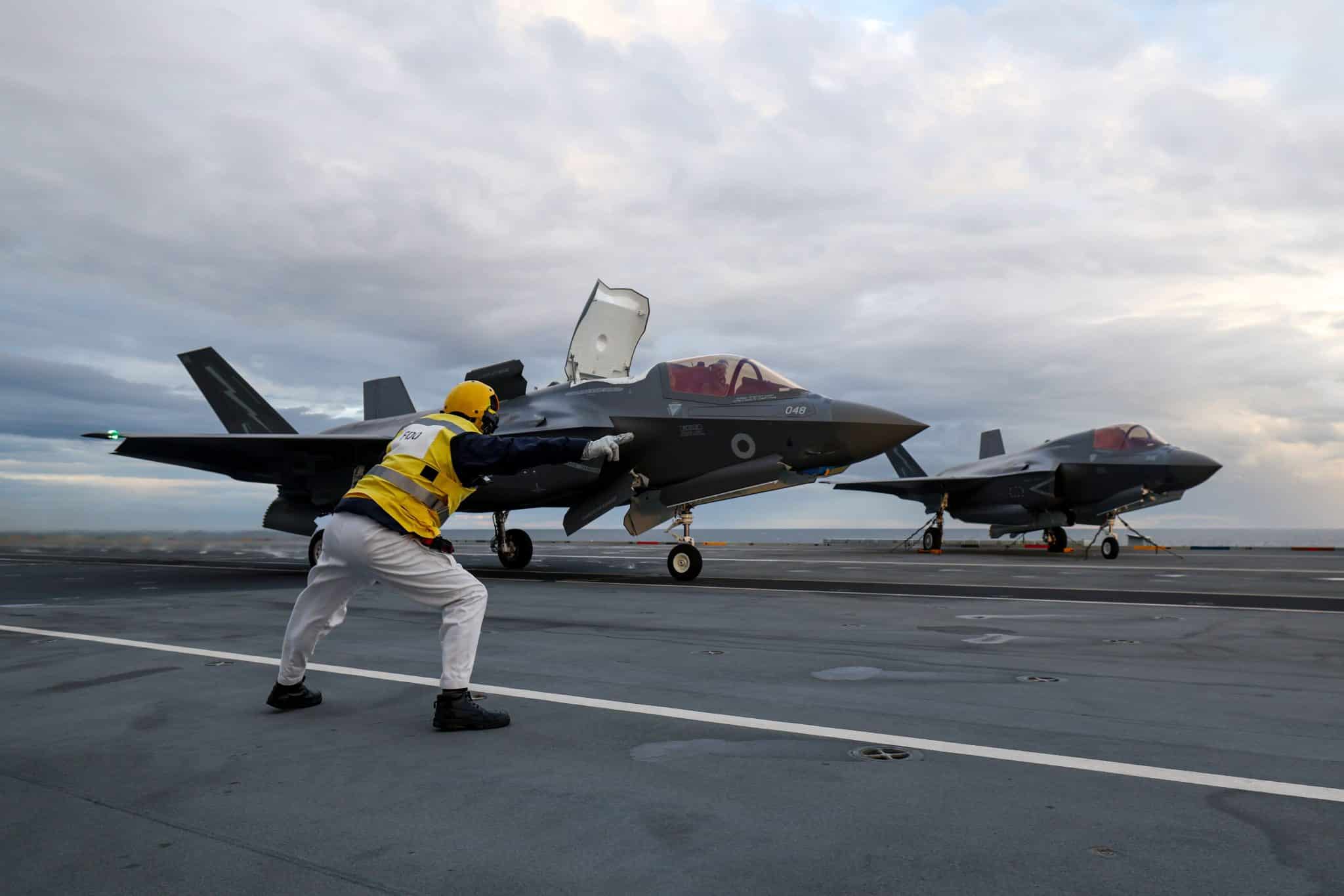
Based on board the Queen Elizabeth-class aircraft carrier HMS Prince of Wales, the CSG’s airwing currently includes eight F-35Bs, three Merlin Mk2 anti-submarine warfare helicopters, two Wildcat HMA Mk2 multi-role helicopters, and two Malloy T150B remotely piloted UAVs. Two more Malloys are embarked in the Type 45 destroyer HMS Duncan, the CSG’s ‘air defender’.
The flexibility inherent in the navy’s two Queen Elizabeth-class carriers’ large, open flight decks enables implementation of the ‘hybrid navy’ concept on operations. During ‘Firecrest’ for example, either F-35Bs or helicopters have been operating from one part of Prince of Wales’ flight deck at the same time that Malloy drones have been operating from another.
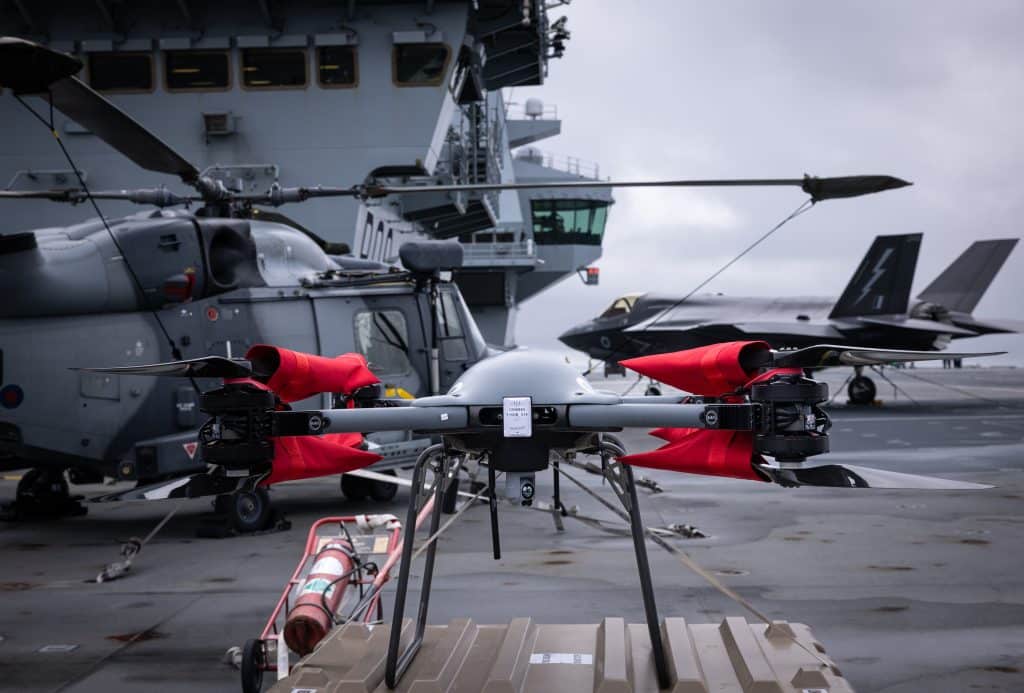
“The navy is going to go forward at pace with the concept of a ‘hybrid navy’,” Commodore Richard Hewitt, Commander UK CSG (COMUKCSG), told Naval News in an interview on board Prince of Wales while the CSG deployed on ‘Firecrest’ off Norway in late June.
Pointing to the on-deck capacity to conduct F-35B, helicopter, and UAV operations both continuously and simultaneously, Cdre Hewitt added “We’re only at the very start of that process. Autonomous platforms are only going to increase in their ability, their endurance, their complexity, their capability – the list is endless.”
With the flight deck size and configuration, “[The navy is] really well poised to cope with what is a technological revolution that is only accelerating in pace,” Captain Ben Power, Prince of Wales’ Commanding Officer (CO), added.
Although UAV integration may amplify the existing complexity in conducting CSG operations, Cdre Hewitt said “I only see the benefits of what it will add. That’s very much the future for Carrier Strike.”
In Carrier Strike terms, the ‘hybrid’ airwing construct will continue to bring a blend of crewed and uncrewed platforms, Cdre Hewitt explained. “I think you’re always going to have an element of crewed, both in the air and in the maritime [domain] from the surface perspective …. You can see that the task elements around the CSG are supported by uncrewed elements [too].”
Introducing a ‘hybrid’ approach for airwing and CSG operations has another significant impact, the Cdre explained. “The composition and size of your CSG, depending on the threat you face, can be scalable,” he said.
Scalable versatility
Alongside the large, flexible flight deck, the planned lengthy service life of Prince of Wales and sister ship HMS Queen Elizabeth is another factor enabling the carriers, and the navy, to exploit the opportunities a ‘hybrid’ approach may offer.
The ships were designed to accommodate and operate up to 36 F-35s. “We have that capacity – but these ships [will bring] scale and versatility for decades to come as the airwing develops,” Captain Ed Philips, the CSG’s Commander Air Group (CAG), told Naval News. With the navy- and defence-wide ‘hybrid’ focus, “There’s great flexibility and versatility in carriers for us to develop that concept [across those decades].”
The focus in ‘Firecrest’ on developing uncrewed and ‘hybrid’ operations merely mirrors capability and operational developments in other contexts, like the Ukraine conflict, Capt Philips explained.
“If we want to stay at the cutting edge of that, we have to adapt to be able to accommodate [uncrewed platforms],” the CAG continued. “The Malloys we have here are a first step towards that, and are allowing us as much as [anything] to start building the concepts, procedures, thinking, culture, and mindset.”
“The pace of change in [UAV] technology is such that, when other drones arrive in due course, we will be able to integrate and operate them seamlessly alongside everything else,”
Captain Ed Philips
“That’s the power I see in what we’re doing with it now.”
Capt Philips also stressed the role of the UK’s carrier-borne F-35B capability at the core of the ‘hybrid’ airwing, while noting that the airwing mix may shift as UAV technologies develop going forward. “F-35 in particular is going to be with us for many years to come … but you could see that, if we were standing here in 10 or 20 years’ time, the balance, I imagine, would be quite different.”
He emphasised though that the requirement to operate crewed and uncrewed aircraft together, and concurrently, will remain vital.
Naval News comment
‘Firecrest’ is still demonstrating the strategic importance of crewed platforms, including those designed to conduct high-end warfighting operations.
At a NATO level, the CSG deployment is demonstrating UK capability to project force in support of NATO requirements and to operate seamlessly within alliance command structures. For example, a major component of the deployment is for the CSG to lead NATO’s new ‘Arctic Sentry’ operation. ‘Arctic Sentry’ was established in January 2026 following alliance discussions surrounding the need to improve deterrence and defence around the Greenland-Iceland-UK (GIUK) Gap and further into the Arctic and High North.
At a national level, with two carriers in its force structure, the RN has capacity to support the requirement to generate continuous carrier capability, an output that provides strategic-level conventional deterrence for the UK (in the same way the UK’s continuous at-sea deterrence posture generated from the RN’s four Vanguard-class ballistic missile submarines provides strategic-level nuclear deterrence).