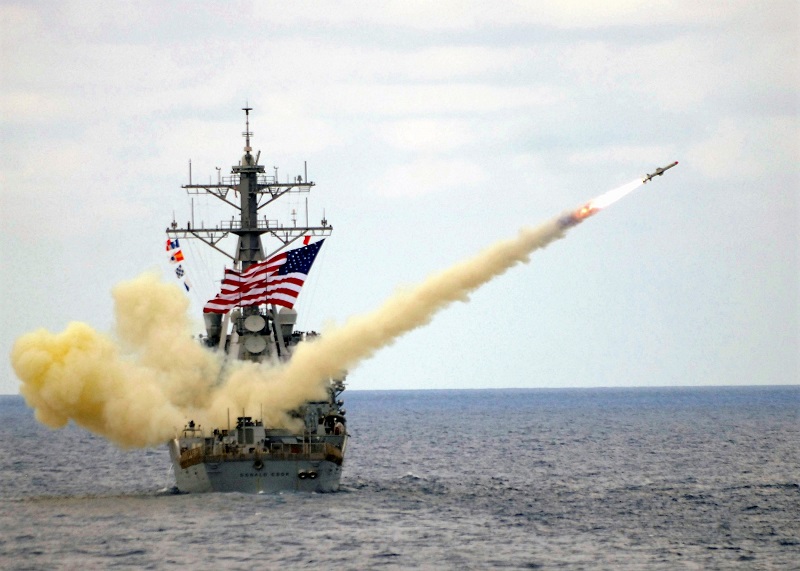
The U.S. Navy is looking to upgrade its aging Harpoon missiles via new seekers in a new service life extension program.
Naval Air Systems Command is looking at Raytheon Missiles & Defense to work on new seekers in support of a service life extension program for the Harpoon missile.
The Harpoon missile has been a mainstay of U.S. Navy’s surface strike capabilities since the 1970s. Numerous upgrades have been made to the Cold War-era anti-ship missile over the years to accommodate new threats. Block II+, the latest variant of the Harpoon missile in U.S. service, could strike out to targets up to 124 kilometers away. This seeker modernization effort comes amid the service’s efforts to prepare the fleet against Chinese naval threats in the Indo-Pacific.
According to a NAVAIR solicitation, the modernization effort will require RTX to provide supplies and services for the upgrade, stating that the defense contractor was “the sole designer, developer and manufacturer” capable of producing the Harpoon missile seeker.
The company previously provided sensors to Boeing, the prime contractor for the anti-ship missile itself, in the 1990s. RTX has also teamed up with Norwegian defense company Kongsberg to pitch the Naval Strike Missile to the U.S. Navy, which now makes up the primary over-the-horizon maritime strike capability of Littoral Combat Ships and at least one Arleigh Burke. The upcoming Constellation-class guided missile frigates are slated to receive 16 of the low-observable missiles. Other navies, including the Royal Navy and Royal Australian Navy, have opted to replace Harpoon with the NSM.
RTX deferred Naval News to the U.S. Navy for comment on the Harpoon missile service life extension program.
Despite its age and the introduction of other anti-ship capabilities such as the NSM, Maritime Strike Tomahawk, and SM-6 Block IB, the U.S. Navy has been recapitalizing Harpoon missiles. The reintroduction of an underwater-launched variant of Harpoon for the fleet’s nuclear attack boats was revealed in 2021, with Boeing claiming that the service’s “deep inventory of Harpoon Block IC missiles” could be quickly retrofitted for sub-surface operation. Harpoon production lines have also been busy producing a 400-missile order for Taiwanese ground-based coastal defense batteries.
The service’s initiatives to upgrade older systems while simultaneously procuring newer missiles could alleviate stockpile concerns of a precision-guided munitions shortage in a prolonged peer-to-peer conflict, an issue that has been highlighted by recent lessons in Ukraine, the Middle East, and the Red Sea.