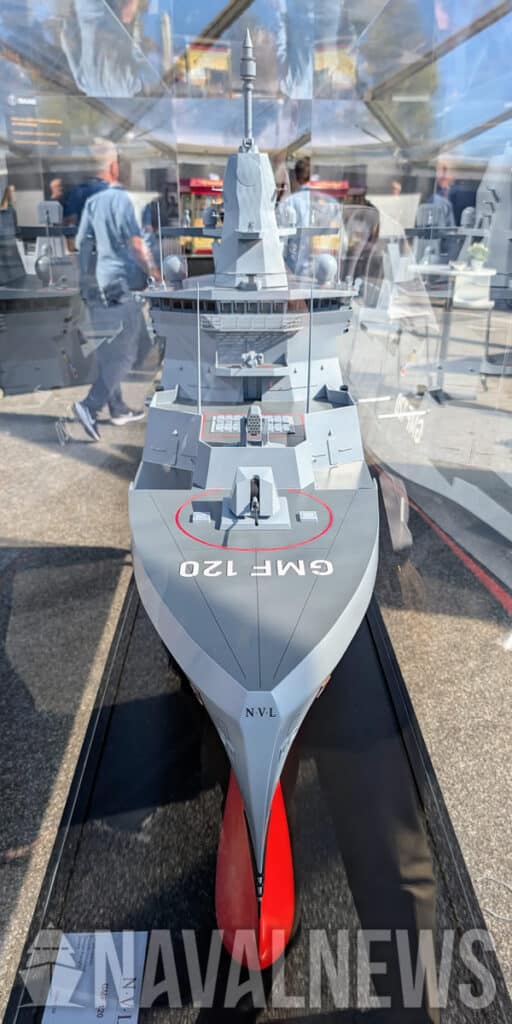
German shipbuilder Naval Vessels Lürssen (NVL) has presented a new frigate design at the Danish DALO Industry Days 2025 in Ballerup last week. NVL dubs the concept the “GMF-120”. The designation stands for “Guided Missile Frigate”, referring to the hull length of the warship at a little over 120 metres.
With GMF-120 Lürssen aims at a Danish requirement for new air defence missile frigates under the recently unveiled new “Fleet Plan”. Beyond Denmark however the builder also considers notional requirements elsewhere across Northern Europe and further abroad for a moderately sized warship nevertheless offering significant armament and multirole capability.

Compact hullform contrasting with wider trends
NVL’s GMF-120 is notable for its unusually short overall length of only 121.1 metres at a draft of five metres. The broad beam of 19 metres results in a stocky hull providing significant volume for weapons, propulsion and other onboard equipment. NVL does not provide a displacement for GMF-120. Based on overall dimensions Naval News estimates full load displacement at around 5,000 tons. For reference, the Danish Iver Huitfeldt-class air defence frigates displace 6,645 tons at full load with length of 138.7 m, a beam of 19.8 m and draft of 6.5 m.
The moderate size stands in notable contrast to recent global developments. New multirole “frigates” with other navies easily approach and exceed double the displacement of GMF-120, with the exception of France’s FDI. As understood by Naval News however, NVL believes a more compact warship design is desirable for many smaller and littoral navies having to cover a flexible operational spectrum.
GMF 120 features an inverted or vertical bow and fully enclosed forward hull, both increasingly prominent features on new generation naval combatants.

Heavy missile armament for air defence and surface strike
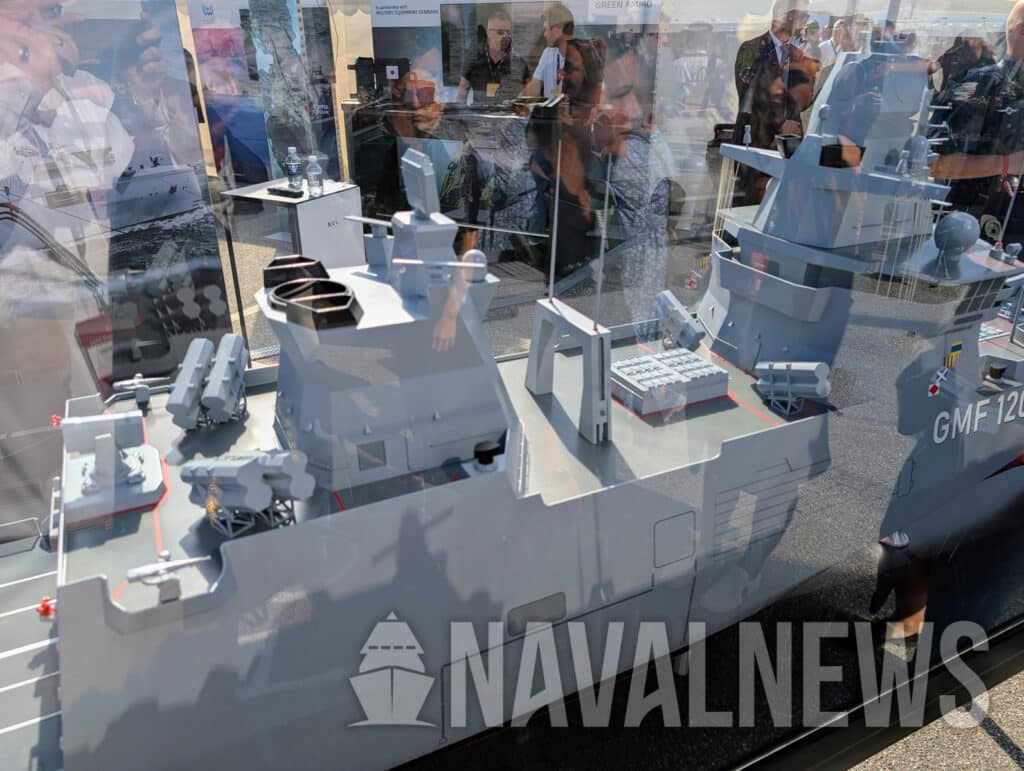
GMF 120 offers significant missile armament, with a total of 64 cells for the Mk 41 VLS in strike length. The vertical launch system is distributed across the bow and mid-section, with 32 cells for each magazine. For close range air defence the NVL-design carries two Mk 49 launchers for RIM-116 RAM, with a total capacity of 42 missiles. Antiship missile capability consists of a total of 12 rounds, distributed across six dual launchers. Two launchers sit behind the forward superstructure, ahead of the second VLS. Another four launchers are located on top of the hangar ahead of the stern-facing RAM. The model on display at DALO carries the SAAB RBS-15 antiship missile, although this may not be indicative of a preferred configuration.
Gun armament includes a Leonardo main gun in 76 mm ahead of the forward RAM, and three Rheinmetall Sea Snake 30 mm-style autocannons, one ahead of the bridge and two at the rear. Four Rheinmetall MASS decoy launchers provide additional protection. Propulsion features diesel engines and a gas turbine driving two propellers for a top speed of 30 knots. A bow thruster increases manoeuvrability in port.
Radar suite by Thales and CUBE modular payload system
The sensor configuration consists of a Thales Nederlands APAR Block 2 X-band AESA multifunction radar on the main mast. Thales advertises the APAR Block 2 as being capable of guiding ESSM Blk 2 and new generation SM-series missiles through the JUWL-datalink. The radar also equips German F126 and the new Dutch/Belgium ASW-frigates. A rotating Thales NS200 S-band AESA panel for air and surface surveillance sits atop the secondary mast. The GMF-120 offers a wide flightdeck and two hangars. One hangar can accommodate a regular helicopter in the 10 ton-range. The other facility may be used for a smaller VTOL-drone.
The flightdeck is also notable for also featuring the skidding system developed by Danish company SH Defense. The design accommodates the proprietary CUBE-payload system. CUBE offers mission modules for a range of applications. The modules mount either to the flight deck, within the hangar or a mission bay, if available.
ASW-capability, low crewing and industrial workshare-offer
To perform anti-submarine warfare, GMF-120 may carry a towed array and variable depth sonar. The bow accommodates a hull-mounted sonar. The frigate also offers lightweight torpedo launchers ahead of RHIB bays port and starboard. Total crew capacity is for 120 personnel. However, NVL notes the ship emphasises low crewing requirements and is designed for a regular complement of 100 sailors.
As noted above, Denmark intends to realise the related frigate recapitalisation through a yet to be defined local industry workshare arrangement. NVL proposes participation of state-owned infrastructure company Sund & Bælt in the construction of GMF-120. The company presently executes the Fehmarnbelt tunnel project between Denmark and Germany. The intent is to utilise Sund & Bælt production capacity in Rødby on the Danish island of Lolland in pursuit of a GMF-120-based offer for the Royal Danish Navy.
For a video-outline on GMF-120 at DALO 2025 and NVL’s broader effort in Denmark please enjoy our Naval News-coverage below: