The German Navy has been planning for some time to procure 18 unmanned surface vessels, known as Future Combat Surface Systems (FCSS), to supplement its corvettes, as well as at least 12 Large Unmanned Underwater Vehicles (LUUV) to support its submarines. A new class of unmanned vehicles has recently been added: Large Remote Missile Vessels (LRMV). According to a table published as part of its strategic direction document “Kurs Marine”, the navy wants to commission a total of three of these LRMVs by 2035 to supplement its frigates.
By Lars Hoffmann / Hartpunkt
According to information obtained by Hartpunkt from naval circles, the plans are essentially for arsenal ships carrying missiles in vertical launchers. It is also conceivable that these could be optionally manned vessels. However, this would mean additional planning work, as appropriate accommodation and supply rooms for personnel would have to be provided. The plans appear to be at an early stage, which is why details such as displacement and the number of launch containers have apparently not yet been finalized.
While the Netherlands wants to introduce unmanned supply ships – known as Multifunctional Support Vessels – for use in the North Sea, which will also take on patrol duties, the German LRMVs are intended for use in the Atlantic. The harsher weather conditions in this ocean are likely to have an impact on the design – for example, in terms of size and seaworthiness.
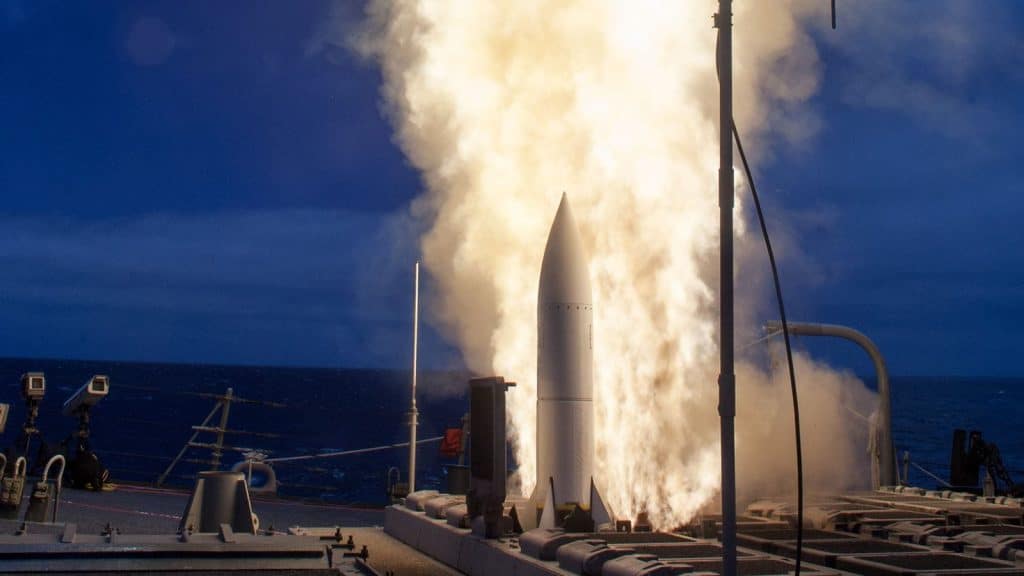
According to naval circles, the German arsenal ships are primarily designed for air defence, including ballistic missile defence (BMD). They would therefore carry missiles such as the SM-2 or SM-6. The sensor of another ship would be used for target guidance. The future F127 frigates, which are specifically designed for air defence and BMD, would be suitable for this purpose. It is also conceivable that target data could be assigned to the interceptor missiles positioned on the LRMV via satellite links. This would eliminate the need for physical proximity to a ship equipped with sensors. The Large Remote Missile Vessels are also to be armed for self-defence, but only to a very limited extent. The Kurs-Marine graphic also shows that, in addition to air defence, the LRMVs will have maritime strike as one of their main tasks. The armament for this mission is likely to be Tomahawk cruise missiles, the procurement of which is currently being reviewed. However, it is also conceivable that they could be armed with the 3SM Tyrfing missiles currently under development.
In principle, the navy plans to have the projected arsenal ships ‘loiter’ in a specific sea area for extended periods of time, which could indicate that they do not need to reach the same speed as an F127, which is also intended to escort aircraft carrier groups.
The procurement of three Large Remote Missile Vessels is likely due to the fact that, according to an old rule of thumb, three units are required to have one permanently at sea. This is because the other two are either in the shipyard or in training. However, the training phase is likely to differ significantly from that of crewed ships.
While the new arsenal ships do not represent anything truly new in terms of shipbuilding, the challenge is likely to lie in IT and secure communications. These must be reliable and resilient to enemy attempts to penetrate the system. Otherwise, there would be a risk of the LRMVs being ‘hacked’ and ending up in the enemy’s port. Given the pace of technological progress, the introduction of the new ships after 2030 does not seem unrealistic, especially as the navy is currently gaining experience in the field of autonomy, for example with the two operational experiments for the FCSS scheduled for the coming months.
This article by Lars Hoffman was originally published in German language at Hartpunkt.de. It has been translated and republished with authorization.