The Hellenic Navy’s first upgraded P-3B Orion maritime patrol and reconnaissance aircraft has successfully completed its maiden test flight, marking a key milestone after prolonged delays. Lockheed Martin and Hellenic Aerospace Industry’s announcement is accompanied by a Naval News overview of the P-3’s service in Greece, along with a detailed account of the Mid-Life Upgrade (MLU) program.
Lockheed Martin & Hellenic Aerospace Industry press release
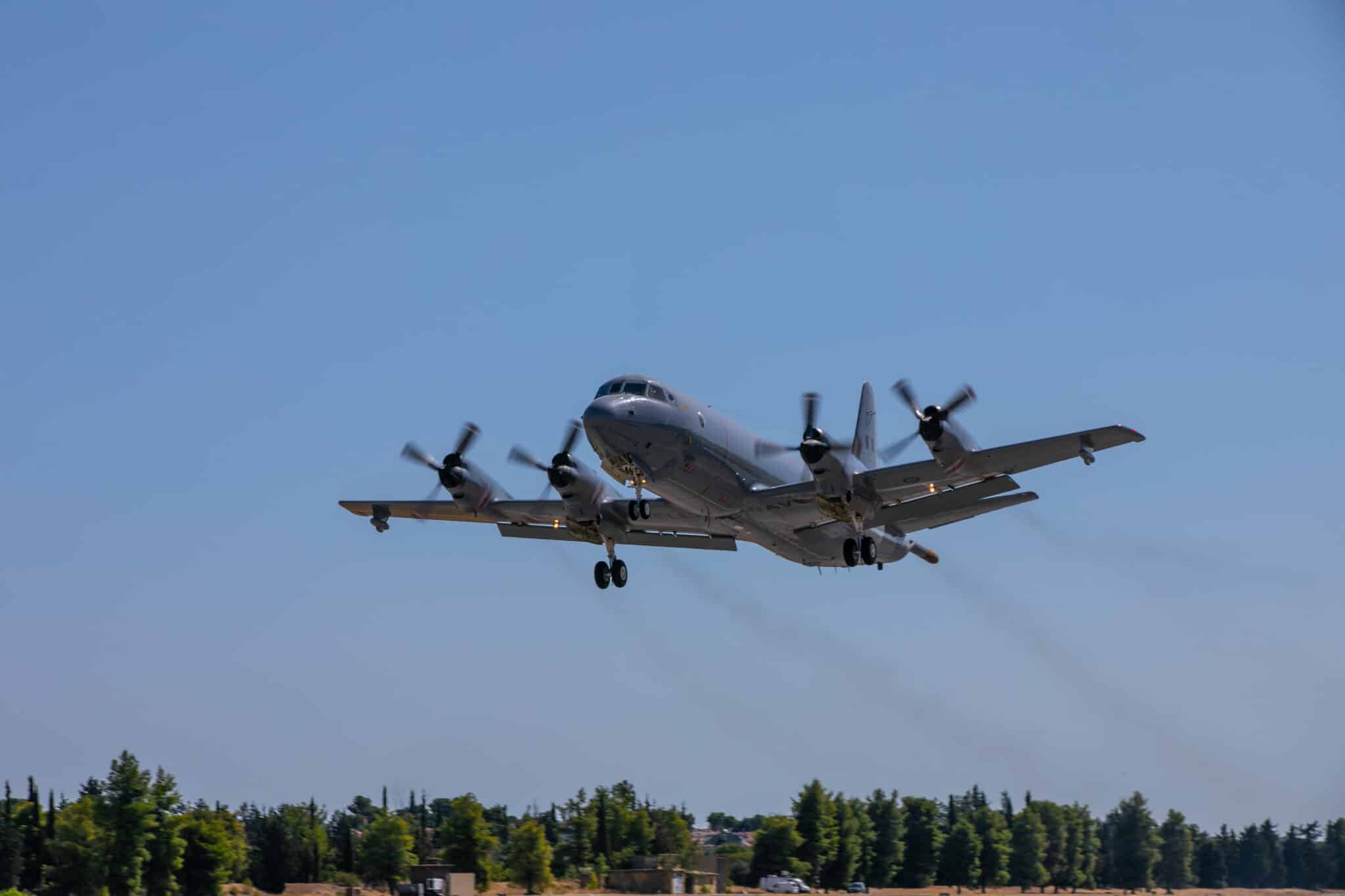
ATHENS, Greece, Sept. 01, 2025 –The Hellenic Navy’s first upgraded P-3B Orion aircraft successfully completed its maiden test flight, marking a major milestone in the Mid-Life-Upgrade (MLU) Program.
The flight, which took place today, validated the aircraft’s onboard systems, including its state-of-the-art glass cockpit and mission data interfaces, which will enhance the Hellenic Navy’s maritime surveillance and anti-submarine warfare capabilities.
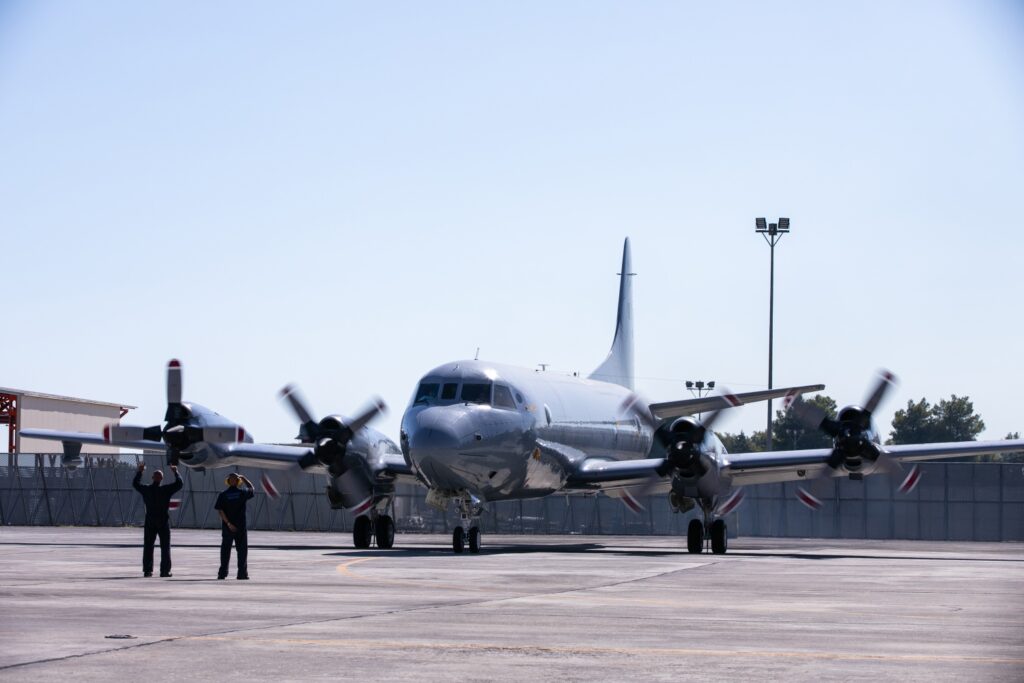
Lockheed Martin, the program’s prime contractor, demonstrated its commitment to the Hellenic Navy P-3B modernization program by increasing its on-site team and investing significant resources to ensure the program’s success. The company worked closely with Hellenic Aerospace Industry (HAI) to resolve compatibility issues between the new digital cockpit and older systems, paving the way for the successful test flight.
“The successful test flight of the upgraded P-3B Orion aircraft is a key milestone,” said Rod McLean, vice president and general manager Air Mobility and Maritime Missions. “The upgraded P-3B Orion will play a vital role in enhancing Greece’s maritime patrol capability and ensuring the Hellenic Navy is mission ready for decades to come.“
“The completion of the first upgraded P-3B Orion marks a milestone in the course of a structural and avionics modernization program characterized by a particularly high degree of difficulty and complexity,” said Alexandros Diakopoulos, executive chairman and CEO of HAI. “During its implementation, technical challenges arose, the resolution of which required significant investment of time and resources. Despite these difficulties, the commencement of flight tests of the prototype upgraded aircraft demonstrates our dedication to the mission.”
The Hellenic Navy P-3B maritime patrol aircraft MLU and modernization program launched in 2015 as a government-to-government agreement between the United States and Greece and is the only one of its kind globally. It provides for phased depot maintenance, a Greece indigenous mission integration and management system, new avionics, and other ancillary hardware and services.

The agreement includes the modernization of four Hellenic Navy P-3B aircraft through the MLU Program. MLU kits provide an extension of service life by 15,000 flight hours, greatly enhancing capability leveraged with cost-effectiveness.
The Hellenic Navy has operated the P-3 fleet for more than 20 years. The upgraded Greek versions of the P-3B Orion are uniquely equipped for anti-ship warfare, while the modern glass cockpit, featuring LCD displays and mission data interfaces, will provide pilots with improved situational awareness and threat identification capabilities.
The P-3 Orion is the model in maritime patrol and reconnaissance aircraft, and is used for homeland security, anti-piracy operations, humanitarian relief, search and rescue, intelligence gathering, antisubmarine warfare and, recently, to assist in air traffic control and natural disaster relief support. Find out more about the P-3 Orion here.
– End –
The P-3 in Greek service

The P-3 Orion acquisition agreement was signed in February 1994 to replace the obsolete HU-16B Albatross. It was a $69 million agreement with the aircraft to be given free of charge while the amount of money was for repair and rehabilitation works, spare parts, and training of the crews. Various accessories were also provided, such as air-dropped sea mines and sonobuoys. In total, four P-3As were allocated to Greece for ground training and spare parts, as well as six P-3Bs for operational use. All the aircraft of version “B” had gone through the Tactical Navigation Modification (TACNAVMOD) as they were manufactured during 1965-67.
The first operational P-3B was officially delivered in May 1996; the deliveries were completed in December 1997. The six P-3Bs joined the 353th Navy Cooperation Squadron (NCS), which was administratively subordinated to the 112 Air Force Combat Wing and operationally to the Navy Fleet Headquarters. The 353 NCS later on changed to Hellenic Navy Aircraft Squadron.
In the 2000s, Greece explored the acquisition of modernized P-3 aircraft from abroad, but these plans did not materialize as the focus shifted toward procuring new MPAs. As a result, all P-3Bs were gradually phased out by 2009. However, the procurement of a new platform never progressed, and the subsequent financial crisis ultimately brought the Orion replacement program to a definitive halt.
Finally, a decision was taken in 2014 for the re-activation of existing P-3Bs and their submission to a program of overhaul, upgrade and service life extension. The program for the modernization of the Greek P-3B, with a maximum potential cost of $500 million, was finalized at the end of 2014 with the US Navy being the General Supervisor of the programme, Lockheed Martin the main contractor and ΗΑΙ as a partner together with a number of other smaller companies.
The MLU Program

The modernization program consists of four parts:
- Phased Depot Maintenance (PDM) with complete repair and restoration of all structural and mechanical parts and, at the same time, structural MLU to provide 15,000 more flight hours and 25 years of use to the lifespan of each plane. The service life extension includes the replacement of main and tail wing sections by new ones.
- Installation of new navigation and communications equipment, with new flight avionics and a cockpit digital suite (glass cockpit).
- Installation and integration of new mission equipment (navigation, communications, sensors and tactical mission system).
- Follow-On Support (FOS) of the aircraft and their systems.
The contract includes the return of one aircraft to airworthy condition with the existing mission equipment as an “interim solution” (it was delivered in May 2019) and the complete modernization and upgrade of four other aircraft in HAI (with the option for the upgrade of the first “interim solution” aircraft). The sixth P-3B was permanently withdrawn and is used as a source of spare parts. The deal includes personnel training and training equipment, logistical support, the usual spare and repair parts, publications and technical documentation, US Government and contractor support and other related elements of logistics and program support. The Hellenic Navy, Lockheed Martin and HAI hosted a ceremony 24 July 2016 at HAI’s facilities in Tanagra to recognize the official launch of the Hellenic Navy P-3B maritime patrol aircraft modernization and upgrade program.

It should be noted that the original schedule, set when the contract was signed in 2015, foresaw the delivery of the first upgraded aircraft in 2019, with the remaining three to be handed over to the Hellenic Navy between 2020 and 2022. Under the leadership of Alexandros Diakopoulos, who was appointed CEO of HAI in January 2024, the P-3 MLU program, as well as other projects, has been accelerated, while the overall situation at HAI has improved significantly. It is now expected that all aircraft will be fully operational within the Navy by 2027 while the non-modernized P-3B will be used for training for its remaining lifetime.
The modernized aircraft is equipped with Collins Aerospace’ Flight-2 integrated avionics system, that converts the flight deck into a large, all-glass cockpit, making for easier viewing of critical information on the primary and multi-function flight displays (MFD), and the engine instrument display system. Additionally, integrated communications and identification friend or foe (IFF) Mode 5 capabilities ensure mission readiness.
The system includes the ASW-33 automatic pilot, the RINU-G EGI/INS system, the ELB-3000F emergency buoy detection system, six MFD-268 displays, three CDU-7000 display control units, panel display unit (PDU), digital engine instrument display system (EIDS), traffic collision avoidance system (TCAS), MLR-2020 VOR/ILS, and AN/ASH-37 structural data recording set (SDRS). The communications suite includes the installation of six new HF, UHF and VHF terminals, new navigation terminals, intercom communication system (ICS) and tactical data links.
The new mission equipment includes an IAI ELM-2022A 3D X-Band all-weather multimode airborne maritime surveillance radar incorporating synthetic aperture radar (SAR), inverse SAR (ISAR), ground moving target indication (GMTI) features and the IAI EL/L-8385 ESM/ELINT; both systems integrated with the automatic identification system (AIS) and the AN/ APX-123 IFF system. These will be complemented by a rotating and retractable L3 Wescam MX-15HD stabilized thermal imaging and tracking turret, the UYS-505 ASW suite and the self-protection suite that consists of AN/AAR-47 missile warning system (MWS) and AN/ALE-47 Airborne countermeasures dispenser systems (CMDS), and the maritime mission integration and management system (M2IMS) made by the Greek company SCYTALIS as the aircraft’s new tactical mission system with five workstations.

Despite strong criticism of the MLU program, largely due to its significant cost and the prolonged delays caused by its technical difficulty and complexity, the aircraft has undergone an extensive modernization. More than 85% of its systems were replaced or redesigned, significantly enhancing reliability, introducing state-of-the-art avionics, and improving overall mission effectiveness. Powered by turboprop engines, the upgraded P-3B combines long endurance with potent anti-submarine (ASW) and anti-surface warfare (ASuW) capabilities, while also excelling in intelligence, surveillance, and reconnaissance (ISR) missions. No equivalent platform with such advanced multi-role capabilities currently exists in the Greek aircraft inventory.
The P-3B HN Orion is expected to serve as a formidable force multiplier in modern naval operations for decades to come, offering unique features such as the ability to deploy and monitor sonobuoys and carry a broad array of guided and unguided weapons on its 18 hardpoints (two of the ten hardpoints on the wings are dedicated to ESM sensors, while the remaining eight are housed within the internal bomb bay) support a payload exceeding 9 tons, including MAVERICK and HARPOON missiles, as well as torpedoes, bombs, and naval mines.