The Spanish Navy’s first-in-class new S-80 Plus diesel-electric submarine (SSK), ESPS Isaac Peral, has deployed on its first NATO operation.
The boat was commissioned in November 2023.
“Isaac Peral is operating in the Mediterranean Sea as part of ‘Sea Guardian’, NATO’s ongoing mission to increase maritime security in the region,” NATO Allied Maritime Command (MARCOM), which runs the OSG deployments, said on social media on 21 October.
“The deployment … under NATO’s flag on OSG represents a clear demonstration of deterrence and interoperability with our allies,” an Armada Espanola spokesperson told Naval News.
MARCOM defines OSG as “a non-Article V [NATO Charter] maritime security operation aimed at working with Mediterranean stakeholders to maintain maritime situational awareness (MSA), deter and counter terrorism, and enhance capacity building.” OSG also covers: upholding freedom of navigation; maritime interdiction; weapons of mass destruction counter-proliferation; and critical infrastructure protection.
MARCOM confirmed Isaac Peral is operating on OSG under what is known as ‘associated support’, whereby it is deployed already on operations in the region but contributes to OSG’s MSA activities through surveillance and information gathering, for example. “The submarine is focused on maritime domain awareness [MDA] activities,” Commander Arlo Abrahamson, MARCOM chief spokesperson, told Naval News.
Detailing how a submarine like the S-80 Plus contributes to OSG taskings, Cdr Abrahamson said “It’s about understanding the maritime environment, from the air, on the surface, and undersea: this capable submarine provides a robust capability to maintain the high state of MDA the alliance is looking to achieve.”
In command-and-control (C2) terms, Isaac Peral was fully integrated into NATO’s command structure to participate in OSG, but – as is customary for an asset contributing to NATO tasking while conducting national operations – remained under Spain’s operational control. “This means the boat complies with MARCOM guidelines but retains national command for administrative and sovereignty aspects,” the Armada spokesperson said.
OSG is conducted across the Mediterranean’s high seas, via a number of Focused Operations (FOCOPs) annually. “We employ FOCOPs where they are needed to enhance the alliance’s MDA and increase our understanding of the maritime environment,” said Cdr Abrahamson. Together, OSG and NATO’s wider maritime surveillance presence provide a comprehensive approach to building regional MDA, through enhancing understanding of ‘patterns of life’ at sea and working with regional partners to build co-operation, capacity, and interoperability.
Capacity and capability
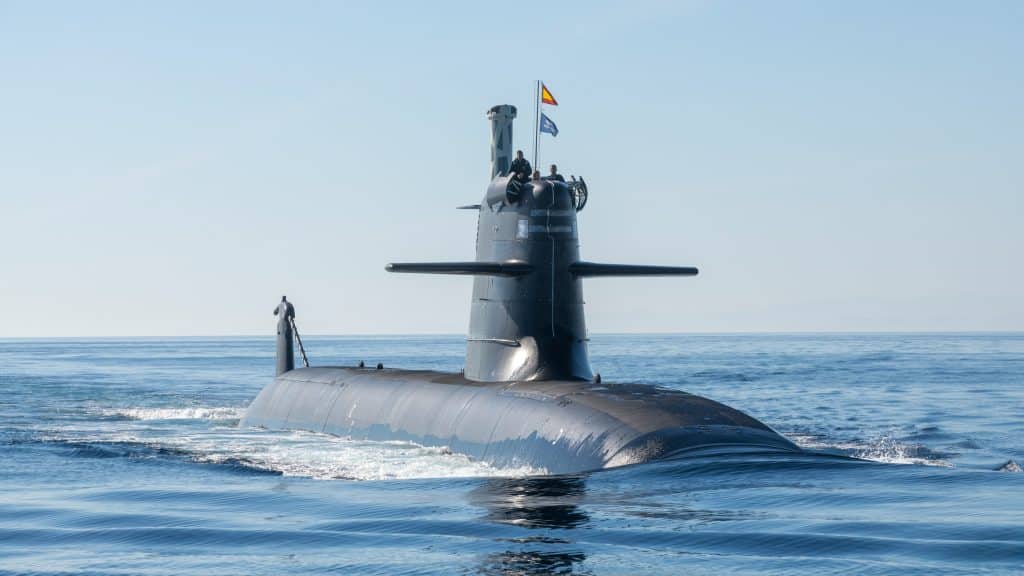
Spain’s S-80 Plus type consists of four boats. Boats two to four are in build, and (according to Janes) are anticipated to enter service every two years from 2026. Boat two, Narciso Monturiol, powered up for the first time in March 2025 and is being prepared for launch.
To support surface and sub-surface MSA tasks like those conducted on OSG, the S-80 Plus sensing capability consists of: an L3Harris Mod 2010 OS optronics mast for surface search; and a Lockheed Martin-supplied integrated sonar suite for underwater sensing, which includes an L3Harris medium-frequency passive cylindrical array, two low-frequency passive flank arrays, an SAES Solarsub very-low-frequency passive reelable towed array, and ranging and intercept arrays.
These state-of-the-art systems, when combined with the boat’s stealth, range, and wider intelligence-gathering capabilities, provide added value for surveillance and protection missions and wider MDA and maritime security, the Armada spokesperson said.
The navy also highlighted the boat’s satellite communications capability as being crucial to ensuring effective co-ordination within the allied operational framework.
In the future, the 80-metre, 3,000-tonne dived displacement boats will bring more sustained stealth through adding the Bio-Ethanol Stealth Technology (BEST) enhanced air-independent propulsion (AIP) system. This new capability is being introduced in build into boats three and four (Cosme García and Mateo García de los Reyes) before being back-fitted into the first two boats in first refits.
Speaking at the Combined Naval Event 2025 conference in Farnborough, UK in May, José Luis Saez, Navantia’s Submarine Commercial Programme Manager, said BEST offers dived endurance of up to three weeks.
Isaac Peral is now fully operational, the Armada spokesperson confirmed.
The boat’s final preparations for operations included: operational evaluation, to verify system and equipment functionality; operational qualification trials at sea to test the boat, systems, and crew in combat scenarios; and two medium-range deployments from its Cartagena, southern Spain homeport to demonstrate capability to operate autonomously, safely, and effectively, the Armada spokesperson said.
The first deployment – to waters off Galicia, northwestern Spain – encompassed MARCOM’s ‘Dynamic Mariner’ exercise, followed by the Spanish Navy-led ‘FLOTEX 25’. ‘Dynamic Mariner’ is designed to prepare NATO maritime forces for multi-threat, multi-domain, non-Article V crises. The second deployment – to waters off the Canary Islands – saw the boat join a ‘SINKEX’ activity.
Isaac Peral’s participation in OSG demonstrates the S-80 Plus programme’s operational reliability and Spain’s contribution within NATO as a partner providing fully integrated, state-of-the-art high-technology capabilities for allied operations, the Armada spokesperson said.
OSG was established at NATO’s Warsaw Summit in 2016 as a more broadly maritime security-focused successor to the Article V-based ‘Active Endeavour’ counter-terrorism mission initiated following the 9/11 terrorist attacks on the United States.
Naval News Comment
Isaac Peral’s early deployment on a NATO operation is an immediate demonstration to the alliance of the operational benefits of adding a new class of submarine to the allied underwater force structure. The new boats will add more capability, and maybe more numbers. The Armada Espanola’s previous SSK class – four S-70 Galerna/Agosta boats – began retiring in 2012, with only ESPS Galerna still in service. There has been informal discussion in Spain regarding increasing the force level to six boats.
The new submarines are also an immediate demonstration to potential alliance adversaries. For example, NATO will now have new boats operating out of Cartagena, close to the Straits of Gibraltar maritime chokepoint that marks the Mediterranean’s Western entrance. With Russia no longer able to send submarines not homeported at Novorossiysk in the Black Sea back-and-forth through the Bosporus/Dardanelles Straits (following Türkiye invoking the 1936 Montreux Convention when the Russo-Ukraine war erupted in 2022) and no longer having basing access in Syria (following the Assad regime’s fall in 2024), Russian submarines deploying to the Mediterranean – including its nuclear-powered attack boats (SSNs), none of which are Black Sea based – will have to squeeze through the Gibraltar Straits under the watchful eye of Spain’s new submarines.