On the opening day of the Defense & Security 2025 exhibition in Bangkok, French company Thales and its Thai partner Universal Communication Systems Co. Ltd. (UCS) signed a contract with the Royal Thai Navy (RTN) to upgrade the Integrated Platform Management System (IPMS) of the Navy’s sole aircraft carrier HTMS Chakri Naruebet (CVH 911).
Built in Spain by Navantia and commissioned in 1997, the 28‑year‑old light aircraft carrier remains the flagship of the RTN and the only operational carrier in Southeast Asia. Over the past decades, the ship has undergone several upgrades to sustain operations, but its platform management system — responsible for controlling propulsion, electrical, and auxiliary systems — has reached obsolescence. The last major modernization, led by Dutch company RH Marine around ten years ago, is now due for replacement.
The new Thales‑UCS project will deliver a complete replacement of the platform’s management and control architecture. According to Thales, the modernized IPMS will serve as the ship’s central operational system, integrating real‑time monitoring, alarms, and automation functions to enhance safety and operational efficiency.
Under the contract, Thales will supply both the hardware and software components of the system, while UCS will act as a local industrial partner responsible for in‑country activities and support. The integration will enable the Royal Thai Navy to monitor and control the ship’s mechanical, electrical, and damage‑control subsystems through a single integrated interface.
Company officials at Thales’ booth told Naval News that the upgrade work will be divided between Türkiye and Thailand. The software development and testing will take place in Istanbul, while the hardware installation and integration phases will be carried out in Thailand. “The tests will be made in Istanbul,” a Thales official said.
According to information obtained by Naval News, the complete modernization process is expected to take 15 months.
The Royal Thai Navy has maintained a long‑term partnership with Thales that spans more than five decades. Over 80 percent of RTN vessels are equipped with various Thales systems, including radars, sonar suites, mine‑hunting sensors, and fire‑control systems. This new contract marks the first time the Royal Thai Navy will integrate an IPMS system from Thales, extending the existing cooperation to platform management.
While the original shipbuilder Navantia is not involved in the current contract, the upgrade is seen as crucial to keeping the carrier operational for years to come. The modernization will ensure that the Chakri Naruebet continues to serve as a multi‑role asset capable of operating helicopters, supporting disaster relief missions, and carrying out training and regional engagement activities.
Thales describes the IPMS as a modular and scalable platform that links the ship’s technical systems with its combat management and navigation suites. The new configuration will also interface with onboard training simulators, allowing the crew to simulate technical scenarios and emergency drills directly through the same operating network.
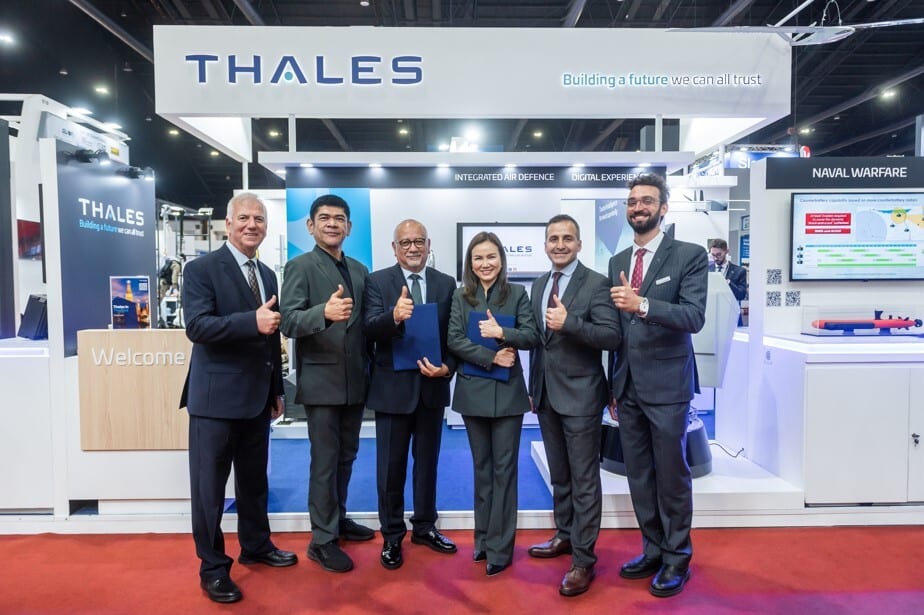
The Thales–UCS partnership also includes an industrial cooperation component intended to strengthen in‑country capability. UCS, designated as a Key Industrial Partner of Thales in Thailand, will gain technical expertise and maintenance training on the system, allowing future sustainment and support to be handled locally by Thai personnel.
In his remarks following the signing ceremony, Nicolas Bernardin, Country Director of Thales in Thailand, said:
“Modernising the flagship vessel of the Royal Thai Navy is no easy task, and we are grateful for the trust in Thales to bring this long-awaited project forward. The IPMS will enhance the operational capability of this significant platform and marks a new chapter of partnership between Thales and UCS. With our deep understanding of the operational needs of the RTN, coupled with the technical expertise of our teams, our solution will help contribute to Thailand’s maritime sovereignty.”
Naval News comments
For the Royal Thai Navy, the upgrade is a rare major investment in its only capital ship. Commissioned in 1997, the Chakri Naruebet has seen limited operational use over the years due to budgetary constraints and maintenance challenges. The vessel is powered by a combination of diesel and gas turbine engines and displaces around 11,500 tonnes at full load.
According to Thales, the modernization will not only extend the platform’s service life but also optimize crew workload and improve overall situational awareness within the ship’s engineering departments. By updating the underlying technical network architecture and replacing obsolete components, Thales expects the new system to reduce maintenance demands and improve reliability in daily operations.
The project delivery period of 15 months suggests that installation and final trials could be completed in early 2027, keeping the RTN’s flagship fully operational into the next decade.
About Chakri Naruebet
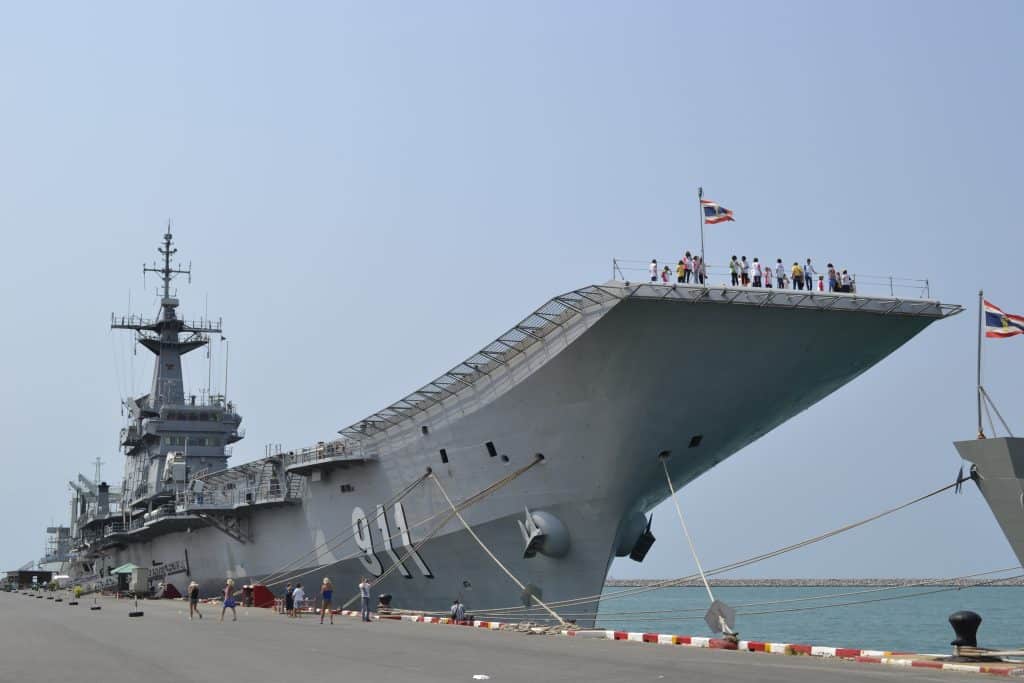
HTMS Chakri Naruebet (CVH 911) was constructed by the Spanish shipbuilder Bazán (now Navantia) at its Ferrol shipyard, with her keel laid in 1993 and commissioning in 1997. Designed as an offshore patrol helicopter carrier, she was initially intended to operate a squadron of AV-8S Matador V/STOL fighter aircraft, though these were decommissioned in 2006. Since then, the carrier has primarily served as a platform for Royal Thai Navy helicopters, including the S-70B Seahawk and MH-60S Knighthawk, focusing on maritime surveillance, search and rescue, and disaster relief operations.
The Chakri Naruebet has a full load displacement of approximately 11,486 tonnes, a length of 182.6 meters (599 ft), and a beam of 30.5 meters (100 ft). Her propulsion system is a Combined Diesel or Gas (CODOG) arrangement, featuring two General Electric LM2500 gas turbines and two Bazán-MTU 16V 1163 TB83 diesel engines, driving two shafts. This configuration allows for a maximum speed of around 26 knots (48 km/h) and a range of 10,000 nautical miles at 12 knots. The ship’s air wing capacity includes up to 14 helicopters, and her flight deck measures 174.6 meters (573 ft) by 27.5 meters (90 ft).